Halgerda aurantiomaculata (J. K. Allan, 1932)
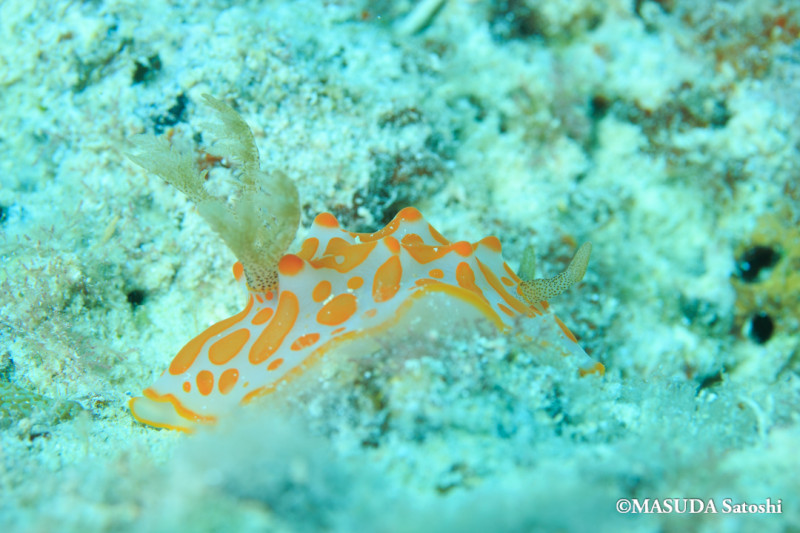
- Location
- tubs ans co, New Caledonia Island, New Caledonia
- Date
- 2018/12/14
- Length
- 70mm
- Depth
- 10.0m
- Water temperature
- 25.0℃
Description
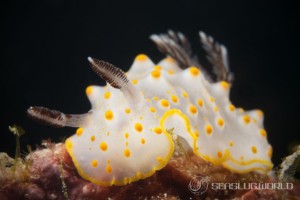
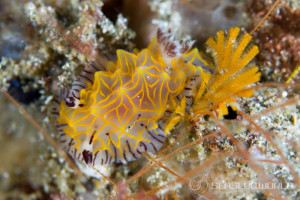
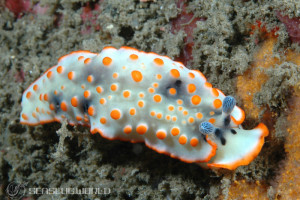
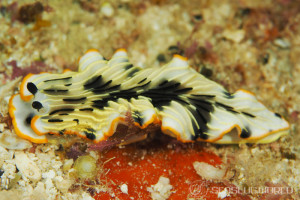
A large dorid reaching about 8 cm in length. The body is oval to elongate-oval and slightly depressed. The mantle is thick and smooth, with low conical tubercles scattered over the dorsum. Ground colour is a translucent white to pale yellowish-white, densely overlaid with small orange to deep yellow spots — the source of the specific name aurantiomaculata, "orange-spotted". Each orange spot is bordered by a fine black line, and these lines join into an irregular reticulum that gives the dorsum a stained-glass appearance.The rhinophores are orange and bear thin parallel lamellae. The gill plume is translucent white with 6-7 plumes, each rachis and margin tinged deep orange. The mantle edge is undulate and the orange spots are visible from the side as well.
Distribution
Type locality: North-West Islet, Capricorn Group, Queensland, Australia (southern Great Barrier Reef; Allan, 1932). Subsequent records come mainly from the eastern coast of Australia, with additional reports from eastern Papua New Guinea and Fiji. The species inhabits coral reefs at shallow to moderate depths.Etymology
The specific epithet aurantiomaculata combines Latin aurantium ("orange") and maculatus ("spotted"), in reference to the dense orange to deep yellow spots covering the dorsum.Remarks
Originally described by Allan 1932 from material in the Australian Museum as Dictyodoris aurantiomaculata. Dictyodoris Bergh, 1880 is now treated as a junior synonym of Halgerda Bergh, 1880; the species is therefore presently combined as Halgerda aurantiomaculata — the parentheses in the author citation reflect this generic transfer.The genus Halgerda comprises numerous species centred on the tropical Indo-West Pacific. All share the striking dorsal pattern of orange or yellow spots within a black reticulate framework. Members of the genus are sponge-feeders, and Halgerda aurantiomaculata is presumed to feed on sponges in the same manner as its congeners.
References
- Dictyodoris aurantiomaculata J.K. Allan, 1932 — original description, Allan J.K. (1932). Australian nudibranchs. Australian Zoologist. 7(2): 87-105, pls 4-5.
A Kindle field guide by the site author
Kimoto N. (2026). Sea Slugs of Japan & the Indo-Pacific, 2nd Edition.
Kindle Edition
View on Amazon PR (Amazon Associates)Seasonality
Shooting Locations
Loading shooting locations...
Photos of Halgerda aurantiomaculata
Tag:


Same Genus Nudibranchs
Similar Colors Nudibranchs


Academic Database
Sea slug observation data is available in international marine biodiversity databases.