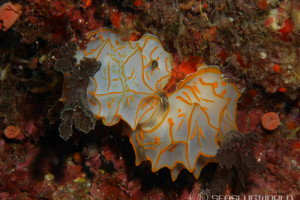
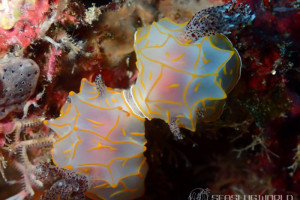
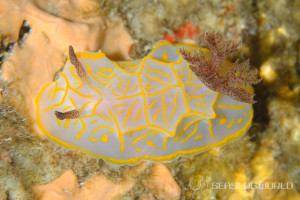
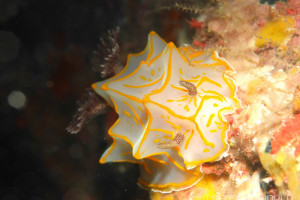
Halgerda diaphana Fahey & Gosliner, 1999
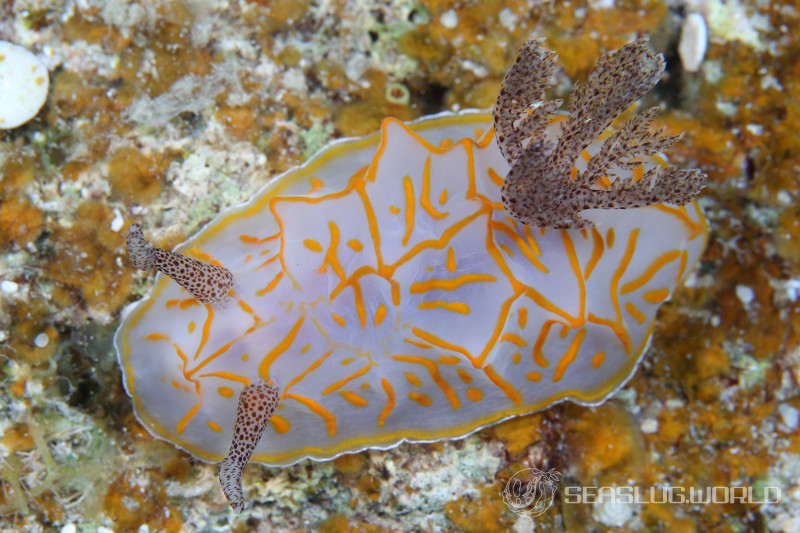
- Location
- Horse Shoes, Okinawa Island (Onna and Yomitan area), Okinawa, Japan
- Date
- 2015/05/14
- Length
- 40mm
- Depth
- 35.0m
- Water temperature
- 25.0℃
Description
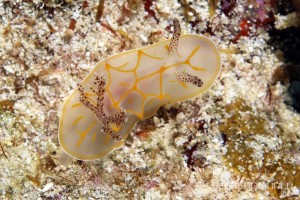
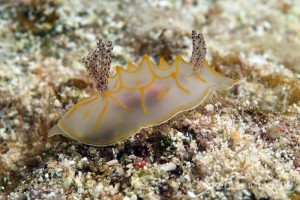
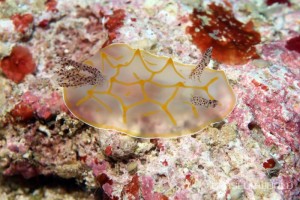
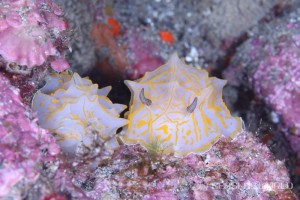
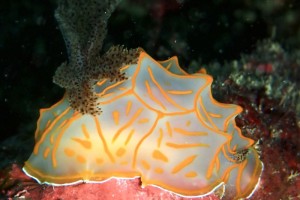
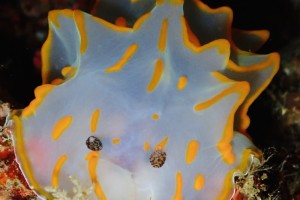
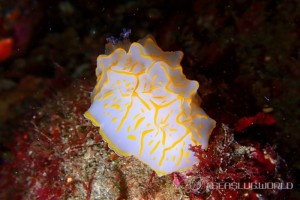
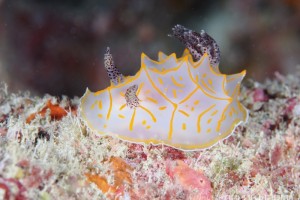
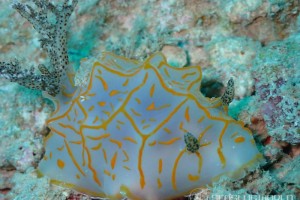
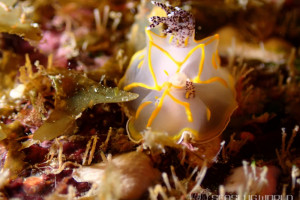
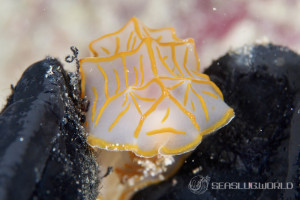
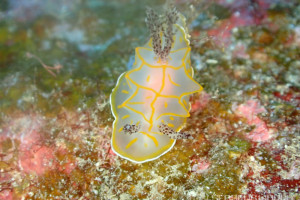
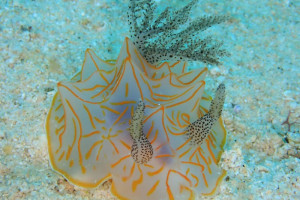
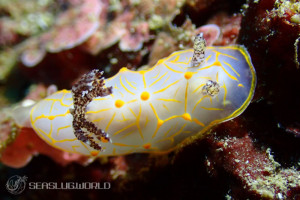
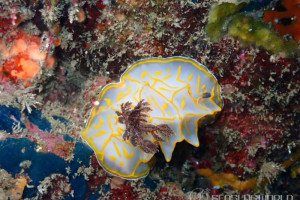
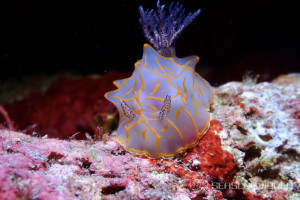
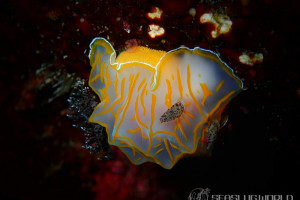
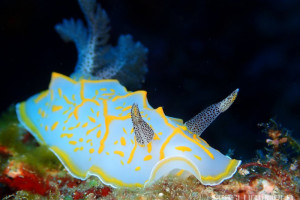
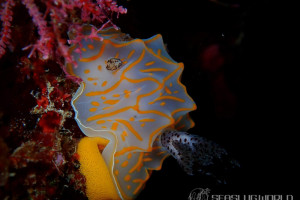
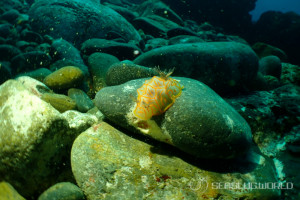
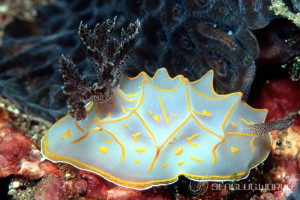
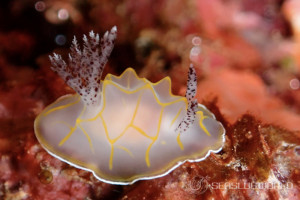
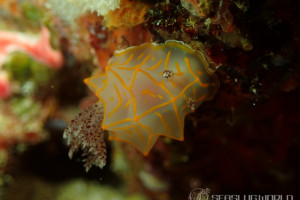
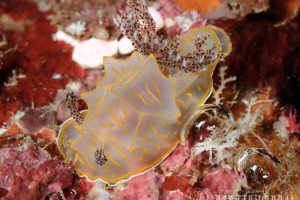
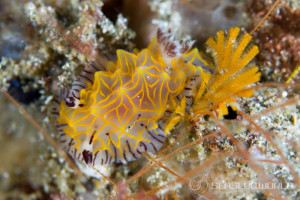
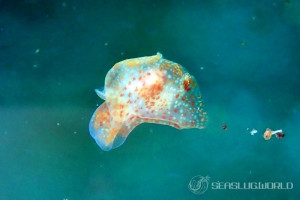
Body translucent white, so thin that the viscera show through the dorsum. Orange ridges form a distinct triangular pattern with three points on each side of the dorsum, and four low pustules run along the midline, joining the ridges. Secondary orange lines lie in the concavities between the ridges. The mantle bears a vivid orange submarginal band edged outside by a bright white margin. Rhinophores and the bipinnate branchial leaves are translucent white, densely speckled with black along their entire length. Reaches around 70 mm in length.Distribution
Type locality is Horseshoe Cliffs, about 1 km WNW of Onna Village, Okinawa Island, Ryukyu Islands, at 50 m depth. Originally known only from the Ryukyu Islands; subsequent records extend the range to the Philippines (Dauin, Negros), placing the species in the western Pacific.Etymology
Verbatim from the original description (Fahey & Gosliner, 1999, p.45):The trivial name diaphana is from the Greek word diaphanes meaning a gauzy texture that is translucent or transparent, like the dorsum of this new species.
Remarks
Interspecific mating with Halgerda carlsoni has been photographed and reported by Mitsuo and Ayumi Murakami on the Sea Slug Forum. The molecular phylogeny of a 2023 study supports H. diaphana as a distinct species, clearly separable from the morphologically similar Halgerda maaikeae (not in this catalog) and Halgerda dichromis by external coloration, radular details, and reproductive anatomy.References
- Halgerda diaphana sp. nov., Fahey S.J. & Gosliner T.M. 1999. Preliminary phylogeny of Halgerda (Nudibranchia: Halgerdidae) from the tropical Indo-Pacific, with descriptions of three new species. Proceedings of the California Academy of Sciences, (4) 51(11): 425-448.
- キスジカンテンウミウシ(仮称), 益田一. (1999). 海洋生物ガイドブック. 東海大学出版会.
- キスジカンテンウミウシ(仮称), 小野篤司. (1999). ウミウシガイドブック. TBSブリタニカ.
- キスジカンテンウミウシ, 小野篤司. (2000). ウミウシガイドブック. 第2版. TBSブリタニカ.
- Halgerda diaphana Fahey & Gosliner, 1999b, Donohoo S.A., Villalobos S.G., Hallas J.M. & Gosliner T.M. (2023). Hyperdiversity of the genus Halgerda Bergh, 1880 (Nudibranchia: Discodorididae) with descriptions of fourteen new species. Marine Biodiversity. 53(3): 42. https://doi.org/10.1007/s12526-022-01334-9
A Kindle field guide by the site author
Kimoto N. (2026). Sea Slugs of Japan & the Indo-Pacific, 2nd Edition.
Kindle Edition
View on Amazon PR (Amazon Associates)Seasonality
Shooting Locations
Loading shooting locations...
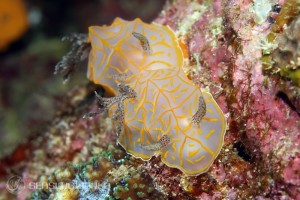
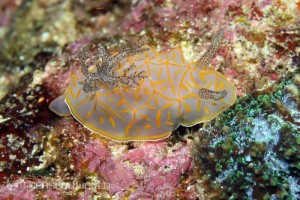
Photos of Halgerda diaphana
Tag:




















Same Genus Nudibranchs
Similar Colors Nudibranchs
Academic Database
Sea slug observation data is available in international marine biodiversity databases.