Halgerda okinawa Carlson & Hoff, 2000
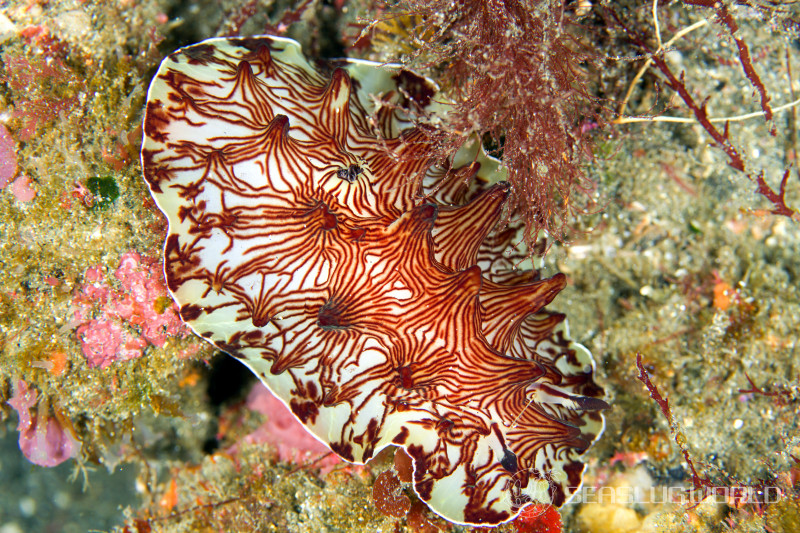
- Location
- Akinohama, Izu Oshima, Tokyo, Japan
- Date
- 2012/12/27
- Length
- 200mm
- Depth
- 40.0m
- Water temperature
- ??℃
Description
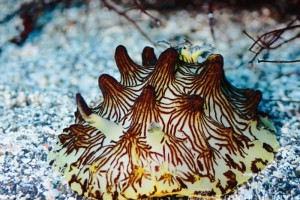
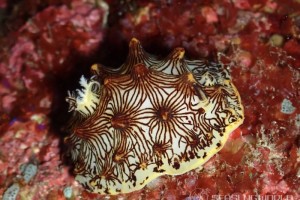
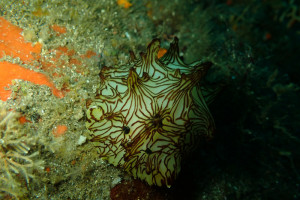
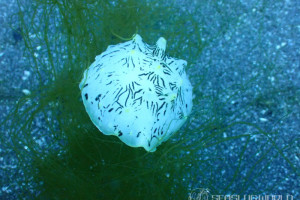
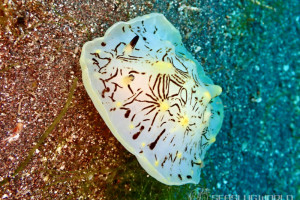
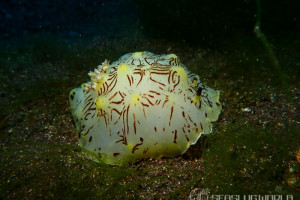
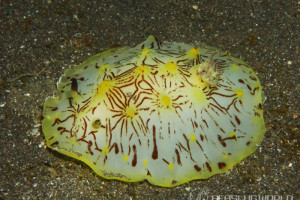
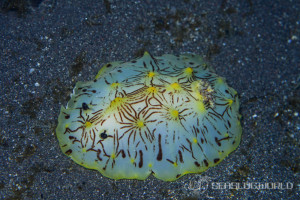
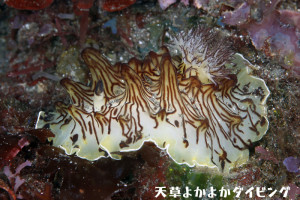
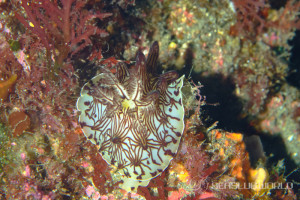
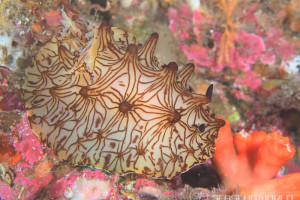
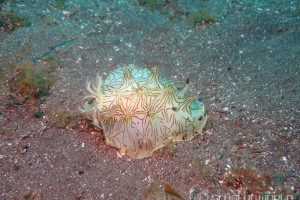
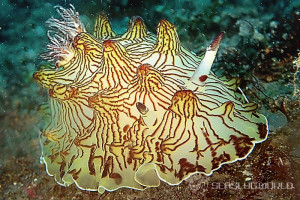
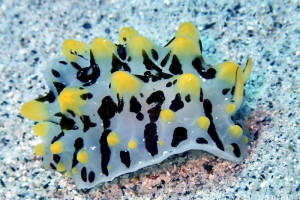
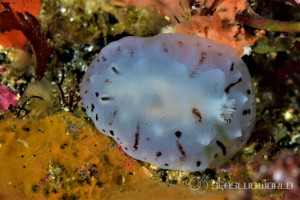
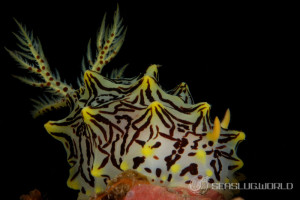
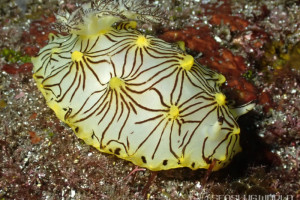
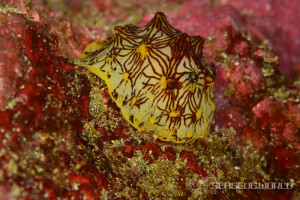
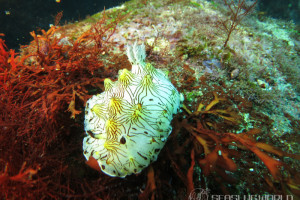
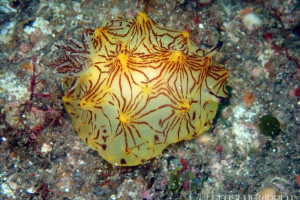
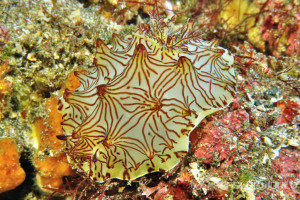
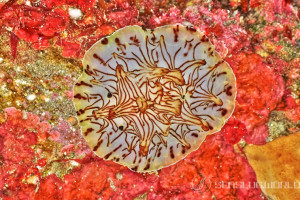
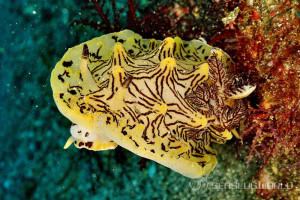
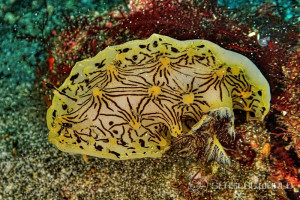
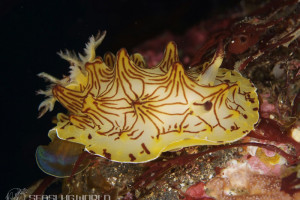
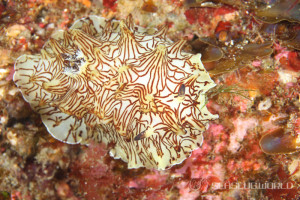
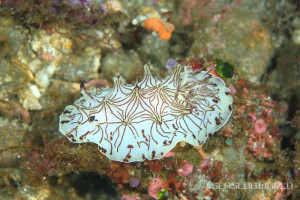
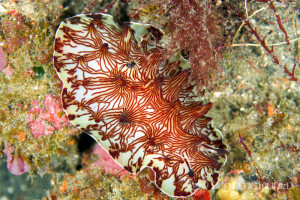
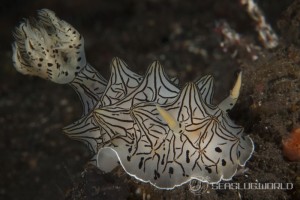
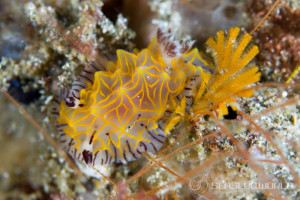
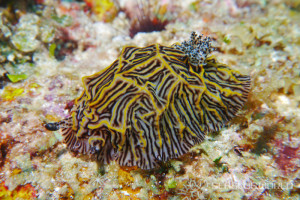
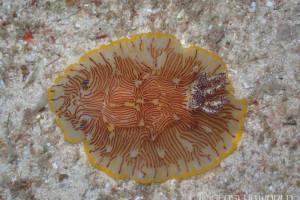
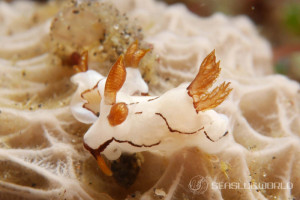
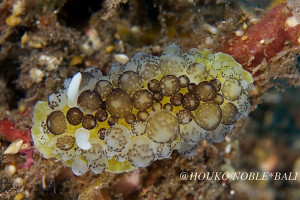
Body translucent white, with the dorsum sculpted by a complex meshwork of large and small tubercles connected by ridges. Dark brown lines radiate from the apex of each tubercle and link with lines from neighbouring tubercles, producing the network pattern that gives the species its Japanese vernacular name. Some individuals have yellow-tipped tubercles, but it is unclear whether this represents geographic variation. Irregular black blotches are arranged along the mantle edge. Rhinophores have a white stalk and brown-tipped lamellae, with a single longitudinal brown line on the posterior face. The branchial plumes are white with brownish rachises. Short black lines run perpendicular to the mantle edge on the underside. A large species, reaching at least 120 mm in length.Distribution
The type locality is Seragaki, Okinawa, Japan, at about 53 m depth. Reported from the western Pacific including Okinawa, the Philippines, Indonesia (Lembeh Strait, Sulawesi, Alor Island) and East Timor. Tends to occur on deeper, mesophotic-zone reefs; specimens sequenced by a 2023 study were collected from 53–76 m off Okinawa.Etymology
The specific epithet okinawa refers to the type locality, the island of Okinawa, southern Japan. The original description was based on a specimen collected by Bob Bolland from off Seragaki at about 53 m depth in 1995 (Carlson & Hoff, 2000).Remarks
The Japanese vernacular "Internet umiushi" is a provisional name alluding to the network-like dorsal pattern, established in Japanese guidebooks of the 1990s and 2000s. An alternative name "Okinawa-hiodoshi-umiushi" was proposed by Nakano 2018 but the older "Internet" name remains in common use. In the molecular phylogeny of a 2023 study, Halgerda okinawa sits within a well-supported mesophotic clade together with four new species (H. scripta, H. mesophotica, H. profunda and H. takipsilim), and is recovered as the sister species of H. scripta from the Philippines.References
- インターネットウミウシ(仮称), 益田一. (1999). 海洋生物ガイドブック. 東海大学出版会.
- インターネットウミウシ, 鈴木敬宇. (2000). ウミウシガイドブック〈2〉. TBSブリタニカ.
- Halgerda okinawa n. sp., Carlson C.H. & Hoff P.J. (2000). Three new Pacific species of Halgerda (Opisthobranchia: Nudibranchia: Doridoidea). The Veliger. 43(2): 154-163.
- インターネットウミウシ, 小野篤司. (2004). 沖縄のウミウシ. ラトルズ.
- インターネットウミウシ, 中野理枝. (2004). 本州のウミウシ. ラトルズ.
- インターネットウミウシ, 小野篤司 & 加藤昌一. (2009). ウミウシ. 誠文堂新光社.
- Halgerda okinawa, Terrence Gosliner, Ángel Valdés and David Behrens. (2015). Nudibranch and Sea Slug Identification Indo-Pacific. New World Pubns Inc.
- オキナワヒオドシウミウシ(改称), 中野理枝. (2018). 日本のウミウシ. 文一総合出版.
- Halgerda okinawa, Donohoo S.A., Villalobos S.G., Hallas J.M. & Gosliner T.M. (2023). Hyperdiversity of the genus Halgerda Bergh, 1880 (Nudibranchia: Discodorididae) with descriptions of fourteen new species. Marine Biodiversity. 53(3): 42. https://doi.org/10.1007/s12526-022-01334-9
Featured in this book
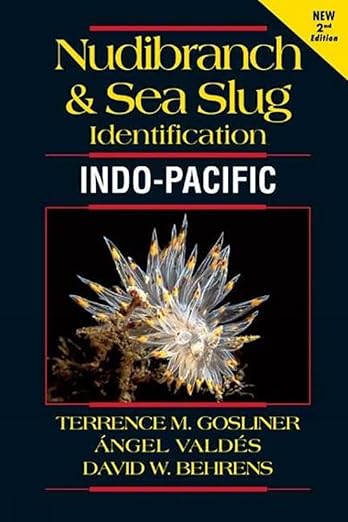
Terrence Gosliner, Ángel Valdés and David Behrens. (2018). Nudibranch and Sea Slug Identification Indo-Pacific 2nd Edition. New World Pubns Inc.
New World Publications
This species, Halgerda okinawa, is included in the book.
View on Amazon PR (Amazon Associates)Seasonality
Shooting Locations
Loading shooting locations...
Photos of Halgerda okinawa





















Same Genus Nudibranchs
Similar Colors Nudibranchs

Academic Database
Sea slug observation data is available in international marine biodiversity databases.