Hypselodoris imperialis (Pease, 1860)
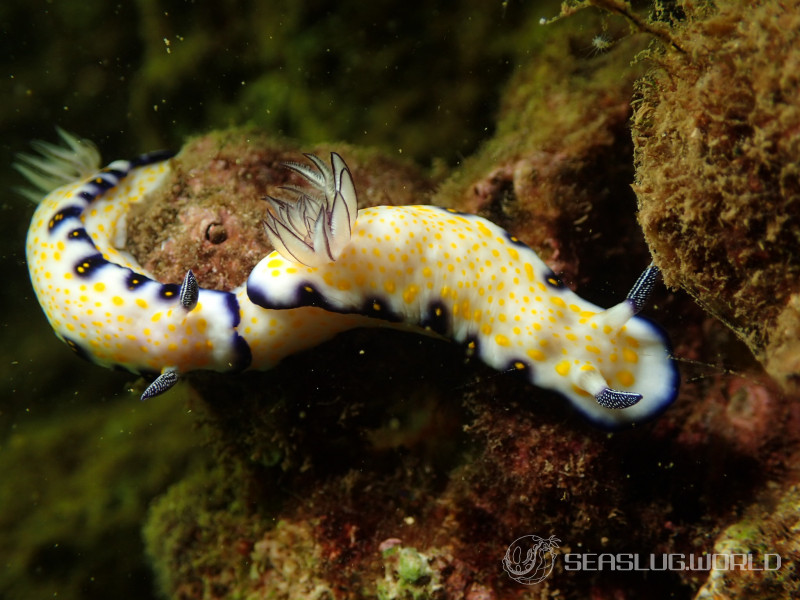
- Location
- Magic Island, O'ahu, Hawaii, United States
- Date
- 2018/12/12
- Length
- 30mm
- Depth
- 5.0m
- Water temperature
- 25.0℃
Description
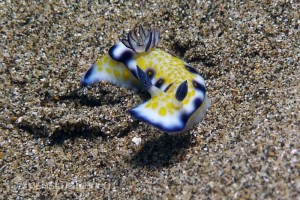
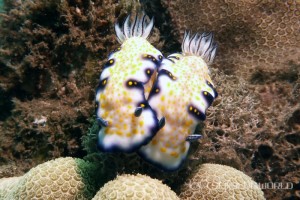
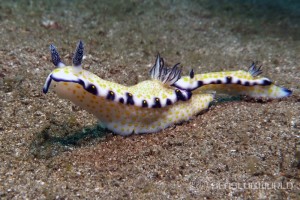
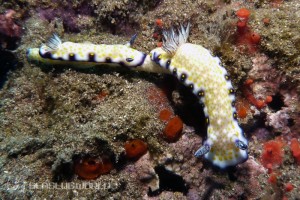
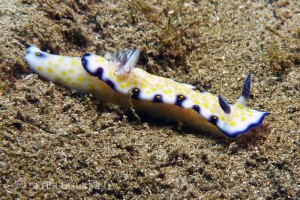
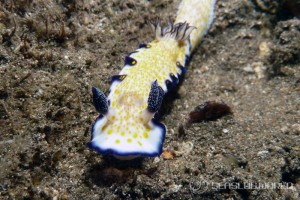
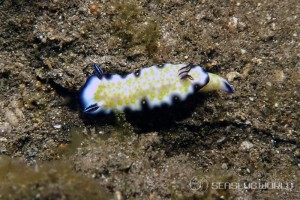
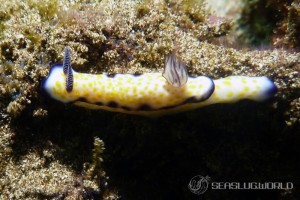
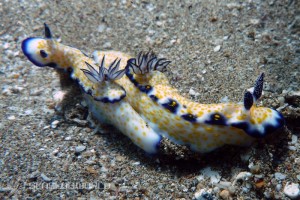
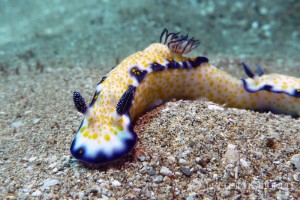
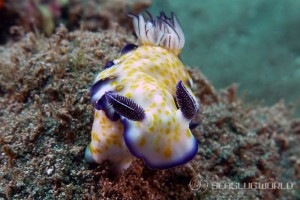
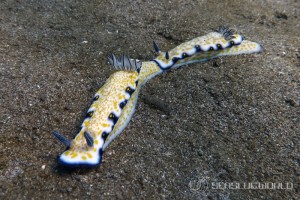
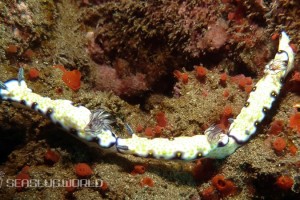
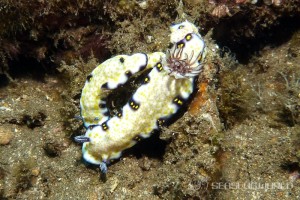
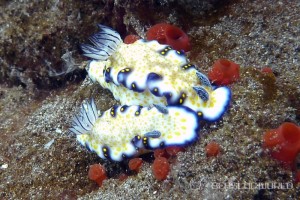
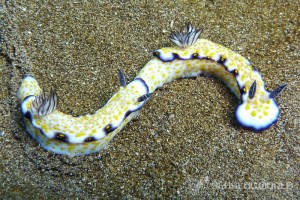
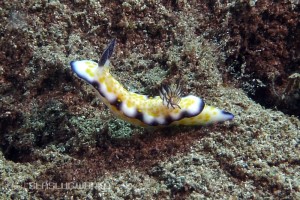
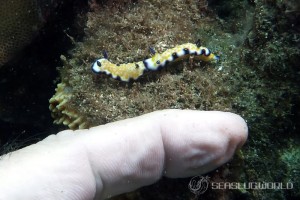
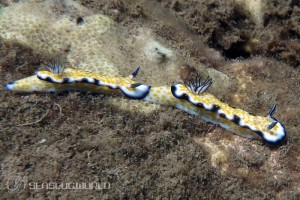
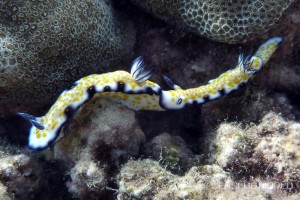
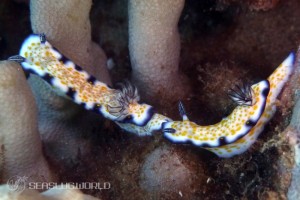
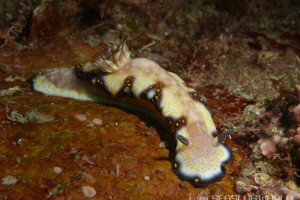
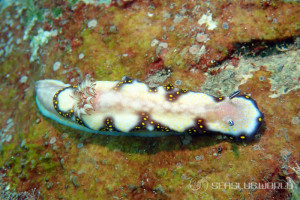
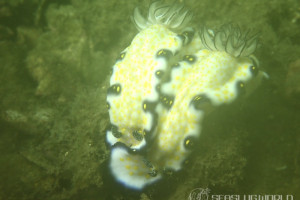
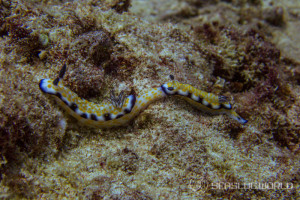
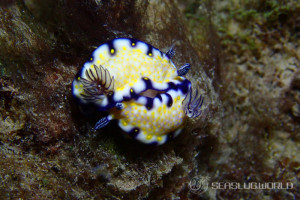
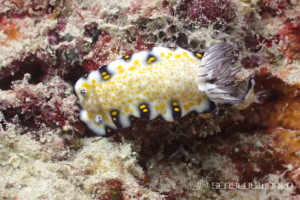
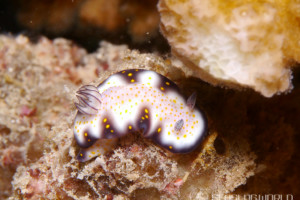
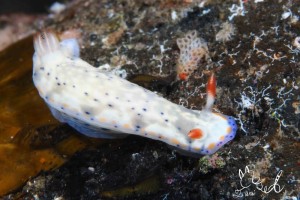
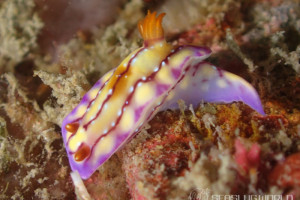
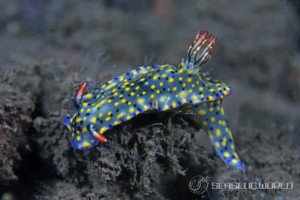
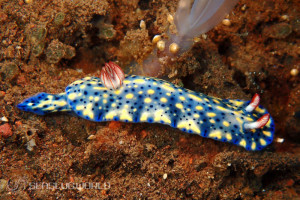
A medium-sized chromodorid reaching about 50 mm in body length. The body is elongate, smooth and convex above. The mantle is small and narrow, dilated and rounded in front, more acutely rounded behind. The foot is large, elongate, pointed posteriorly, projecting far beyond the mantle. The gill is rather large, erect, non-retractile, of ten leaves: the six anterior leaves are simple, the next two trifurcate, and the posterior pair quadrifurcate; all decrease in height posteriorly, and in structure are linear, quadrangular and ciliated. The anal papilla is prominent. The rhinophores are oblong-ovate, slightly compressed, closely and finely obliquely lamellate, sub-retractile. The oral tentacles are cylindrically tapering. In life the ground colour is pale cream-white, spotted above and on the sides with small, irregular, very slightly raised, rich yellow spots. The mantle is margined with purple; a few broken rings of the same colour run along the sides and the upper posterior end of the foot, each with a yellow centre. The gill is pale and edged with purple. The rhinophores are deep black, minutely speckled with white, and marked with two longitudinal white lines, one behind and one in front. Pease originally described the species as a variety (var. imperialis) of Doris prismatica Alder & Hancock, based on an animal about 2 inches (≈ 5 cm) long.Distribution
Indo-Pacific to the central Pacific. Type locality: Sandwich Islands (Hawaiian Islands), based on Pease's observations of Hawaiian specimens. Subsequently recorded from the Hawaiian Islands, southern Japan, Taiwan, the Philippines, Indonesia, Guam, New Caledonia and elsewhere.Etymology
The specific epithet imperialis is the Latin adjective meaning "imperial, regal, magnificent", in reference to the splendid colour pattern of purple-edged mantle, yellow dorsal spots and white-flecked black rhinophores. Pease did not state an etymology, but the colour combination evidently evoked imperial dignity. The Japanese name "コウテイイロウミウシ" is a direct translation of imperialis.Remarks
In the original description Pease treated the form as Doris prismatica var. imperialis. The variety was subsequently raised to species rank and transferred to Hypselodoris; the parentheses in the author citation reflect both the generic transfer and the elevation from variety. In the same paper Pease also described Doris prismatica var. lineata, which has had a similar nomenclatural history.References
- Doris prismatica var. imperialis Pease n. var., Pease W.H. (1860). Descriptions of new species of Mollusca from the Sandwich Islands. Part I. Proceedings of the Zoological Society of London. 28: 18-36.
- Risbecia imperialis (Pease, 1860), Gosliner T.M. & Johnson R.F. (1999). Phylogeny of Hypselodoris (Nudibranchia: Chromodorididae) with a review of the monophyletic clade of Indo-Pacific species, including descriptions of twelve new species. Zoological Journal of the Linnean Society. 125: 1-114. https://doi.org/10.1111/j.1096-3642.1999.tb00585.x
- Hypselodoris imperialis, Johnson R.F. & Gosliner T.M. (2012). Traditional taxonomic groupings mask evolutionary history: a molecular phylogeny and new classification of the chromodorid nudibranchs. PLoS ONE 7(4): e33479.
- Hypselodoris imperialis, Terrence Gosliner, Ángel Valdés and David Behrens. (2015). Nudibranch and Sea Slug Identification Indo-Pacific. New World Pubns Inc.
- コウテイイロウミウシ(新称), スーザン・ミドルトン他. (2015). 海の美しい無脊椎動物. 創元社.
Featured in this book
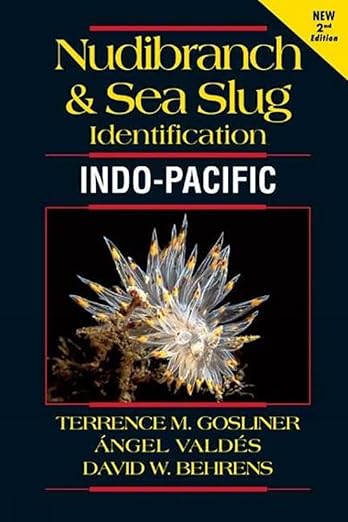
Terrence Gosliner, Ángel Valdés and David Behrens. (2018). Nudibranch and Sea Slug Identification Indo-Pacific 2nd Edition. New World Pubns Inc.
New World Publications
This species, Hypselodoris imperialis, is included in the book.
View on Amazon PR (Amazon Associates)Seasonality
Shooting Locations
Loading shooting locations...
Photos of Hypselodoris imperialis
Tag:






Same Genus Nudibranchs

Similar Colors Nudibranchs
Academic Database
Sea slug observation data is available in international marine biodiversity databases.