Luisella telja (Ev. Marcus & Er. Marcus, 1967)
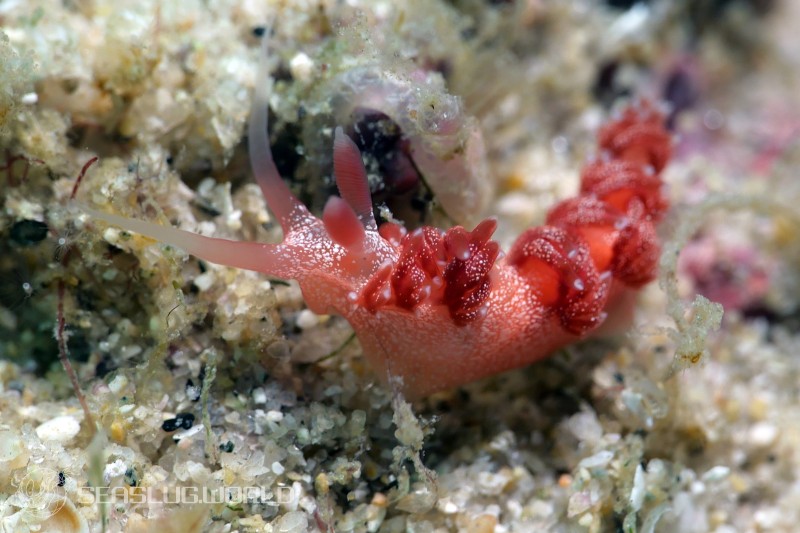
- Location
- Baja California, Mexico
- Date
- 2020/12/13
- Length
- ??mm
- Depth
- ??m
- Water temperature
- ??℃
Description
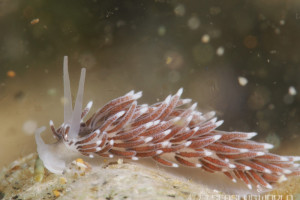
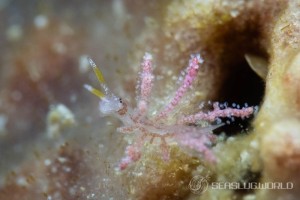
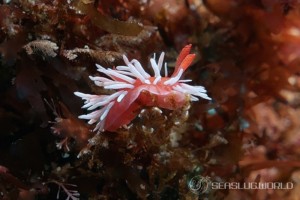
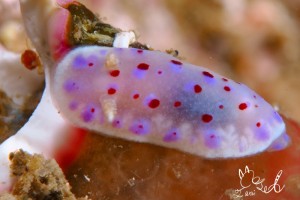
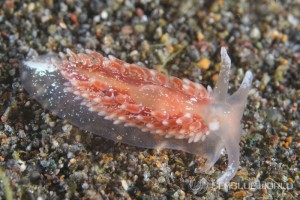
Luisella telja is a small translucent pink aeolid nudibranch of the tropical eastern Pacific, dusted with opaque white spots of irregular size and shape over both the body and the cerata. After feeding, the body and the digestive gland inside the cerata deepen to a reddish pink. The rhinophore clubs are rounded and lamellate, usually translucent white but light brown or deep pink in some animals; the oral tentacles are thin and elongate. The cerata are set 4-8 to a shared peduncle, forming oblique rows along the body, and the notal edge is completely absent. Living animals are usually 5-12 mm long, with records to 24 mm.Distribution
Tropical and subtropical eastern Pacific, recorded from the Gulf of California to the Galápagos Islands. The type locality is Cholla Bay, Puerto Peñasco, Sonora, Mexico; at the time of the original description only three specimens, all from around Puerto Peñasco, were known. It lives from the intertidal down onto shallow reef, and at Bahía de Banderas on the Pacific coast of Mexico it becomes more numerous in winter.Remarks
This species swims by bending its body from side to side. The behaviour was recorded in the original description, where it is noted as being much like that of Dendronotus nanus, a species described as new in the same paper.It feeds on hydroids and is not tied to a single prey species. Over three years of monthly surveys at Bahía de Banderas it was the second most abundant of the six closely related aeolids present. At some sites, however, numbers fell sharply during the rainy season and did not recover, which has been linked to river-borne sediment smothering the hydroids it feeds on. The egg mass is pale pink.
The animals in the original description were recorded as bluish rather than pink: the back bluish grey, the cerata with orange-brown digestive gland and white tips, and the dorsal surface of the tail dark blue with a white crest. The blue pigment leached into the alcohol the specimens were preserved in. Animals photographed around the eastern Pacific in later decades are pink with opaque white spots.
Luisella babai, the type species of the genus, is a Mediterranean and eastern Atlantic species and differs in having an orange to yellow ring near the tip of each ceras. The genus Luisella is separated from Samla by having 4-8 cerata on each shared peduncle and by the complete loss of the notal edge.
References
- Flabellina telja spec. nov., Marcus Er. & Marcus Ev. (1967). American Opisthobranch Mollusks. Studies in Tropical Oceanography, Miami. 6: 1-256.
- Flabellina telja, Farmer W.M. (1970). Swimming gastropods (Opisthobranchia and Prosobranchia). The Veliger. 13(1): 73-89.
- Flabellina telja, Gosliner T.M. & Kuzirian A.M. (1990). Two new species of Flabellinidae (Opisthobranchia: Aeolidacea) from Baja California. Proceedings of the California Academy of Sciences, Series 4. 47(1): 1-15.
- Flabellina telja (Rudman 2005), Rudman W.B. (1998-2010). Sea Slug Forum. Australian Museum, Sydney. http://www.seaslugforum.net/
- Flabellina telja, Millen S.V. & Hermosillo A. (2007). The genus Flabellina Voight, 1834 (Mollusca: Opisthobranchia) from Bahía de Banderas (Pacific coast of Mexico) with ecological observations, the description of a new species, and the redescription of Flabellina cynara. Proceedings of the California Academy of Sciences, Series 4. 58(26): 543-559.
- Samla telja comb. n., Korshunova T., Martynov A., Bakken T., Evertsen J., Fletcher K., Mudianta I.W., Saito H., Lundin K., Schrödl M. & Picton B. (2017). Polyphyly of the traditional family Flabellinidae affects a major group of Nudibranchia: aeolidacean taxonomic reassessment with descriptions of several new families, genera, and species (Mollusca, Gastropoda). ZooKeys. 717: 1-139. https://doi.org/10.3897/zookeys.717.21885
- Luisella telja, Ekimova, I., Carmona, L., Mikhlina, A. L., Grishina, D., Stanovova, M. V., Schepetov, D. M., Hoover, C., de Souza-Canal, J., Kuznetsov, K. O., & Valdés, Á. (2026). Neither "lumpers" nor "splitters": A global revision of Flabellinidae s.l. nudibranchs (Gastropoda: Heterobranchia: Nudibranchia). PLoS One. 21(5): e0347759. https://doi.org/10.1371/journal.pone.0347759
A Kindle field guide by the site author
Kimoto N. (2026). Sea Slugs of Japan & the Indo-Pacific, 2nd Edition.
Kindle Edition
View on Amazon PR (Amazon Associates)Seasonality
Shooting Locations
Loading shooting locations...
Photos of Luisella telja

Same Genus Nudibranchs
Similar Colors Nudibranchs
Academic Database
Sea slug observation data is available in international marine biodiversity databases.