Phestilla poritophages (Rudman, 1979)
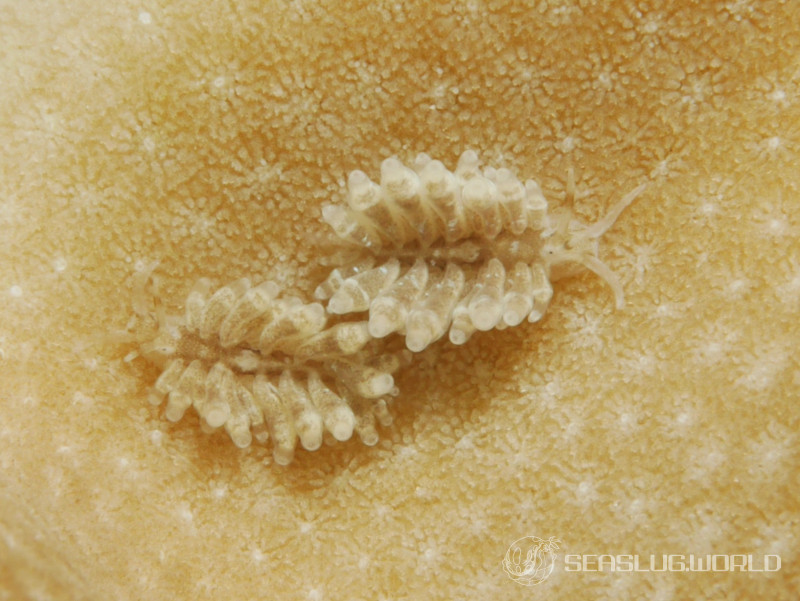
- Location
- Blue Coral, Cebu, Philippines
- Date
- 2025/09/13
- Length
- 5mm
- Depth
- 10.0m
- Water temperature
- 30.7℃
Description
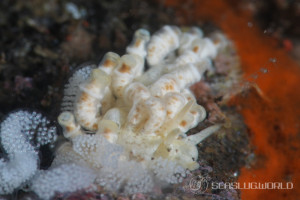
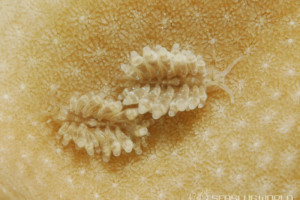
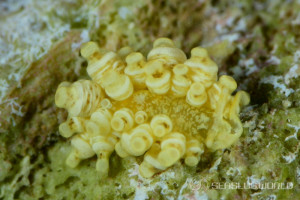
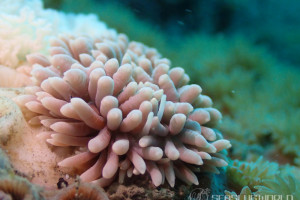
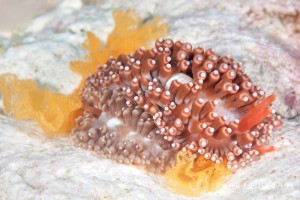
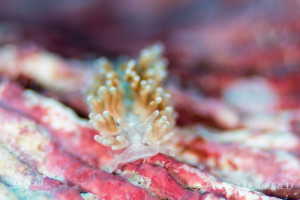
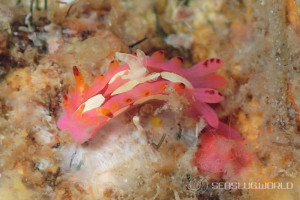
Body long and slender, widest just behind the head. Oral tentacles and rhinophores long, slender, and smooth. Cerata are arranged in slightly oblique rows (three rows pre-cardiac, four or more post-cardiac); each ceras has a characteristic large bulbous distal region narrowing to a bluntly rounded tip — a key diagnostic feature. The most common colour form is dark-brown speckling on a translucent white dorsum, with an inverted triangular white patch between the rhinophores, a white pericardial hump, and a colourless region around the eyes. The digestive gland inside each ceras is reddish-pink in the lower two-thirds and yellowish-brown in the upper bulbous third. Yellow-brown to orange-yellow colour variants are also known. Like all Phestilla, this species lacks functional cnidosacs (replaced by glandular tissue at the ceras tip). The radula is uniseriate, with 18 teeth in an 8.5 mm specimen; each tooth bears a long central cusp and 8-9 long thin denticles on each side. Reaches 14 mm in body length; maturity is reached in about three weeks at 5-7.5 mm.Distribution
Type locality is on a colony of Porites somaliensis 1 km south of the Kunduchi Marine Biological Station, Dar es Salaam, Tanzania (June 1976). The original description (Rudman, 1979) records the species only from Tanzania. Subsequent observations extend the distribution widely across the Indo-West Pacific (Hawaii, Marshall Islands, New Caledonia, Samoa, East Africa) and into the eastern Pacific (Gulf of California).Etymology
The specific epithet poritophages is a Greek compound of Porites (the host coral genus) and phages (eater), referring to the species' feeding habits (verbatim from the original description).Remarks
Originally described as Cuthona poritophages in the family Tergipedidae and later transferred to Phestilla (Rudman, 1981) on the basis of coral-feeding habits and loss of cnidosacs. Feeds exclusively on the scleractinian corals Porites somaliensis and Porites lobata; selectively digests zooxanthellae from the coral tissue but does not retain them as symbionts (per Rudman's follow-up histological study, 1981). The species marks the start of Rudman's research programme on coral-feeding aeolids and zooxanthellae, which continues into the Phyllodesmium revisions of 1981 and 1991.References
- Mehrotra R., Arnold S., Wang A., Chavanich S., Hoeksema B.W. & Caballer M. (2020). A new species of coral-feeding nudibranch (Mollusca: Gastropoda) from the Gulf of Thailand. Marine Biodiversity. 50(3): 36. https://doi.org/10.1007/s12526-020-01050-2
- Tenellia poritophages (T. sp. C1 / C2 / C3 cryptic complex), Fritts-Penniman A.L., Gosliner T.M., Mahardika G.N. & Barber P.H. (2020). Cryptic ecological and geographic diversification in coral-associated nudibranchs. Molecular Phylogenetics and Evolution. 144: 106698. https://doi.org/10.1016/j.ympev.2019.106698
A Kindle field guide by the site author
Kimoto N. (2026). Sea Slugs of Japan & the Indo-Pacific, 2nd Edition.
Kindle Edition
View on Amazon PR (Amazon Associates)Seasonality
Shooting Locations
Loading shooting locations...
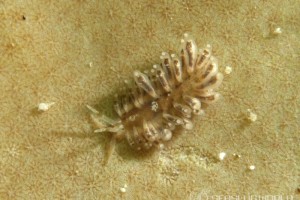
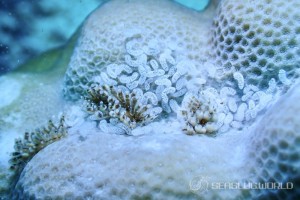
Photos of Phestilla poritophages
Tag:



Same Genus Nudibranchs
Similar Colors Nudibranchs

Academic Database
Sea slug observation data is available in international marine biodiversity databases.