Polycera alabe Collier & Farmer, 1964
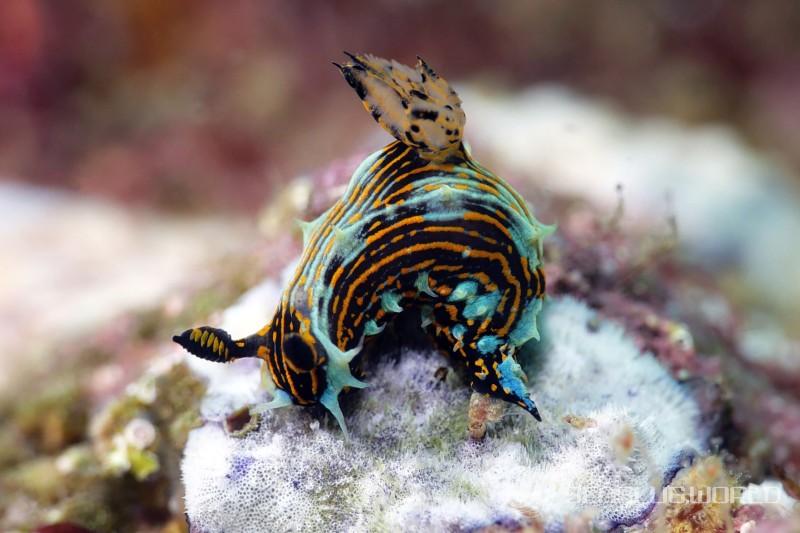
- Location
- La Blanquita, Huatulco, Oaxaca, Mexico
- Date
- 2022/03/14
- Length
- ??mm
- Depth
- ??m
- Water temperature
- ??℃
What is the ink-stain dorid?
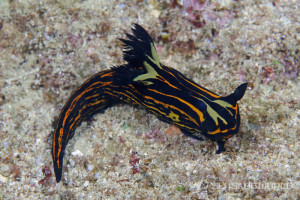
The ink-stain dorid (Polycera alabe) is a small blue-black nudibranch of the eastern Pacific, sprinkled with orange spots and named for the ink-like stain its pigment leaves in preservative. It reaches about 25 mm and, like other members of its genus, is a bryozoan feeder.Description
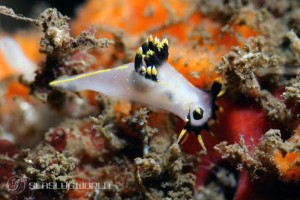
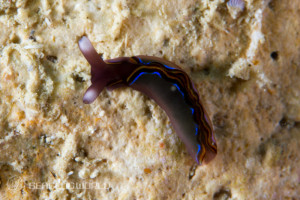
The living animal is a deep blue-black, covered everywhere except the sole of the foot with orange spots that fall roughly into rows behind the rhinophores. The gills and rhinophores are also black with orange markings. Four processes stand along the front edge of the head; in the holotype the middle two were black and the outer two white, while animals from the Gulf of California had all four black. The edge of the foot is white and the area over the eyes is translucent. About twenty colourless translucent projections, some yellow-tipped, run along the body, and eleven closely set black projections sit on the tail. There are six gills, all unipinnate, and the rhinophores are non-retractile with eleven leaves. The holotype measured 25 mm while crawling; other animals were 12-15 mm.Colour varies markedly with locality, and four regional colour forms have been recognised across the eastern Pacific.
Distribution
Northeastern to tropical eastern Pacific. The type locality is the southeast side of Isla de Cedros, Baja California, Mexico; at the time of the original description the species was known only from there and from Puerto Refugio on Isla Ángel de la Guarda in the Gulf of California. Later work places P. alabe from Mexico north to southern California, with the morphologically similar animals of Costa Rica and Panama treated as a separate species.Etymology
The specific epithet alabe was taken from a Greek word for a kind of ink, after the way the animal's blue-black pigment bled into the formalin it was preserved in.Remarks
Members of Polycera feed on bryozoans, and this species is reported to do the same.The species is still being untangled, on both colour and molecular grounds. A 2013 analysis recovered three distinct lineages within P. alabe with overlapping ranges, the northernmost of which came out as sister to Polycera atra, leaving P. alabe as currently defined paraphyletic. A 2014 redescription based on the type material separated the similar-looking animals from Costa Rica and Panama as Polycera anae.
References
- Polycera alabe, sp. nov., Collier C.L. & Farmer W.M. (1964). Additions to the nudibranch fauna of the east Pacific and the Gulf of California. Transactions of the San Diego Society of Natural History. 13(19): 377-396.
- Polycera alabe, Santander M. & Valdés Á. (2013). Genetic structure of Polycera alabe and P. atra (Mollusca: Opisthobranchia: Nudibranchia) in the Pacific coast of North America. Bulletin of the Southern California Academy of Sciences. 112(3): 176-184. https://doi.org/10.3160/0038-3872-112.3.176
- Polycera alabe, Pola M., Sánchez-Benítez M. & Ramiro B. (2014). The genus Polycera Cuvier, 1817 (Nudibranchia: Polyceridae) in the eastern Pacific Ocean, with redescription of Polycera alabe Collier & Farmer, 1964 and description of a new species. Journal of Molluscan Studies. 80(5): 551-561. https://doi.org/10.1093/mollus/eyu049
A Kindle field guide by the site author
Kimoto N. (2026). Sea Slugs of Japan & the Indo-Pacific, 2nd Edition.
Kindle Edition
View on Amazon PR (Amazon Associates)Seasonality
Shooting Locations
Loading shooting locations...
Photos of Polycera alabe

Same Genus Nudibranchs
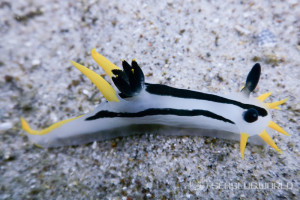
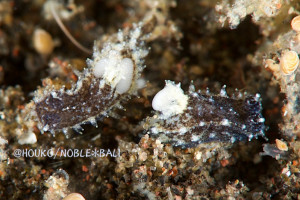
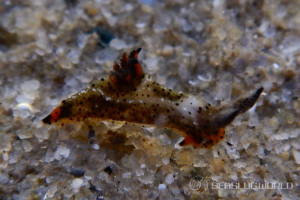
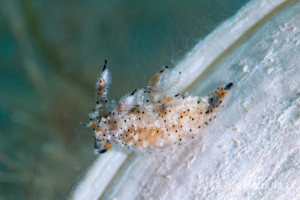
Similar Colors Nudibranchs


Academic Database
Sea slug observation data is available in international marine biodiversity databases.