Pseudobornella orientalis Baba, 1932
Description
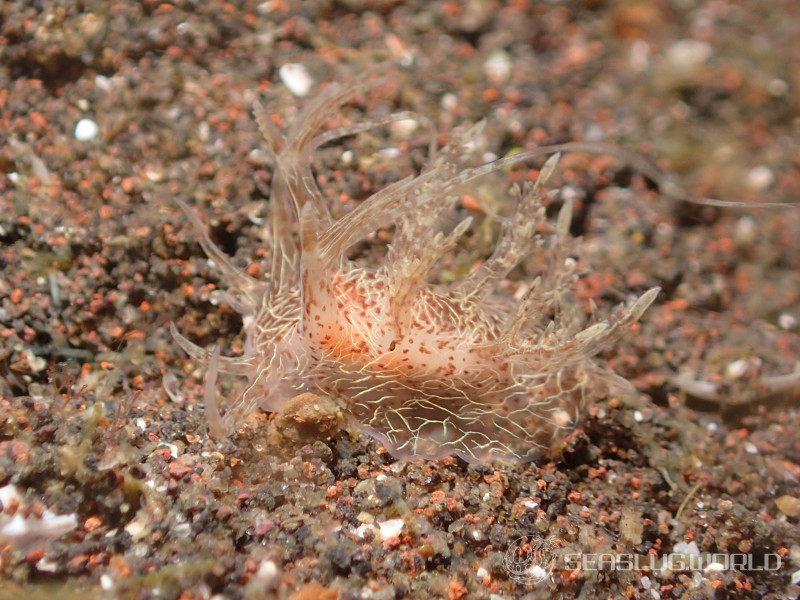
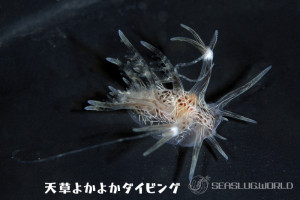
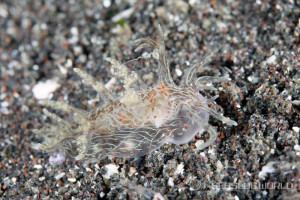
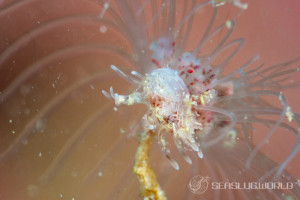
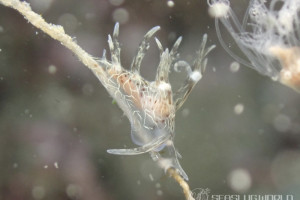
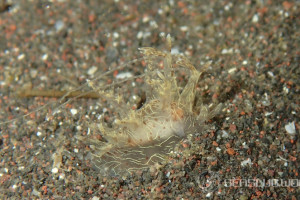
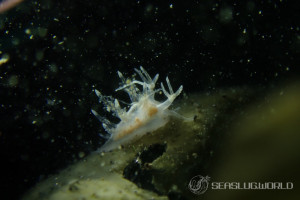
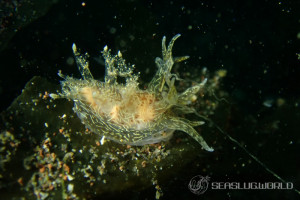
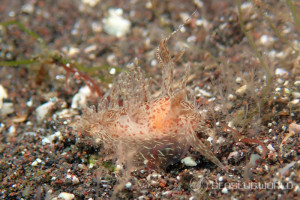
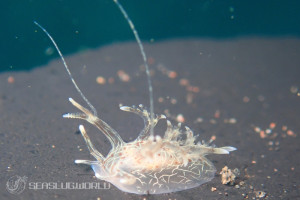
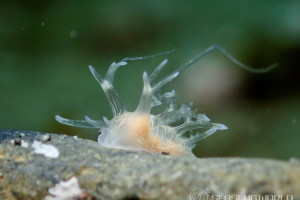
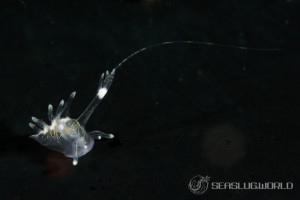
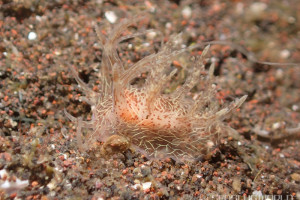
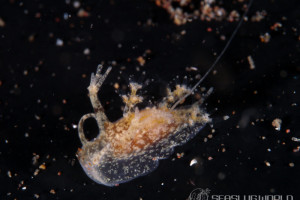
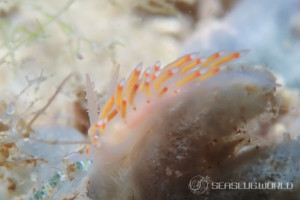
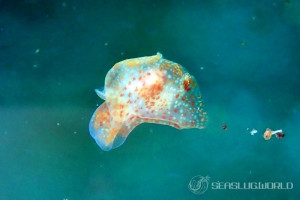
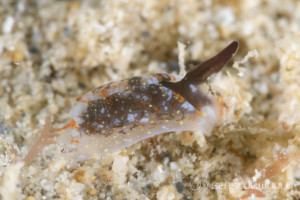
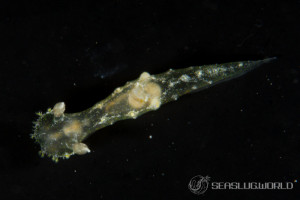
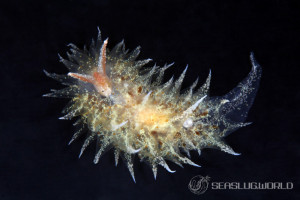
The body is relatively elongate, with a wide foot tapering posteriorly to a pointed tip. Living adults are small, the largest reported animal being less than 10 mm in length. The ground colour is translucent whitish with numerous scattered brown spots and patches and a few small yellow diagonal streaks.On either side of the vertical mouth are three smooth tapering oral tentacles, increasing in size outward; the outermost is about half the body length, the middle one half that length, and the innermost about a quarter. Each rhinophore sheath is very elongate, reaching about as long as the outer oral tentacles. At the upper edge of each rhinophore sheath stand two elongate lateral papillae and one posterior papilla which is extraordinarily slender — extending in the living animal to up to five times the body length, according to Baba 1933. The rhinophores are perfoliate with about ten lamellae. Posterior to the rhinophores are four pairs of elongate dorsolateral processes that decrease in size towards the posterior tip of the foot. The dorsolateral processes are unbranched and taper to a rounded tip; numerous branched and unbranched gills are attached along the inner side of each.
The buccal bulb is relatively large and the labial cuticle is thin and lacks armature. The jaws are elongate, with a distinct long masticatory process consisting of about 7 to 10 rows of small rodlets. A ventral oral gland is absent. The radular formula is 12 × 2.1.2 or 10–11 × 2.1.2. The rachidian teeth are stout, elongate, and bear a very strong forward-projecting cusp flanked by about six or seven sharp, robust denticles. The penial bulb is relatively small and unarmed.
Distribution
Recorded from Japan and China (central-Pacific Japan to the East China Sea). The type locality is in Japan.Etymology
The Latin specific epithet orientalis means "of the East", referring to the Far East provenance of the type material.Remarks
This is the only species of the monotypic genus Pseudobornella. Its most distinctive feature is the extraordinarily long, slender posterior papilla on each rhinophore sheath, which can extend to about five times the body length in living animals. Baba 1932 reported the species feeding on the hydroid Tubularia mesembryanthemum.Pola, Rudman & Gosliner 2009 re-examined the species for the first time since its original description, working on specimens from Luoyuan Bay (Fujian, China) that match Baba's account perfectly, and described the reproductive system for the first time. Specimens reported in the Sea Slug Forum from Japan and the Philippines differ slightly in having longer lateral papillae on the rhinophore sheath, and whether they are conspecific with P. orientalis or represent a different species in this genus must await anatomical study.
References
- 高岡生物研究会. (2002). 日本海のウミウシ. 第2版.
- Pseudobornella orientalis Baba, 1932, Pola M., Rudman W.B. & Gosliner T.M. (2009). Systematics and preliminary phylogeny of Bornellidae (Mollusca: Nudibranchia: Dendronotina) based on morphological characters with description of four new species. Zootaxa. 1975(1): 1-57. https://doi.org/10.11646/zootaxa.1975.1.1
- アミメイトヒキウミウシ(新称), 中野理枝. (2018). 日本のウミウシ. 文一総合出版.
- アミメイトヒキウミウシ, 小野篤司 & 加藤昌一. (2020). 新版 ウミウシ. 誠文堂新光社.
- Pseudobornella orientalis, Korshunova T., Bakken T., Grøtan V.V., Johnson K.B., Lundin K. & Martynov A. (2020). A synoptic review of the family Dendronotidae (Mollusca: Nudibranchia): a multilevel organismal diversity approach. Contributions to Zoology. 90(1): 93-153. https://doi.org/10.1163/18759866-bja10014
- Pseudobornella orientalis, A synoptic review of the family Dendronotidae (Mollusca: Nudibranchia): a multilevel organismal diversity approach in: Contributions to Zoology Volume 90 Issue 1 (2021) . Available online at https://brill.com/view/journals/ctoz/90/1/article-p93_93.xml?srsltid=AfmBOoqaNkfWzLuMREPwOvhifhFlH6O4vKIkdjror75N4AvKHNZHq4kR
Featured in this book
小野篤司 & 加藤昌一. (2020). 新版 ウミウシ. 誠文堂新光社.
誠文堂新光社
This species, Pseudobornella orientalis, is included in the book.
View on Amazon PR (Amazon Associates)Seasonality
Shooting Locations
Loading shooting locations...
Photos of Pseudobornella orientalis








Same Genus Nudibranchs
Similar Colors Nudibranchs

Academic Database
Sea slug observation data is available in international marine biodiversity databases.