Samla macassarana (Bergh, 1905)
Samla macassarana
No field photograph submitted for this species yet
Have you photographed this species?Description
In life the body is about 4.5 cm long and a few mm wide, with dorsal papillae up to 7 mm long. The dorsum is reddish-yellow, as are the rhinophores; the oral tentacles, the upper surface of the propodial tentacles, the dorsal papillae and the tail are carmine red. The body is elongate; the perfoliate rhinophores are shorter than the oral tentacles and longer than the propodial tentacles. The dorsal papillae are clearly distributed on six low, separated foot-stalks: the first stalk bears two rows of six papillae, each of the following stalks three, and the last stalk two papillae; the two innermost papillae are larger than the others. All papillae are cylindrical and smooth. The narrow foot has slightly projecting margins, and the tail extends posteriorly beyond the body.Distribution
Type locality: off Makassar (southern Sulawesi, Indonesia), 27-32 m. Originally known from a single specimen at the type locality.Etymology
The specific epithet macassarana is a toponymic adjective formed from the type locality Makassar (the port of Makassar / Ujung Pandang, southern Sulawesi) and the Latin adjectival suffix -anus, -ana, -anum ("belonging to, of").Remarks
The original combination was Flabellina macassarana. A footnote in the original description anticipated the transfer to Samla, and modern phylogenetic revisions have indeed placed the species in Samla.References
- Flabellina? macassarana Bgh. n. sp., Bergh R. (1905). Die Opisthobranchiata der Siboga-expedition. https://doi.org/10.5962/bhl.title.11223
- Flabellina macassarana, Terrence Gosliner, Ángel Valdés and David Behrens. (2015). Nudibranch and Sea Slug Identification Indo-Pacific. New World Pubns Inc.
- Samla macassarana (Bergh, 1905), comb. n., Korshunova T., Martynov A., Bakken T., Evertsen J., Fletcher K., Mudianta I.W., Saito H., Lundin K., Schrödl M. & Picton B. (2017). Polyphyly of the traditional family Flabellinidae affects a major group of Nudibranchia: aeolidacean taxonomic reassessment with descriptions of several new families, genera, and species (Mollusca, Gastropoda). ZooKeys. 717: 1-139. https://doi.org/10.3897/zookeys.717.21885
Featured in this book
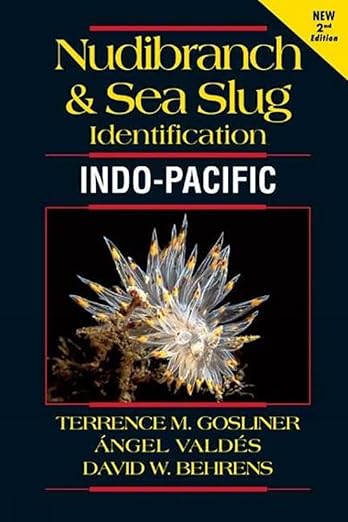
Terrence Gosliner, Ángel Valdés and David Behrens. (2018). Nudibranch and Sea Slug Identification Indo-Pacific 2nd Edition. New World Pubns Inc.
New World Publications
This species, Samla macassarana, is included in the book.
View on Amazon PR (Amazon Associates)Seasonality
Shooting Locations
Loading shooting locations...
Same Genus Nudibranchs
Similar Colors Nudibranchs

Academic Database
Sea slug observation data is available in international marine biodiversity databases.