Samla bilas (Gosliner & Willan, 1991)
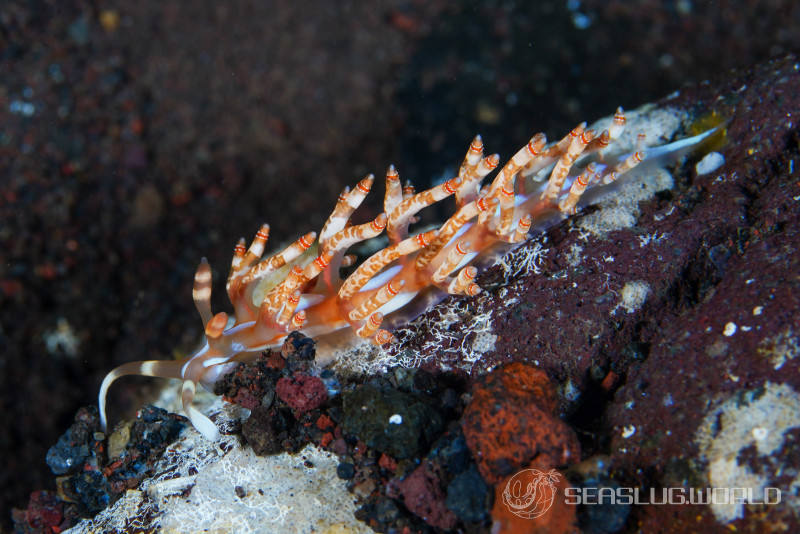
- Location
- Seraya, Tulamben, Pulau Bali, Indonesia
- Date
- 2020/02/19
- Length
- 30mm
- Depth
- ??m
- Water temperature
- 28.0℃
Description
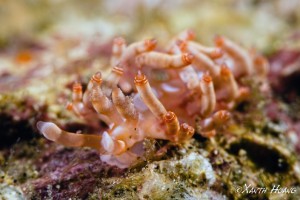
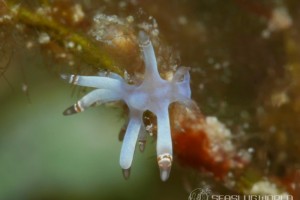
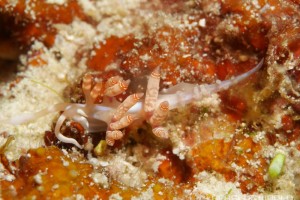
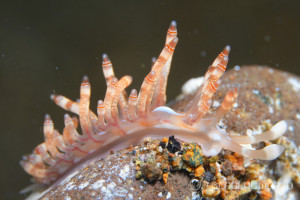
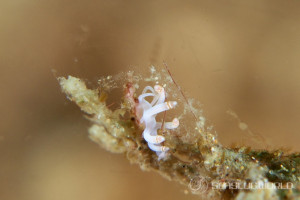
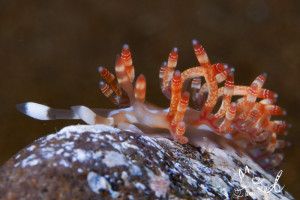
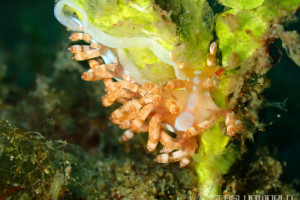
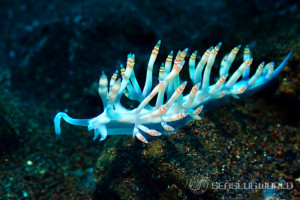
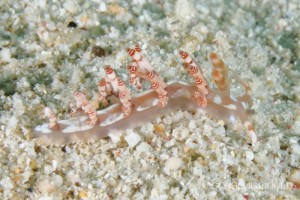
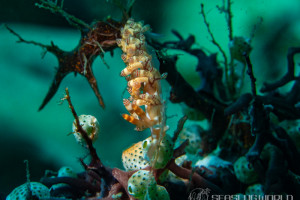
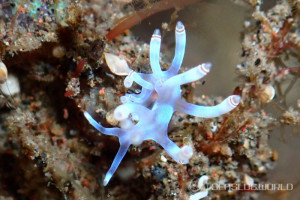
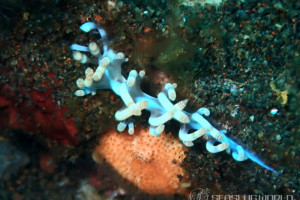
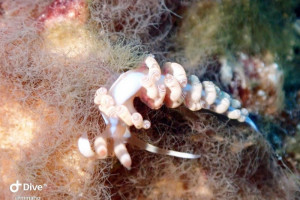
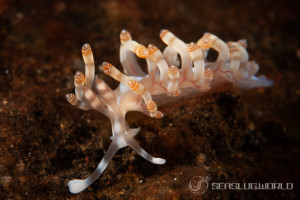
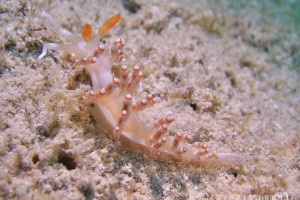
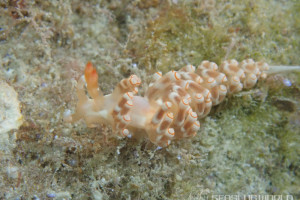
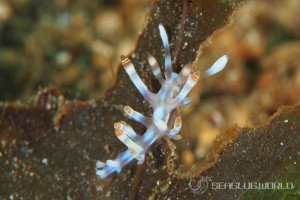
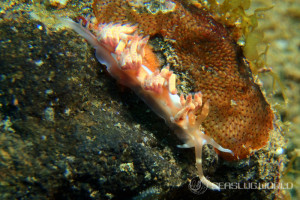
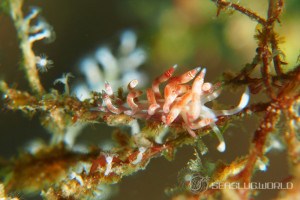
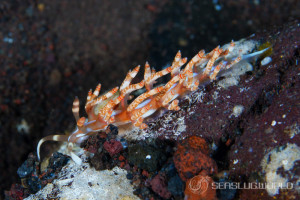
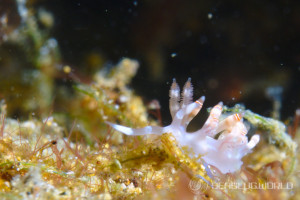
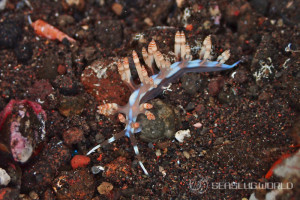
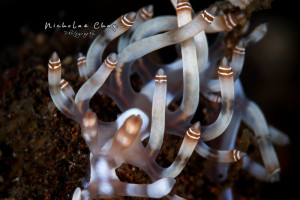
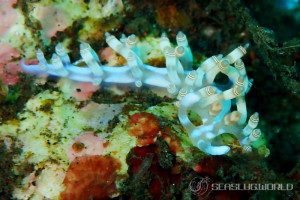
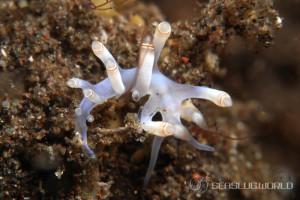
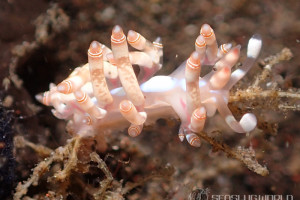
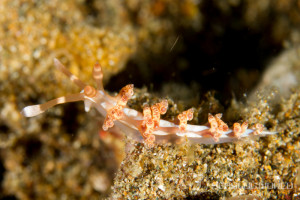
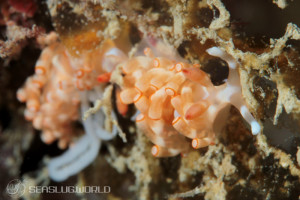
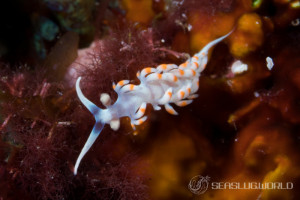
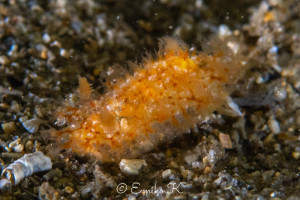
A small flabellinid reaching about 23 mm in length. The species is vividly and distinctively colored, allowing it to be readily identified from external features alone.The general body color is translucent white. There is an orange tinge on either lateral side of the head. The oral tentacles bear two opaque white areas, separating the translucent base, medial region and apex. Opaque white pigment is also present on the foot corners and as a series of ovoid patches along either side of the body extending from the head to the tail. A series of sky-blue diamond- or lozenge-shaped patches is present medially on the notum; these patches may be continuous or well separated.
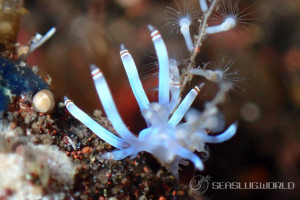
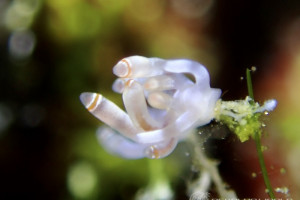
The rhinophores are translucent basally, medially and apically. They possess two bands of opaque cream pigment and a sharply defined subapical blood-red ring. At the translucent base of some cerata a thin, blood-red diverticulum may be visible. More distally, the ceras bears two broad areas of opaque cream separated by a small area of translucence. Subapically, a broad crimson ring is bordered on either side by a thinner irregular band of opaque white.
The body is elongated and slender. The oral tentacles are thin and elongate, approximately three times the length of the rhinophores. The distal third of these tentacles is broadly expanded and paddlelike. The foot corners are short and tentacular, and are held nearly perpendicularly to the longitudinal axis of the body, or may be recurved posteriorly. The anterior margin of the foot is bilabiate. The perfoliate rhinophores bear 25–28 densely packed lamellae.
The notal brim gives rise to a series of pedunculate cerata. There are 7 pairs of ceratal rows in the smaller, intact specimen; the larger one has 6 pairs of ceratal rows. The ceratal formulae are: R 4,P,4,3,3,2,1, L 4,P,4,4,2,2,2 in the larger specimen and R & L 4,P,4,3,2,2,1,1 in the smaller individual. The gonopore is located immediately ventral to the preanal ceratal arch while the anus is situated slightly anterior to the median of the interhepatic space, below the notal brim. The nephroproct is immediately dorsal to the anus.
The buccal mass is highly muscular. From its anterior end emanates a pair of oral glands. These begin as simple ducts and branch many times into highly ramified glands, which are present in the precardiac ceratal peduncles. The jaws are thin and ovoid; their masticatory border contains 4 or 5 rows of denticles. The outermost row bears approximately 20 elongate denticles. The radular formula is 21 × 1·1·1· in the paratype. The rachidian teeth are broad with 9 or 10 elongate denticles on either side of the equally narrow central cusp; they are deeply indented posteriorly without a distinct medial cleft. When viewed laterally, the central cusp is depressed below the level of the adjacent laterals.
Distribution
Type locality: Barracuda Point, Pig Island, near Madang, Papua New Guinea, 20 m depth. The species is known from Kwajalein Island (Marshall Islands) and Madang (Papua New Guinea).Etymology
The specific epithet bilas is a New Guinea Pidgin word meaning "decoration", referring to the brilliant crimson and blue markings of this species.Remarks
The currently valid name is Samla bilas (Gosliner & Willan, 1991), the species having been transferred from Flabellina to Samla by a 2017 revision.S. bilas shares whitish or bluish markings between the cerata with Flabellina engeli Ev. Marcus & Er. Marcus, 1968, but F. engeli has two precardiac ceratal rows (Edmunds & Just, 1983) rather than one. The reproductive morphology also differs considerably: in S. bilas the receptaculum seminis is serial and the bursa copulatrix is present on a short stalk, whereas in F. engeli the receptaculum is semiserial and the bursa copulatrix is apparently absent (Marcus & Marcus, 1968).
S. bilas is also unique among described Indo-Pacific flabellinids with perfoliate rhinophores and a single precardiac ceratal row in having a depressed central cusp on the rachidian teeth.
References
- Flabellina bilas Gosliner & Willan, sp. nov., Gosliner, T. M.; Willan, R. C. (1991). Review of the Flabellinidae (Nudibranchia: Aeolidacea) from the tropical Indo-Pacific, with the descriptions of five new species. The Veliger. 34(2): 97-133.
- フラベリナ・ビラス, 殿塚孝昌. (2003). ウミウシガイドブック〈3〉. TBSブリタニカ.
- Flabellina bilas, Terrence Gosliner, Ángel Valdés and David Behrens. (2015). Nudibranch and Sea Slug Identification Indo-Pacific. New World Pubns Inc.
- Samla bilas (Gosliner & Willan, 1991), comb. n., Korshunova T., Martynov A., Bakken T., Evertsen J., Fletcher K., Mudianta I.W., Saito H., Lundin K., Schrödl M. & Picton B. (2017). Polyphyly of the traditional family Flabellinidae affects a major group of Nudibranchia: aeolidacean taxonomic reassessment with descriptions of several new families, genera, and species (Mollusca, Gastropoda). ZooKeys. 717: 1-139. https://doi.org/10.3897/zookeys.717.21885
- カザリミノウミウシ(新称), 中野理枝. (2018). 日本のウミウシ. 文一総合出版.
Featured in this book

Terrence Gosliner, Ángel Valdés and David Behrens. (2018). Nudibranch and Sea Slug Identification Indo-Pacific 2nd Edition. New World Pubns Inc.
New World Publications
This species, Samla bilas, is included in the book.
View on Amazon PR (Amazon Associates)Seasonality
Shooting Locations
Loading shooting locations...
Photos of Samla bilas
Tag:
























Same Genus Nudibranchs

Similar Colors Nudibranchs
Academic Database
Sea slug observation data is available in international marine biodiversity databases.