Samla riwo (Gosliner & Willan, 1991)
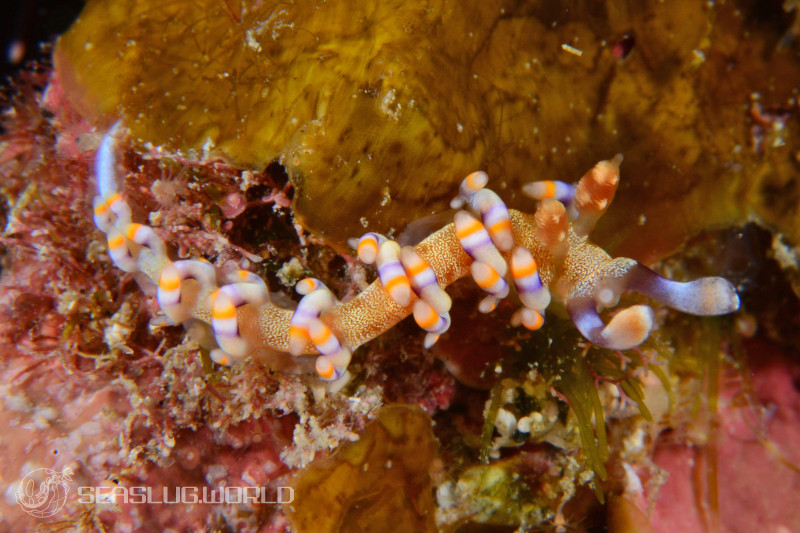
- Location
- Kashinishi, Kouchi, Japan
- Date
- 2016/05/01
- Length
- ??mm
- Depth
- ??m
- Water temperature
- ??℃
Description
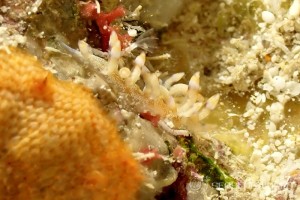
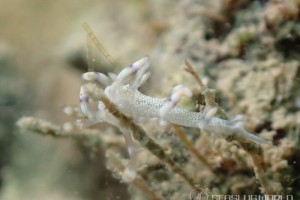
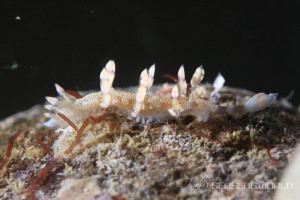
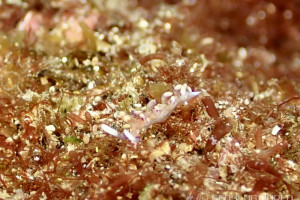
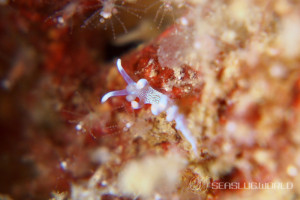
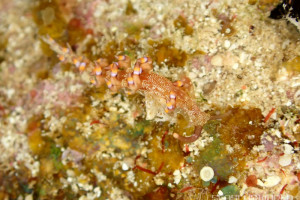
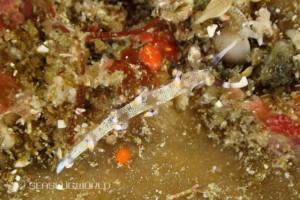
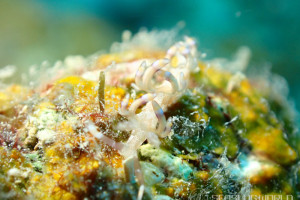
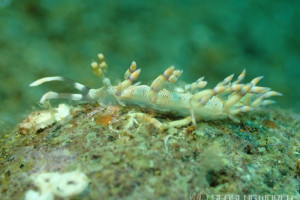
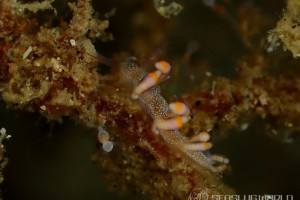
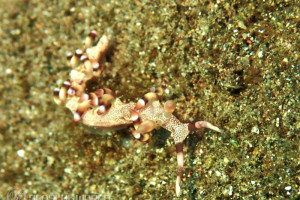
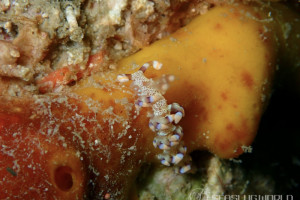
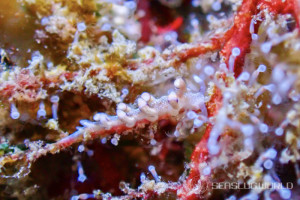
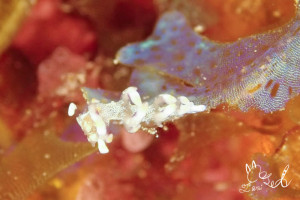
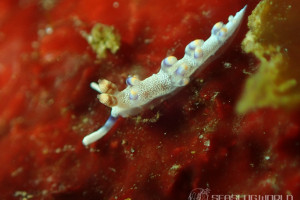
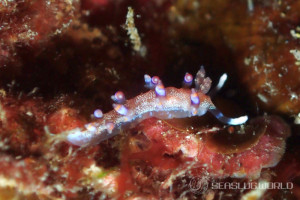
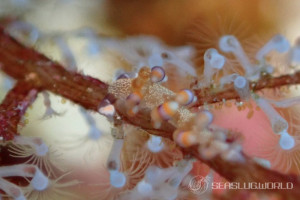
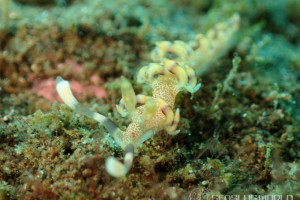
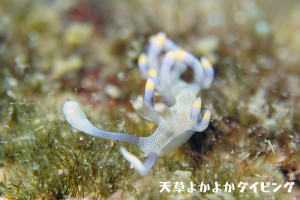
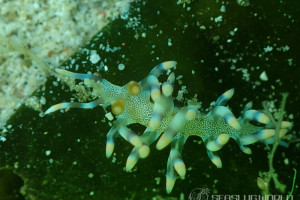
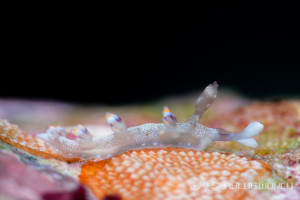
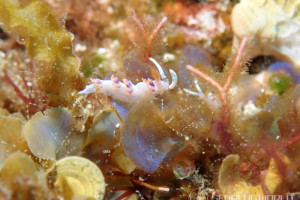
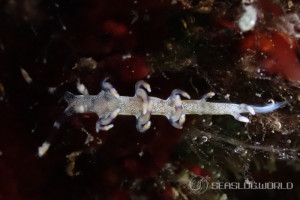
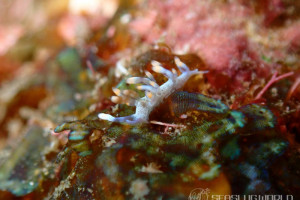
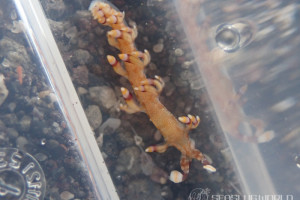
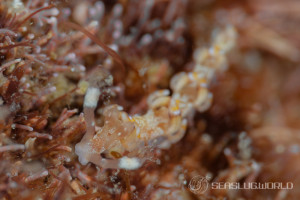
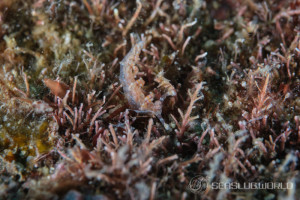
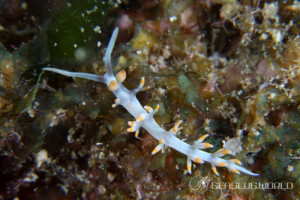
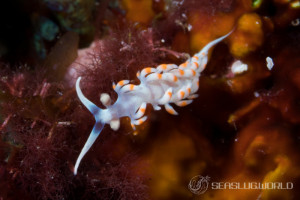
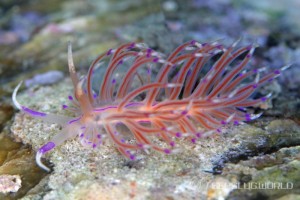
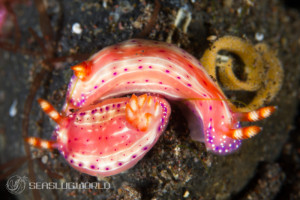
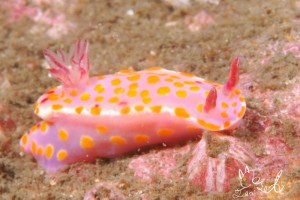
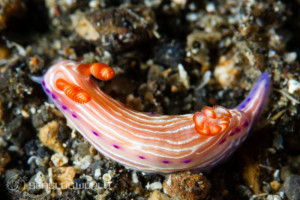
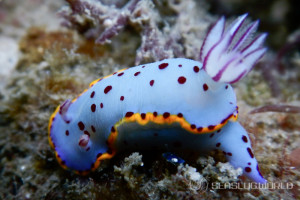
A small flabellinid reaching about 20 mm in length. Most of the body is translucent white, adorned with a dense, lacy reticulum of opaque white lines, which is the most distinctive external character of the species.The oral tentacles are opaque white for most of their length, but possess a translucent basal portion near their junction with the head. The basal portion of the rhinophores is translucent white; the bulbous, lamellate portion is dull peach to light orange and the apex is translucent white. The base of the cerata may be either translucent white or obscured by opaque white pigment. When translucent, the cream, lobate digestive gland is visible. The apical portions of the cerata are covered with opaque white, and near the middle or in the distal third of each ceras a broad purple ring is present.
The body is narrow and elongate. The oral tentacles are three to four times the length of the rhinophores. The bases of the tentacles are terete whereas the distal third is markedly laterally compressed and paddle-shaped. The rhinophores are cylindrical basally and expand into a perfoliate club containing 16–22 densely crowded lamellae. The anterior foot corners are short, tentacular and recurved. The cerata are arranged in 3–6 pedunculate clusters per side of the body. Each peduncle contains a single row of cerata inserted into an expanded portion of the notal brim, with the notal brim only evident in areas where the cerata are inserted. The peduncles contain 1–4 cerata. The first postcardiac row generally contains the largest number of cerata.
The anterior portion of the buccal mass forms a ring immediately inside the mouth. The paired ducts of the highly ramified oral glands extend into the precardiac ceratal peduncles. The masticatory border bears 3 or 4 distinct rows of denticles, with the outermost row containing 18 elongate denticles. The radular formula is 15–23 × 1·1·1·. The rachidian teeth are broad with an evenly curved posterior end and a deep cleft from the posteromedial end to the base of the central denticle. They bear 7–11 narrow denticles on either side of the more elongate central cusp; in lateral view, the central cusp is higher than the adjacent denticles.
The reproductive system lacks a discernible receptaculum seminis. The bursa copulatrix is small and thin-walled, situated adjacent to the female gonopore.
Distribution
Type locality: Cement Mixer Reef, Madang, Papua New Guinea, 3 m depth. Known from the northern coast of Papua New Guinea, Manado (Sulawesi, Indonesia), Okinawa and the northeastern coast of Madagascar.Etymology
The specific epithet riwo refers to Riwo Village, approximately 15 km north of Madang, Papua New Guinea, near where the species was first found.Remarks
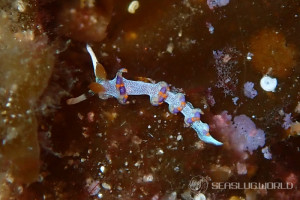
The species was originally described as Flabellina riwo Gosliner & Willan, 1991 and was transferred to Samla by a 2017 revision; the currently valid name is Samla riwo.S. riwo shares perfoliate rhinophores with Samla bicolor, but is readily distinguished externally by the lacy reticulum of opaque white pigment on the body (vs. a powdering of pigment in S. bicolor) and by the bluish purple (rather than orange) ceratal rings. S. bicolor generally has more cerata per cluster than does this species, while S. riwo has 1–4 cerata per peduncle.
Internally, the two species share an elevated rachidian central cusp, but the reproductive systems differ markedly: S. riwo lacks a distinct receptaculum seminis and has a reduced bursa copulatrix, whereas both structures are well developed in S. bicolor.
References
- Flabellina riwo Gosliner & Willan, sp. nov., Gosliner, T. M.; Willan, R. C. (1991). Review of the Flabellinidae (Nudibranchia: Aeolidacea) from the tropical Indo-Pacific, with the descriptions of five new species. The Veliger. 34(2): 97-133.
- ハクテンミノウミウシ(仮称), 小野篤司. (1999). ウミウシガイドブック. TBSブリタニカ.
- ハクテンミノウミウシ(新称), 小野篤司. (2000). ウミウシガイドブック. 第2版. TBSブリタニカ.
- フラベリナ・リワ, 殿塚孝昌. (2003). ウミウシガイドブック〈3〉. TBSブリタニカ.
- ハクテンミノウミウシ, 小野篤司. (2004). 沖縄のウミウシ. ラトルズ.
- ハクテンミノウミウシ, 中野理枝. (2004). 本州のウミウシ. ラトルズ.
- ハクテンミノウミウシ, 小野篤司 & 加藤昌一. (2009). ウミウシ. 誠文堂新光社.
- Flabellina riwo, Terrence Gosliner, Ángel Valdés and David Behrens. (2015). Nudibranch and Sea Slug Identification Indo-Pacific. New World Pubns Inc.
- Samla riwo (Gosliner & Willan 1991), comb. n., Korshunova T., Martynov A., Bakken T., Evertsen J., Fletcher K., Mudianta I.W., Saito H., Lundin K., Schrödl M. & Picton B. (2017). Polyphyly of the traditional family Flabellinidae affects a major group of Nudibranchia: aeolidacean taxonomic reassessment with descriptions of several new families, genera, and species (Mollusca, Gastropoda). ZooKeys. 717: 1-139. https://doi.org/10.3897/zookeys.717.21885
Featured in this book

Terrence Gosliner, Ángel Valdés and David Behrens. (2018). Nudibranch and Sea Slug Identification Indo-Pacific 2nd Edition. New World Pubns Inc.
New World Publications
This species, Samla riwo, is included in the book.
View on Amazon PR (Amazon Associates)Seasonality
Shooting Locations
Loading shooting locations...
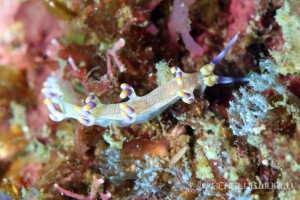
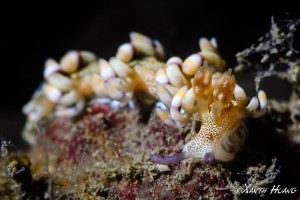
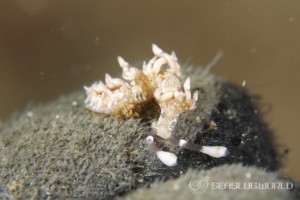
Photos of Samla riwo
Tag:
























Same Genus Nudibranchs

Similar Colors Nudibranchs
Academic Database
Sea slug observation data is available in international marine biodiversity databases.