Samla bicolor (Kelaart, 1858)
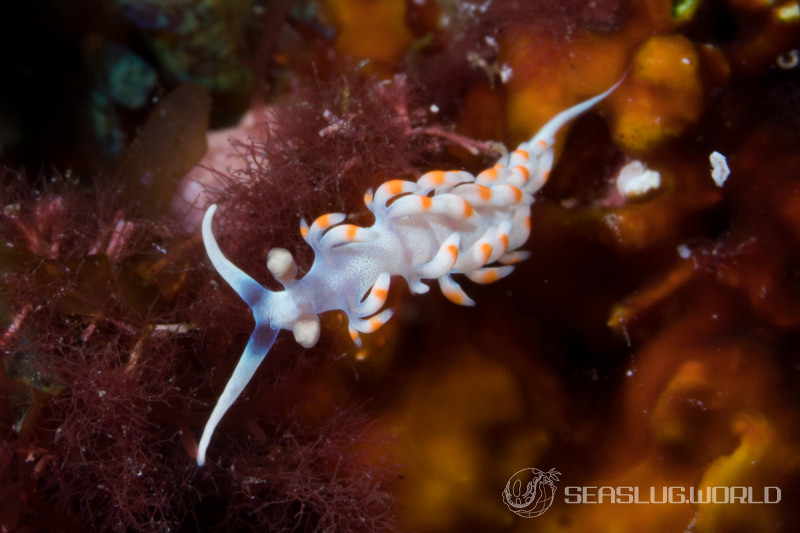
- Location
- Otchogahama, Hachijo Island, Tokyo, Japan
- Date
- 2018/10/10
- Length
- 15mm
- Depth
- 3.0m
- Water temperature
- 26.0℃
Description
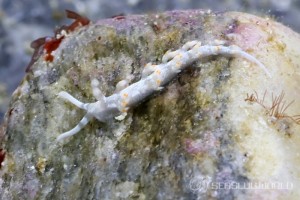
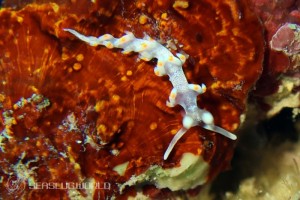
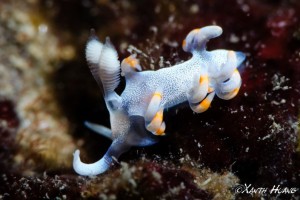
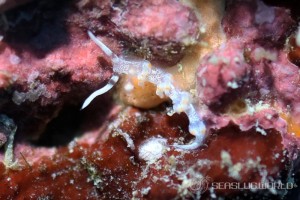
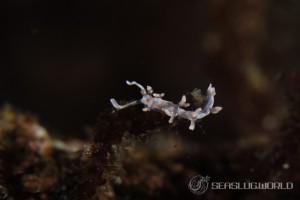
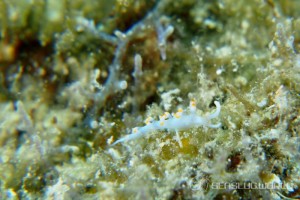
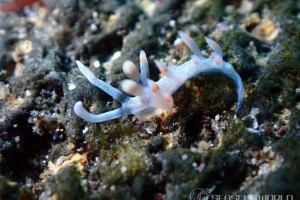
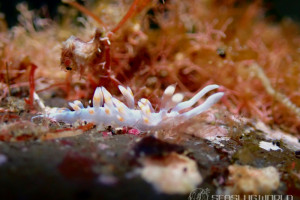
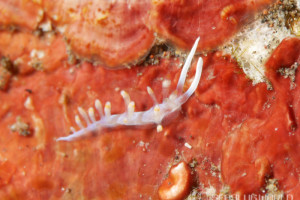
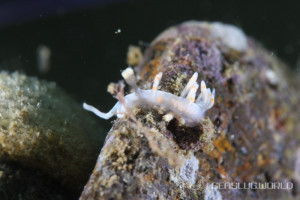
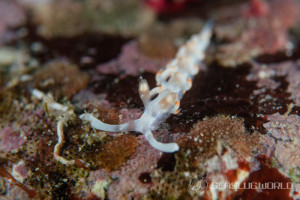
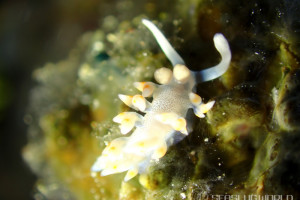
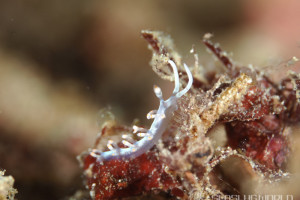
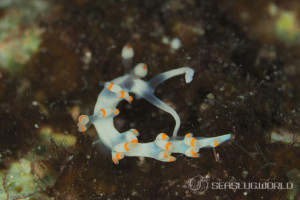
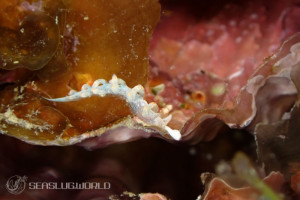
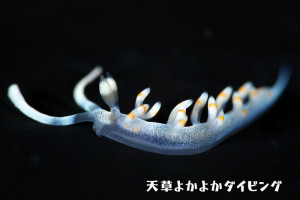
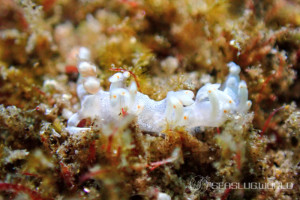
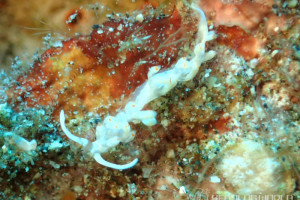
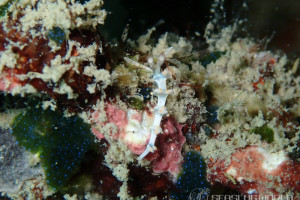
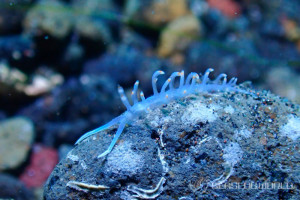
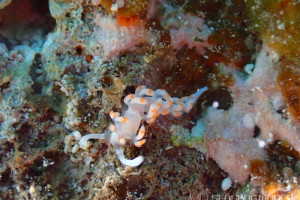
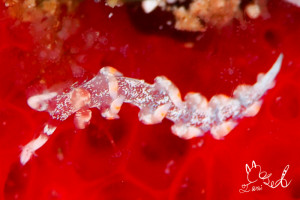
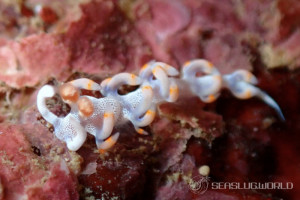
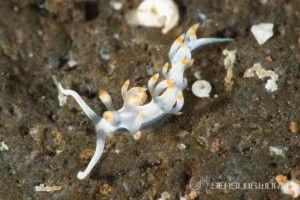
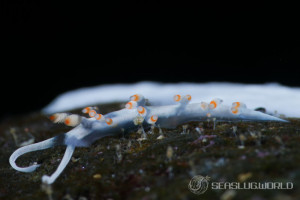
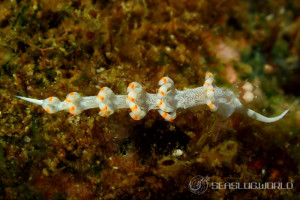
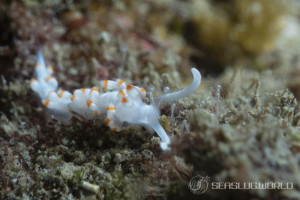
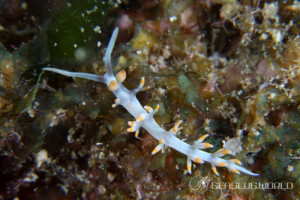
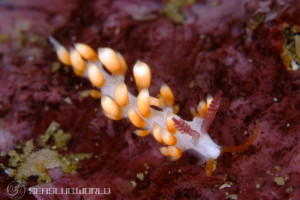
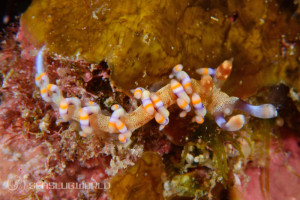
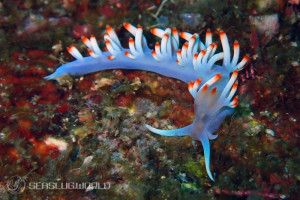
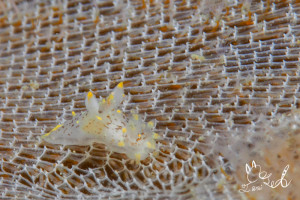
A small flabellinid reaching up to 22 mm in length. The general body color is translucent white or bluish white. Opaque white pigment may be present sparsely or densely on the oral tentacles, head, notum and cerata. This pigment may entirely overlie the translucent white notum or may be present as discrete patches separated by areas of translucence, usually at the bases of the ceratal peduncles. Generally, the bases of the oral tentacles, rhinophoral stalks and cerata are devoid of opaque white, even in the most heavily pigmented individuals.The rhinophoral stalks may be either opaque or translucent white. More distally, a brownish band is present in some individuals and the apical portion is cream or orange. A vivid orange spot or incomplete or complete ring is present subapically on each ceras, with the upper and lower boundaries of the orange pigment sharply demarcated.
The body is narrow and elongate. The notum is high and rounded in profile, continuing as a ridge to the tip of the tail. The anterior foot corners are short, recurved and tentacular, but not acutely pointed. The cerata are generally held erectly in life. They are arranged in 4–8 discrete clusters per side of the body, each elevated on a short but distinct peduncle. The precardiac and first 1–3 postcardiac rows each contain 3 or 4 cerata, while the succeeding 2–4 posterior rows each contain 1 or 2 cerata.
The rhinophores are perfoliate with 11–19 lamellae. The gonopore is situated on the right side of the body, ventral to the anteriormost ceratal cluster. The pleuroproctic anus is located immediately below the notal brim, between the precardiac and first postcardiac ceratal rows, nearer the postcardiac cluster. The nephroproct is immediately dorsal to the anus.
The buccal mass is short and muscular, with highly ramified oral glands extending posteriorly and filling much of the first ceratal peduncle. The jaws are thin and ovoid, with a well-developed masticatory border bearing approximately three rows of denticles. The outer row contains approximately 20 denticles, which are stronger and more prominent than the inner ones. The radular formula is 14–20 × 1·1·1·. The rachidian teeth are evenly curved with a pair of elongate posterior limbs and 7–12 elongate denticles on either side of the longer, wider central cusp. In lateral view, the central cusp of the rachidian tooth is higher than the adjacent denticles.
Distribution
Originally described from Sri Lanka (then Ceylon). The species is widespread throughout the Indo-Pacific tropics, with records extending from the East African coast (South Africa, Madagascar, Réunion, the Seychelles) through Sri Lanka, Papua New Guinea, Fiji, New Caledonia, Australia, Hong Kong, Okinawa and mainland Japan to the Marshall Islands, Guam and the Hawaiian Islands.Etymology
The specific epithet bicolor is Latin for "two-coloured", referring to the contrasting translucent white body and bright orange ceratal rings shown in the original description.Remarks
The currently valid name is Samla bicolor (Kelaart, 1858); the species was transferred from Flabellina to Samla by a 2017 revision.The species was originally described as Eolis bicolor Kelaart, 1858. Kelaart's name was largely overlooked by subsequent authors, and the species was variously described as Samla annuligera (Bergh, 1900), Coryphella ornata Risbec, 1928 and Flabellina alisonae Gosliner, 1980. Gosliner & Willan 1991 demonstrated that morphological variation across the Indo-Pacific covers these forms and treated all three as junior subjective synonyms.
Although Flabellina engeli and F. babai also bear orange ceratal rings, this species is distinguished by having only a single precardiac ceratal row, whereas these two species possess two precardiac rows.
References
- Flabellina bicolor (Kelaart, 1858), Gosliner, T. M.; Willan, R. C. (1991). Review of the Flabellinidae (Nudibranchia: Aeolidacea) from the tropical Indo-Pacific, with the descriptions of five new species. The Veliger. 34(2): 97-133.
- ケラマミノウミウシ(仮称), 小野篤司. (1999). ウミウシガイドブック. TBSブリタニカ.
- フラベリナ・ビコロール, 殿塚孝昌. (2003). ウミウシガイドブック〈3〉. TBSブリタニカ.
- サキシマミノウミウシ, 小野篤司. (2004). 沖縄のウミウシ. ラトルズ.
- ケラマミノウミウシ, 中野理枝. (2004). 本州のウミウシ. ラトルズ.
- Flabellina bicolor, Terrence Gosliner, Ángel Valdés and David Behrens. (2015). Nudibranch and Sea Slug Identification Indo-Pacific. New World Pubns Inc.
- Samla bicolor (Kelaart, 1858) (= Samla annuligera Bergh, 1900) (Fig. 46) (original description in Kelaart 1858; Bergh 1900b; redescription in Gosliner and Willan 1991), Korshunova T., Martynov A., Bakken T., Evertsen J., Fletcher K., Mudianta I.W., Saito H., Lundin K., Schrödl M. & Picton B. (2017). Polyphyly of the traditional family Flabellinidae affects a major group of Nudibranchia: aeolidacean taxonomic reassessment with descriptions of several new families, genera, and species (Mollusca, Gastropoda). ZooKeys. 717: 1-139. https://doi.org/10.3897/zookeys.717.21885
Featured in this book

Terrence Gosliner, Ángel Valdés and David Behrens. (2018). Nudibranch and Sea Slug Identification Indo-Pacific 2nd Edition. New World Pubns Inc.
New World Publications
This species, Samla bicolor, is included in the book.
View on Amazon PR (Amazon Associates)Seasonality
Shooting Locations
Loading shooting locations...
Photos of Samla bicolor
Tag:






















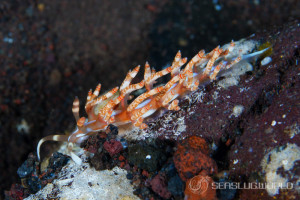
Same Genus Nudibranchs

Similar Colors Nudibranchs
Academic Database
Sea slug observation data is available in international marine biodiversity databases.