Ceratosoma amoenum (Cheeseman, 1886)
- Location
- Bare Island East, New South Wales, Australia
- Date
- 2026/04/29
- Length
- 15mm
- Depth
- 15.0m
- Water temperature
- 20.0℃
Description
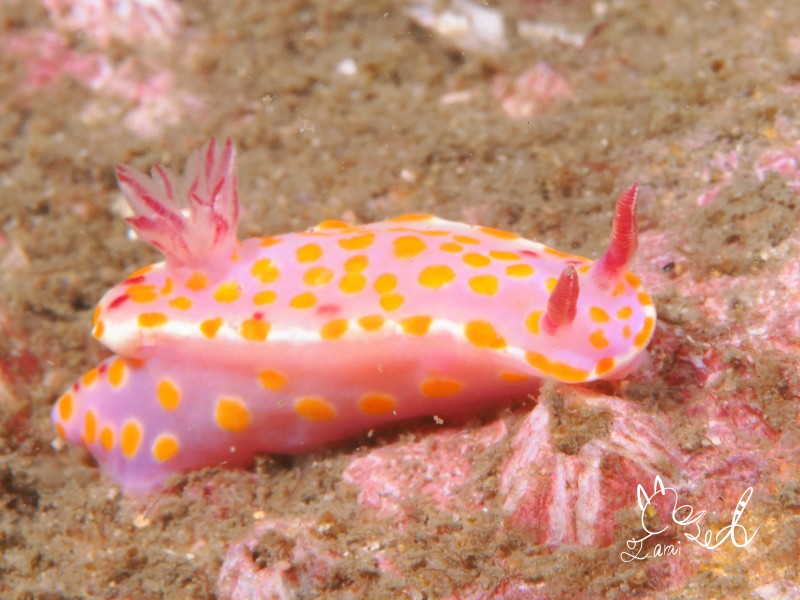
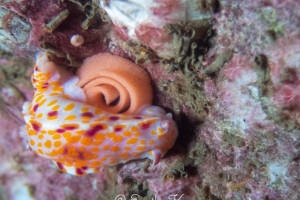
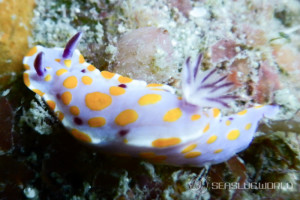
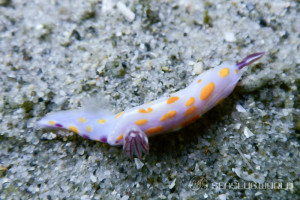
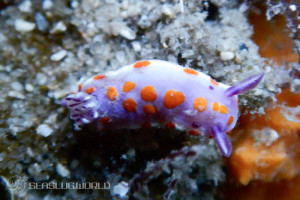
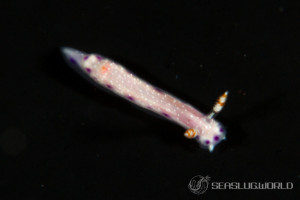
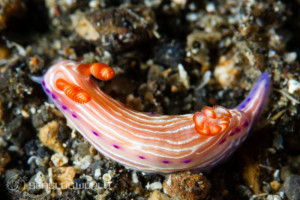
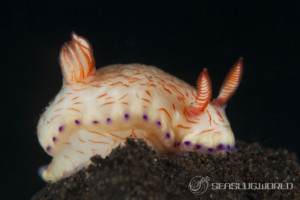
The body is lower and more elongate than that of other species of Ceratosoma, retaining a relatively primitive body shape within the genus. The mantle edge encircles the body without forming distinct lateral lobes. There is a modest swelling in the posterior dorsal midline that represents an incipient posterior horn, and as in Ceratosoma palliolatum and Ceratosoma brevicaudatum the mantle glands tend to concentrate in this region. Small mantle glands are scattered all around the mantle edge, with a larger aggregation in the posterior midline.Colour pattern varies considerably across the range. Specimens from the Sydney region and northern New South Wales typically have a pale pink or pale purple mantle background with large white-ringed orange or yellow spots scattered over the dorsum and a submarginal row of small purple spots. From south of Sydney through Victoria, Tasmania and South Australia the orange spots are smaller and more numerous and the purple spots are replaced by wine-red spots, often with a large reddish background patch midway down the mantle. South-western Western Australian animals have a marginal row of orange and red spots of similar size, with many smaller orange spots, each with a trace of a white encircling ring, in the centre of the mantle. New Zealand specimens (North Island) have large orange or yellow spots and few or no purple spots, resembling the northern New South Wales colour form. Adults can exceed 100 mm in length.
Distribution
Widely distributed across northern New Zealand (North Island) and across south-eastern to south-western Australia (New South Wales, Victoria, Tasmania, South Australia and south-western Western Australia). Material reported by Rudman 1988 demonstrated that the species ranges right across southern Australia to the south-western corner of Western Australia.Etymology
The specific name amoenum (feminine amoena) is from Latin meaning pleasing or lovely, presumably in reference to the striking colour pattern.Remarks
The species was originally described by Cheeseman 1886 in Chromodoris, but the posterior aggregation of mantle glands, the reduced mantle skirt, the strongly denticulate radular teeth and the bifid jaw rodlets ally it with Ceratosoma, and Rudman 1984a transferred it to that genus. The 1988 monograph confirmed its primitive position within the genus, in light of further information on Ceratosoma palliolatum and Ceratosoma brevicaudatum. Chromodoris figurata Bergh, 1905b and Chromodoris atopa Bergh, 1905b, both based on New Zealand material, are considered synonyms.References
- Ceratosoma amoena (Cheeseman, 1886), Rudman W.B. (1988). The Chromodorididae (Opisthobranchia: Mollusca) of the Indo-West Pacific: the genus Ceratosoma J. E. Gray. Zoological Journal of the Linnean Society. 93(2): 133-185. https://doi.org/10.1111/j.1096-3642.1988.tb01532.x
- Ceratosoma amoenum, Johnson R.F. & Gosliner T.M. (2012). Traditional taxonomic groupings mask evolutionary history: a molecular phylogeny and new classification of the chromodorid nudibranchs. PLoS ONE 7(4): e33479.
A Kindle field guide by the site author
Kimoto N. (2026). Sea Slugs of Japan & the Indo-Pacific, 2nd Edition.
Kindle Edition
View on Amazon PR (Amazon Associates)Seasonality
Shooting Locations
Loading shooting locations...
Photos of Ceratosoma amoenum
Tag:



Same Genus Nudibranchs

Similar Colors Nudibranchs
Academic Database
Sea slug observation data is available in international marine biodiversity databases.