Ceratosoma bicolor Baba, 1949
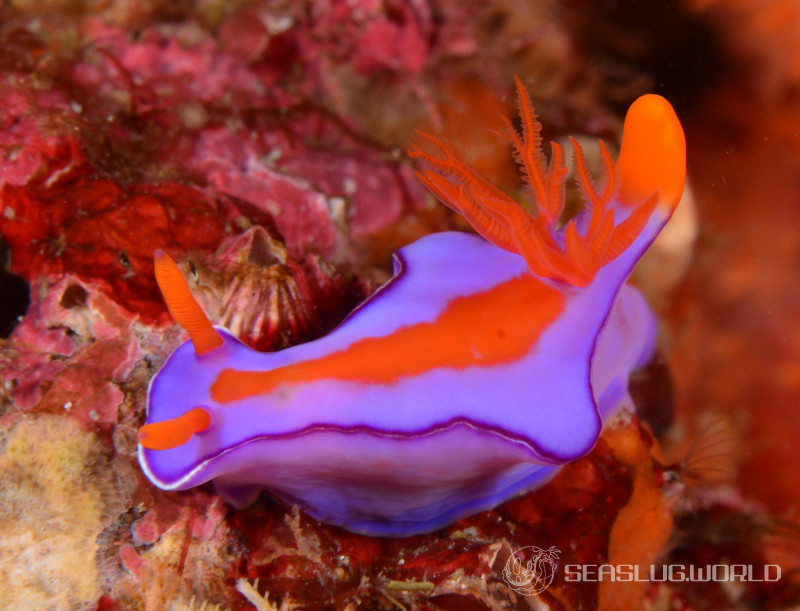
- Location
- Short coral garden, Oobiki Island, Nagasaki, Japan
- Date
- 2017/10/07
- Length
- 20mm
- Depth
- 15.0m
- Water temperature
- 24.0℃
Description
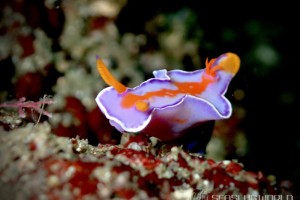
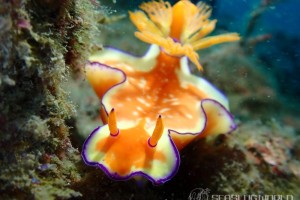
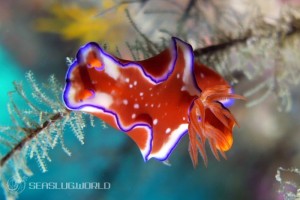
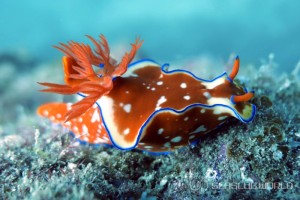
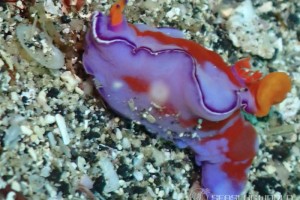
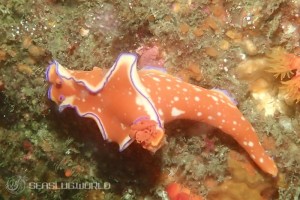
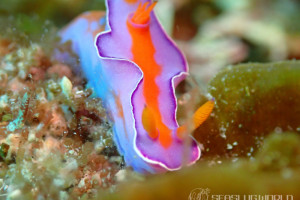
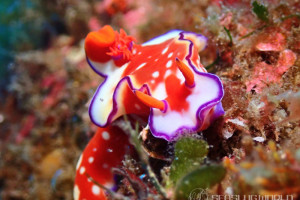
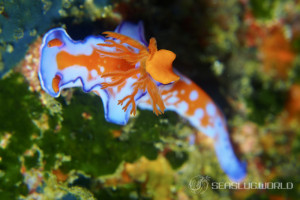
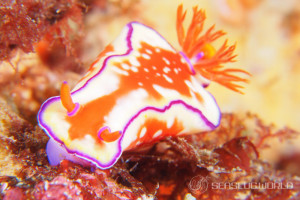
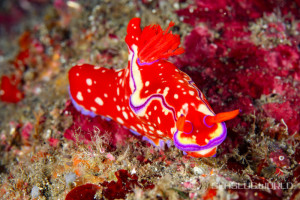
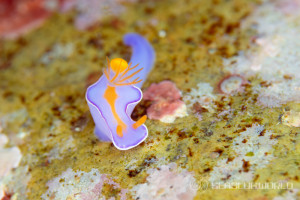
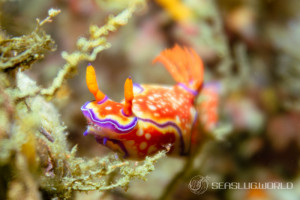
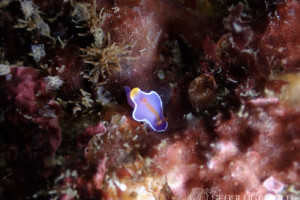
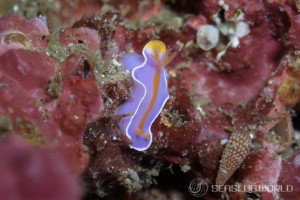
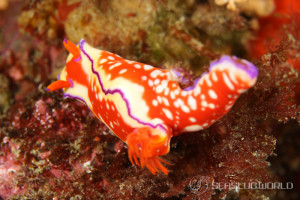
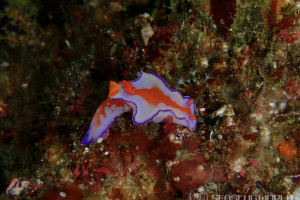
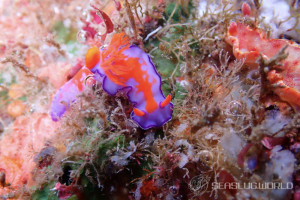
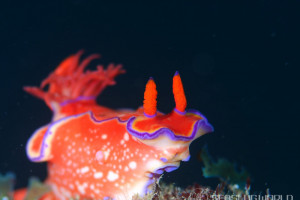
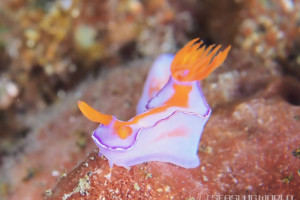
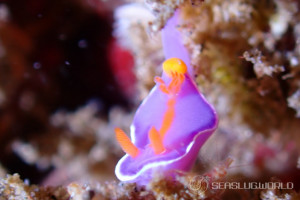
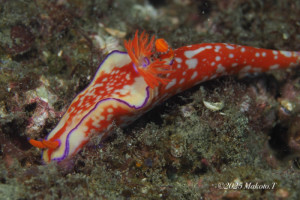
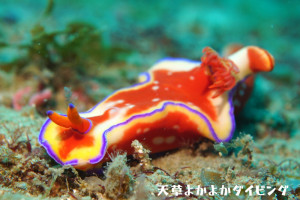
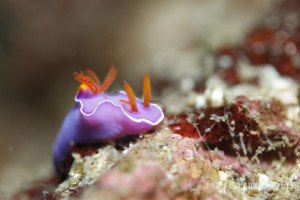
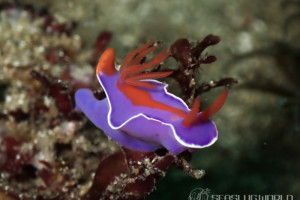
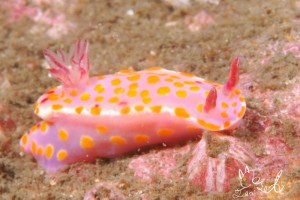
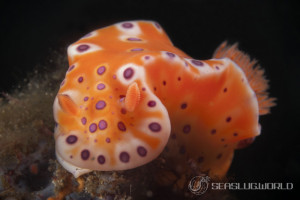
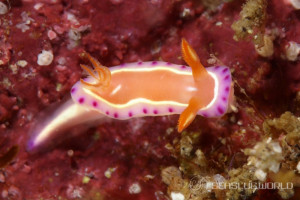
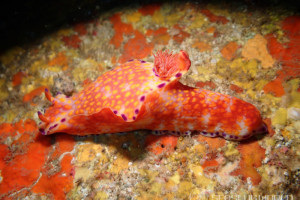
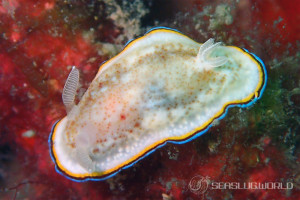
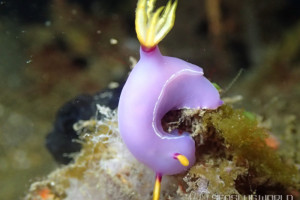
A medium-sized Ceratosoma, total length about 65 mm. Smaller than Ceratosoma cornigerum but with an essentially identical body shape. The coloration is monotone: ground colour pale violet, with darker violet narrow edge lines along the mantle and foot margins. A single vermilion longitudinal stripe runs along the dorsal midline from between the rhinophores to just in front of the gills. The dorsum of the tail bears a vermilion reticulate pattern. Rhinophores, gill leaves, and the tongue-like posterior mantle process are all tinged vermilion. Labial-disc fibres single-tipped. Radula formula 48×58-65.0.58-65 — narrower than that of Ceratosoma cornigerum but with somewhat more denticles per lateral. The first lateral has 1 inner denticle and 3-4 outer denticles flanking the median cusp; from the second lateral onward, 2-3 denticles are arranged along the outer edge.Distribution
Type locality is Amanawa-ba, Sagami Bay (100-350 m depth, July-August 1935, 2 specimens) and off Kameshiro-shō, Sagami Bay (80-90 m depth, August 1935, 2 specimens). The original description records the species only from deeper waters of Sagami Bay.Etymology
The specific epithet bicolor is Latin for two-coloured. The original description does not give an explicit etymology paragraph; the descriptive sense reflects the two-colour contrast (pale violet ground with vermilion median stripe). The Japanese name "Futa-iro-nishiki-umiushi" (two-colour brocade sea slug) likewise refers to the two-colour scheme.Remarks
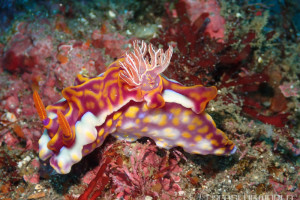
Distinguished from Ceratosoma cornigerum by smaller size, monotone pale-violet ground with only a vermilion median dorsal stripe (versus the orange-yellow / red-violet pattern of Ceratosoma cornigerum), narrower radula. Found at notably deeper water (80-350 m) than typical shallow-water chromodorids.References
- Ceratosoma bicolor Baba, 1949, Baba K. (1949). Opisthobranchia of Sagami Bay collected by His Majesty the Emperor of Japan (相模湾産後鰓類図譜). Iwanami Shoten, Tokyo. 4+2+194+7 pp., pls. 1-50.
- 馬場菊太郎. (1989). 日本産ニシキウミウシ属の再検討. 貝類学雑誌. 48(3): 141-149. https://doi.org/10.18941/venusjjm.48.3_141
- フタイロニシキウミウシ, 益田一. (1999). 海洋生物ガイドブック. 東海大学出版会.
- フタイロニシキウミウシ, 益田一. (1999). 海洋生物ガイドブック. 第2刷. 東海大学出版会.
- フタイロニシキウミウシ, 鈴木敬宇. (2000). ウミウシガイドブック〈2〉. TBSブリタニカ.
- ニシキウミウシ, 中野理枝. (2004). 本州のウミウシ. ラトルズ.
- Ceratosoma bicolor, Helmut Debelius, Rudie H. Kuiter. (2007). Nudibranchs of the World.
- Ceratosoma bicolor, Johnson R.F. & Gosliner T.M. (2012). Traditional taxonomic groupings mask evolutionary history: a molecular phylogeny and new classification of the chromodorid nudibranchs. PLoS ONE 7(4): e33479.
- ニシキウミウシ, 中野理枝. (2018). 日本のウミウシ. 文一総合出版.
Featured in this book
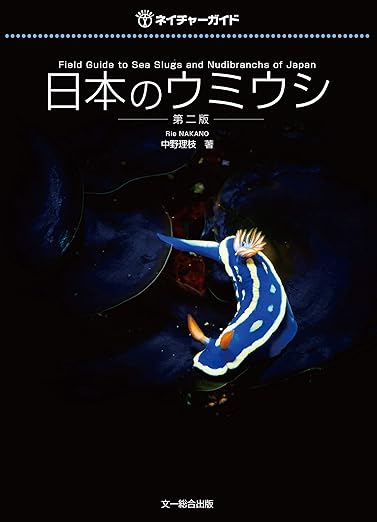
中野理枝. (2019). 日本のウミウシ. 第二版. 文一総合出版.
文一総合出版
This species, Ceratosoma bicolor, is included in the book.
View on Amazon PR (Amazon Associates)Seasonality
Shooting Locations
Loading shooting locations...
Photos of Ceratosoma bicolor
Tag:


















Same Genus Nudibranchs

Similar Colors Nudibranchs

Academic Database
Sea slug observation data is available in international marine biodiversity databases.