Ceratosoma palliolatum Rudman, 1988
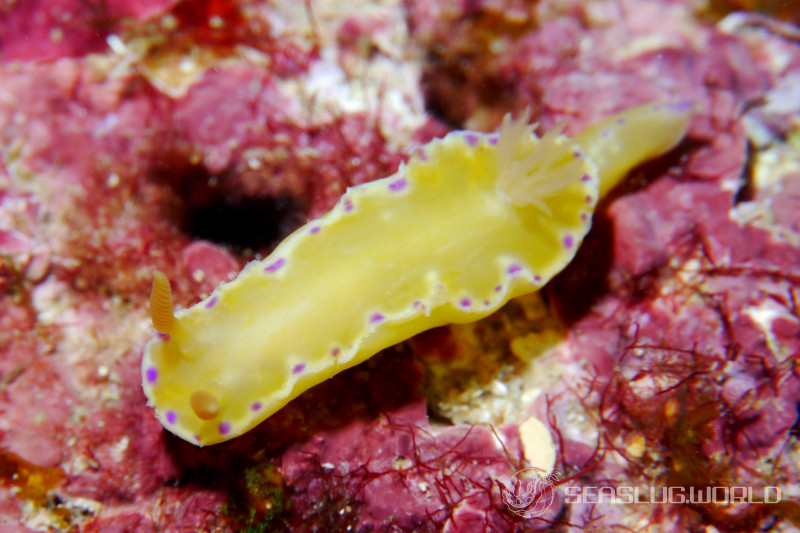
- Location
- Sunabe Water Treatment Plants, Okinawa Island (Chatan and Southern area), Okinawa, Japan
- Date
- 2015/08/18
- Length
- 15mm
- Depth
- 6.0m
- Water temperature
- 28.0℃
Description
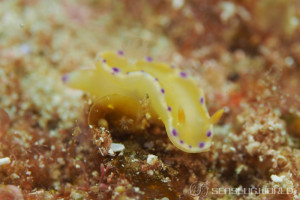
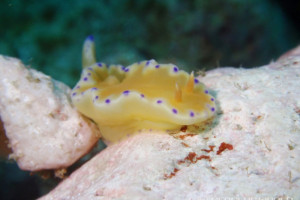
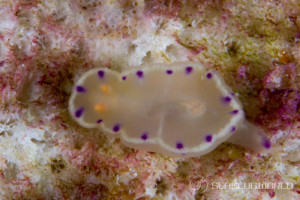
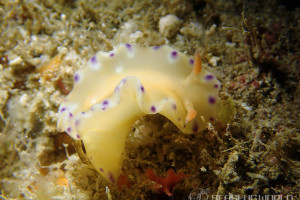
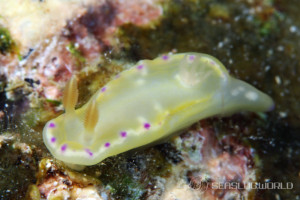
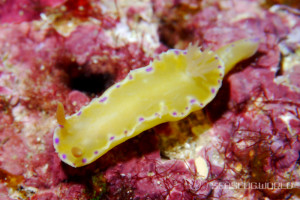
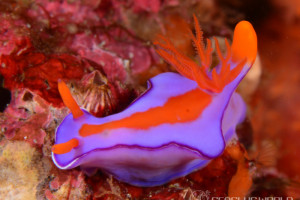
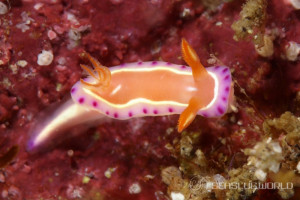
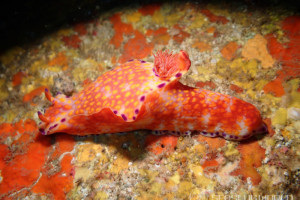
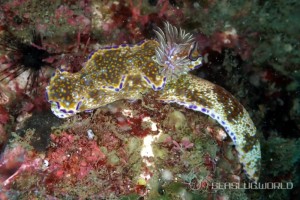
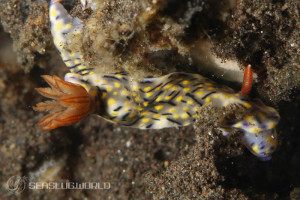
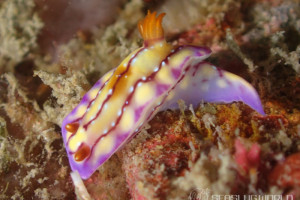
The body is firm and rigid with relatively high sides; the posterior end of the foot extends slightly beyond the mantle. A continuous mantle edge surrounds the body and is produced into three lateral lobes on each side; there is no development of a posterior dorsal horn or hump. Mantle glands are small and arranged in a continuous band around the entire mantle edge. Rhinophores have a short stalk and a long slender lamellate club. Seven long tapering gills, the most posterior on each side bifurcating near the base, giving an initial impression of nine gills; the gills are almost circular in section with a row of greatly reduced lamellae along each side and some branching near the tip. The rounded anterior end of the foot is split transversely with slightly angled foot corners. A distinct keel runs down the dorsal midline of the posterior foot.In the holotype the mantle is bright orange mottled with translucent cream patches; a thin whitish line around the mantle edge accompanies a row of irregularly sized and spaced bluish-purple spots; a wide translucent band along the foot edge contains a few small bluish-purple spots forming a submarginal row. Rhinophores orange tipped with purple; gills translucent orange. The Kwajalein specimen is similar but with a more yellowish-orange ground colour. Radular formula of the holotype 103.1.103 × 74 (+2); the central tooth is a reduced plate with a small pointed cusp. Recorded up to 75 mm alive (holotype).
Distribution
Northern Australia: reef off Gunn Pt., Darwin (intertidal, 13 November 1985, AM C148238 HOLOTYPE, 75 mm alive). Marshall Islands: K-6 Pinnacle, Kwajalein Atoll (12 m, 23 September 1983, AM C148342 PARATYPE, 4.5 mm alive). At the time of the original description only the two known specimens — from Darwin in northern Australia and the Marshall Islands — were on record, suggesting a wide geographic range at least in the western Pacific.Etymology
The specific epithet palliolatum is from Latin and means "to wear a small Greek coat or mantle", referring to the entire mantle skirt around the body.Remarks
The internal anatomy is typical of Ceratosoma, but the species is distinguished from all other species in the genus by the relatively wide continuous mantle overlap with small mantle glands arranged evenly all around the edge. The high firm body and the dorsal keel along the posterior foot also ally it with Ceratosoma. Externally it shows a relatively "primitive" body shape more typical of Chromodoris than of most other Ceratosoma.References
- Ceratosoma palliolatum sp. nov., Rudman W.B. (1988). The Chromodorididae (Opisthobranchia: Mollusca) of the Indo-West Pacific: the genus Ceratosoma J. E. Gray. Zoological Journal of the Linnean Society. 93(2): 133-185. https://doi.org/10.1111/j.1096-3642.1988.tb01532.x
- コハクニシキウミウシ(新称), 小野篤司. (2000). ウミウシガイドブック. 第2版. TBSブリタニカ.
- Ceratosoma palliolatum, Johnson R.F. & Gosliner T.M. (2012). Traditional taxonomic groupings mask evolutionary history: a molecular phylogeny and new classification of the chromodorid nudibranchs. PLoS ONE 7(4): e33479.
A Kindle field guide by the site author
Kimoto N. (2026). Sea Slugs of Japan & the Indo-Pacific, 2nd Edition.
Kindle Edition
View on Amazon PR (Amazon Associates)Seasonality
Shooting Locations
Loading shooting locations...
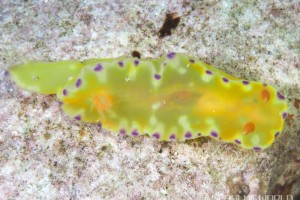
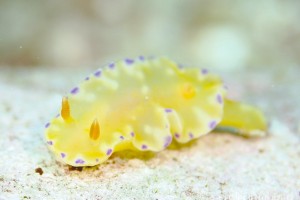
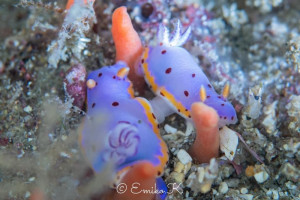
Photos of Ceratosoma palliolatum





Same Genus Nudibranchs

Similar Colors Nudibranchs
Academic Database
Sea slug observation data is available in international marine biodiversity databases.