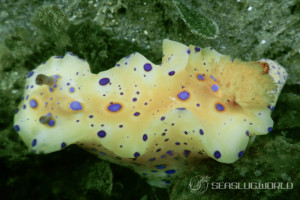
Ceratosoma brevicaudatum Abraham, 1876
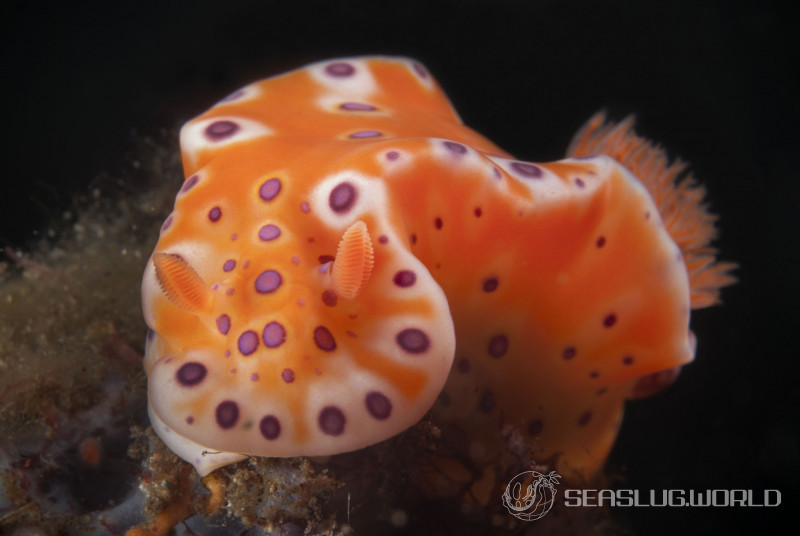
- Location
- Busselton Jetty, Western Australia, Australia
- Date
- 2006/01/15
- Length
- 50mm
- Depth
- 12.0m
- Water temperature
- 19.0℃
Description
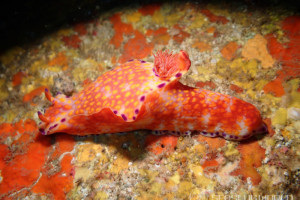
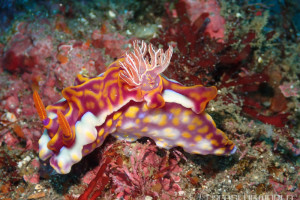
The body is firm and rigid, and the mantle edge forms a wide rim that encircles the body with distinct lateral lobes on each side. The dorsal midline carries a small posterior protuberance just behind the gills, but in this species the protuberance is only weakly developed compared with the tropical species of Ceratosoma; the specific name brevicaudatum (short-tailed) refers to this character. Although small, the protuberance is always conspicuous in life as a brightly coloured (usually red) object, and even in juveniles 2–3 mm long where the protuberance itself is undeveloped there is a red patch in the posterior dorsal midline. Adult specimens reach 130–135 mm alive.The colour pattern is built around an aggregation of mantle glands in the posterior midline overlain by orange spots on a paler ground, but shows considerable geographic variation. The radula of juveniles bears prominent denticles reminiscent of Ceratosoma amoenum, becoming non-denticulate hamate teeth in adults. A minority of jaw rodlets in juveniles have bifid tips, providing a link between the consistently bifid rodlets of C. amoenum and the unicuspid rodlets of the other species of Ceratosoma.
Distribution
Endemic to southern Australia. Recorded from south-western Western Australia (around Fremantle, south of Exmouth Gulf), South Australia (Eyre Peninsula, Spencer Gulf, Yorke Peninsula, Kangaroo Island), Victoria, Tasmania and southern New South Wales, from intertidal habitats down to several tens of metres.Etymology
The specific name brevicaudatum is from Latin meaning short-tailed, in reference to the relatively small posterior dorsal protuberance compared with that of the tropical species of the genus.Remarks
This is one of the most commonly encountered chromodorid nudibranchs in southern Australia; Burn 1961 described it as 'the commonest nudibranch of southern Australia'. Ceratosoma oblongum Abraham, 1876, described in the same paper, is a synonym based on preserved material, as is Ceratosoma adelaidae Basedow & Hedley, 1905, which was based on a juvenile specimen. Doris pustulosa Cuvier, 1804, reportedly from Timor, may well be a senior synonym of C. brevicaudatum, but the type material is too poorly preserved to allow positive identification, and a 1988 paper treated C. pustulosus as unidentifiable.References
- Ceratosoma brevicaudatum Abraham, 1876, Rudman W.B. (1988). The Chromodorididae (Opisthobranchia: Mollusca) of the Indo-West Pacific: the genus Ceratosoma J. E. Gray. Zoological Journal of the Linnean Society. 93(2): 133-185. https://doi.org/10.1111/j.1096-3642.1988.tb01532.x
- Ceratosoma brevicaudatum, Johnson R.F. & Gosliner T.M. (2012). Traditional taxonomic groupings mask evolutionary history: a molecular phylogeny and new classification of the chromodorid nudibranchs. PLoS ONE 7(4): e33479.
A Kindle field guide by the site author
Kimoto N. (2026). Sea Slugs of Japan & the Indo-Pacific, 2nd Edition.
Kindle Edition
View on Amazon PR (Amazon Associates)Seasonality
Shooting Locations
Loading shooting locations...
Photos of Ceratosoma brevicaudatum


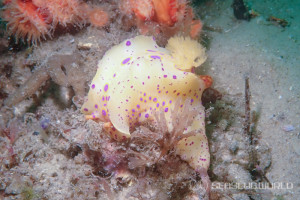
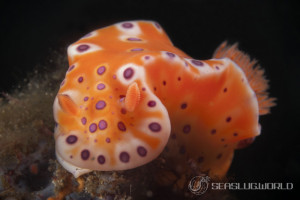

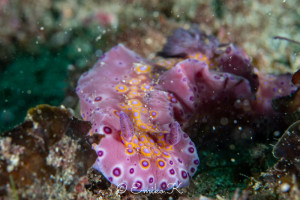

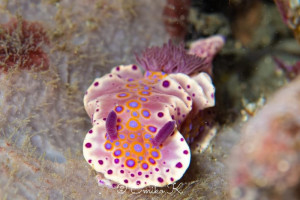
Same Genus Nudibranchs

Similar Colors Nudibranchs

Academic Database
Sea slug observation data is available in international marine biodiversity databases.