Ceratosoma trilobatum (J. E. Gray, 1850)
Description
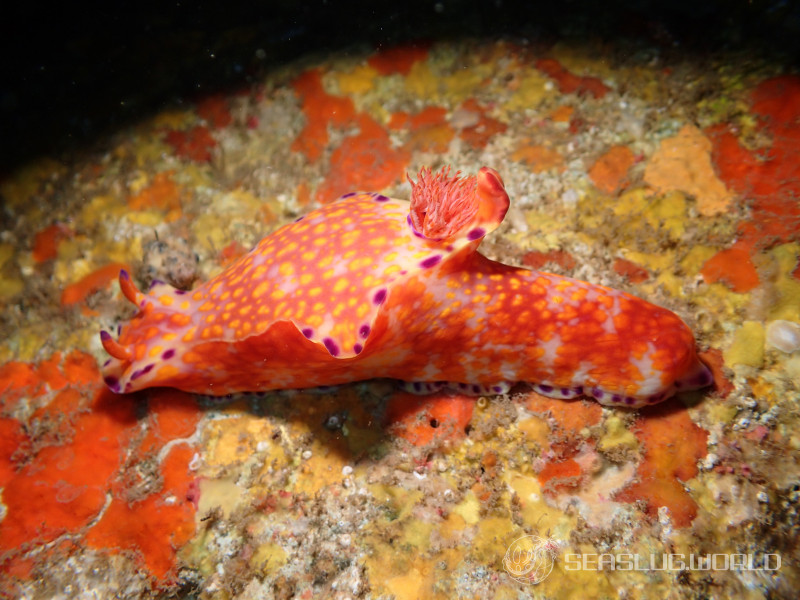
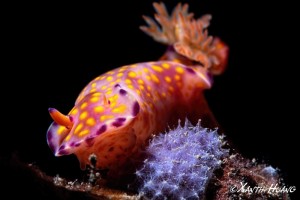
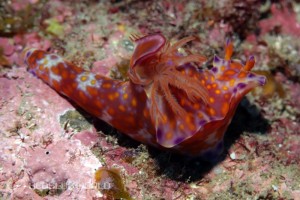
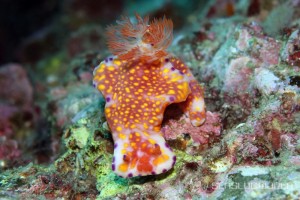
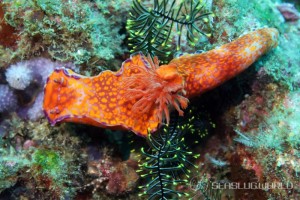
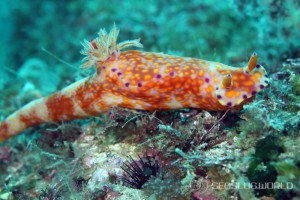
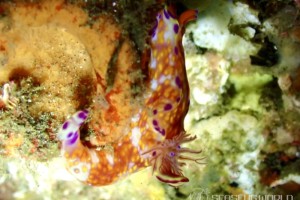
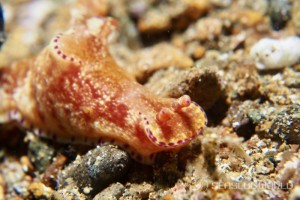
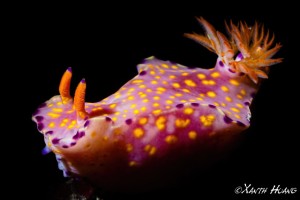
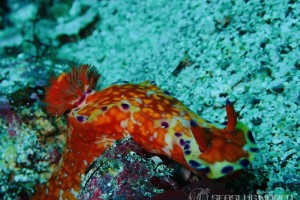
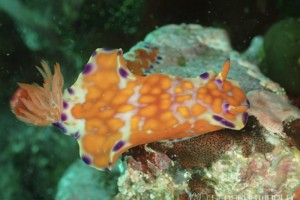
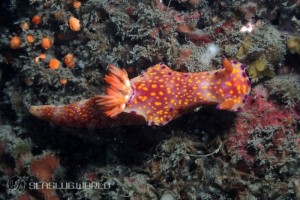
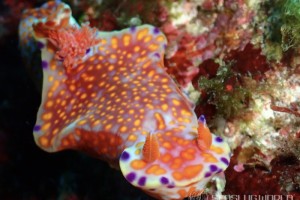
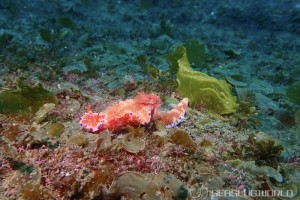
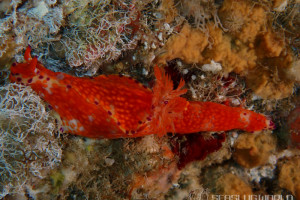
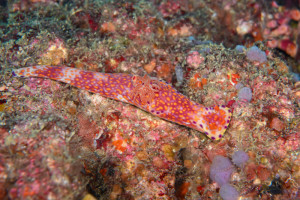
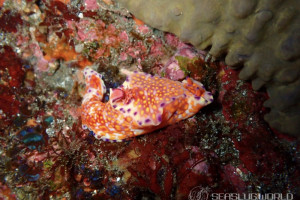
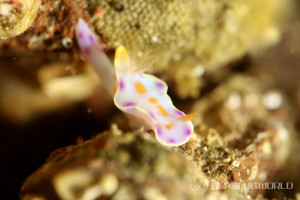
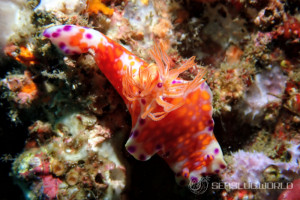
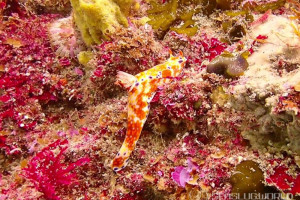
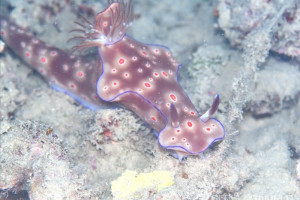
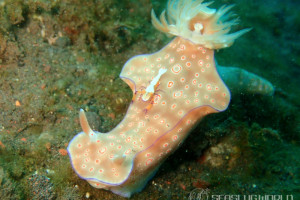
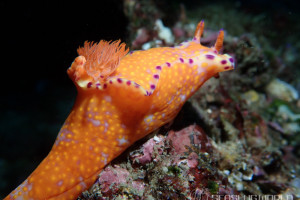
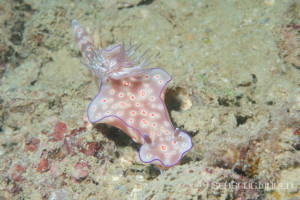
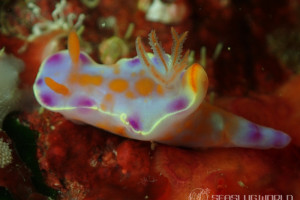
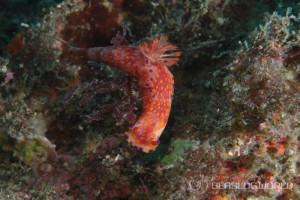
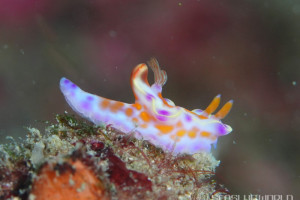
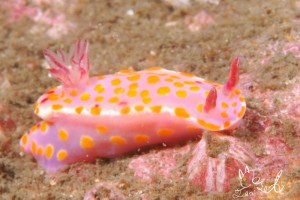
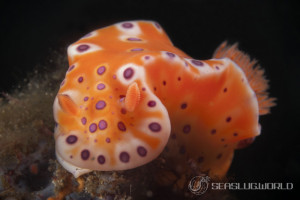
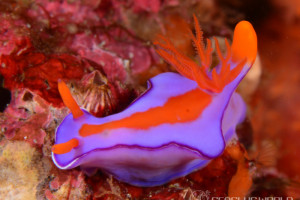
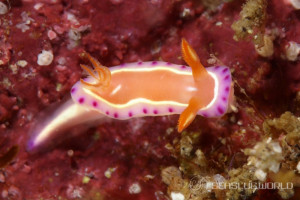
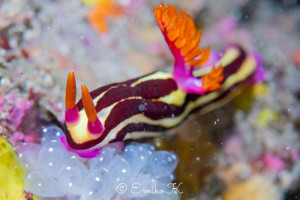
The body is firm and rigid, and is highest just behind the mantle at the level of the gills. The mantle covers only the anterior half of the body, the posterior half consisting of the greatly enlarged foot. Around the head the mantle overlap forms a rigid ledge that is reduced to a narrow ridge along each side before expanding into a large wing-like lobe in front of the gills, and posteriorly the mantle is produced into a large rigid recurved horn in the dorsal midline. There are up to 20 long gills arranged in an arc open posteriorly, each almost circular in cross-section with a few terminal branches and a row of reduced lamellae down each side. The rhinophore stalk is short and the club long, slender and tipped with a rounded knob.The colour pattern is extremely variable. Specimens from coastal Queensland and the Northern Territory typically have a creamy white background mottled with diffuse orange-brown patches, scattered small orange spots, and a thin continuous purple line at the mantle edge; specimens from the Arafura Sea and eastern Gulf of Carpentaria are similar but with a broken purple line. In the Darwin–Cobourg Peninsula region the colour is very different and very variable, with no orange spots and a background ranging from pink, yellow, orange, brown to deep reddish-brown, and rhinophores and gills usually purple. Tanzanian specimens may be cream heavily mottled with purplish to reddish brown, or almost uniformly reddish-brown, with densely scattered small bright orange spots. New Caledonian animals have a creamy ground almost obscured by mottled orange-brown overlain with bright orange spots. Large adults exceed 130 mm in length.
Distribution
Widely distributed in the Indo-West Pacific, with records from Tanzania (including the Dar es Salaam region), the Seychelles, Indonesia, the Philippines, tropical Australia (Queensland, Northern Territory and Western Australia), and New Caledonia. The species was originally described from India. There are few records from the western Pacific outside New Caledonia; the single Hawaiian specimen reported by Kay & Young 1969 is possibly correct but the radula was lost.Etymology
The specific name trilobatum is from Latin and refers to the three-lobed appearance produced by the rigid mantle ledge around the head, the wing-like lateral lobes in front of the gills, and the large recurved posterior horn.Remarks
A long list of names has been synonymised with this species, including Ceratosoma cornigerum (Adams & Reeve, 1850), Ceratosoma caledonicum Fischer, 1876, Ceratosoma berghi Rochebrune, 1895, Ceratosoma gibbosum Rochebrune, 1894, Ceratosoma lixi Rochebrune, 1894, Ceratosoma corallinum Odhner, 1917, and Ceratosoma bicolor Baba, 1949. Earlier authors, including Eliot 1904, confused this species with Ceratosoma tenue; Rudman 1988 showed that the two are clearly separable on the extent of the mantle skirt and on the strong development of the posterior dorsal horn in C. trilobatum. The radula has no central tooth, and the lateral teeth are finely denticulate in juveniles but become essentially smooth and hamate in large adults.References
- Ceratosoma sp. 錦うみうし, 藤田經信. (1893). 相州三浦三崎近傍ノ隱鰓うみうし科 (Cryptobranchiate Dorididae)(第五拾五號ノ續キ). 動物學雑誌. 5(57): 249-252.
- ニシキウミウシ, Baba K. (1949). Opisthobranchia of Sagami Bay collected by His Majesty the Emperor of Japan (相模湾産後鰓類図譜). Iwanami Shoten, Tokyo. 4+2+194+7 pp., pls. 1-50.
- Ceratosoma trilobatum (J. E. Gray, 1827), Rudman W.B. (1988). The Chromodorididae (Opisthobranchia: Mollusca) of the Indo-West Pacific: the genus Ceratosoma J. E. Gray. Zoological Journal of the Linnean Society. 93(2): 133-185. https://doi.org/10.1111/j.1096-3642.1988.tb01532.x
- ニシキウミウシ,ダイニニシキウミウシ,ヤマトニシキウミウシ, 馬場菊太郎. (1989). 日本産ニシキウミウシ属の再検討. 貝類学雑誌. 48(3): 141-149. https://doi.org/10.18941/venusjjm.48.3_141
- ニシキウミウシ, 鈴木敬宇. (2000). ウミウシガイドブック〈2〉. TBSブリタニカ.
- ニシキウミウシ, 殿塚孝昌. (2003). ウミウシガイドブック〈3〉. TBSブリタニカ.
- ニシキウミウシ, 中野理枝. (2004). 本州のウミウシ. ラトルズ.
- ニシキウミウシ, 小野篤司. (2004). 沖縄のウミウシ. ラトルズ.
- ニシキウミウシ, 小野篤司 & 加藤昌一. (2009). ウミウシ. 誠文堂新光社.
- Ceratosoma trilobatum, Johnson R.F. & Gosliner T.M. (2012). Traditional taxonomic groupings mask evolutionary history: a molecular phylogeny and new classification of the chromodorid nudibranchs. PLoS ONE 7(4): e33479.
- Ceratosoma trilobatum, Terrence Gosliner, Ángel Valdés and David Behrens. (2015). Nudibranch and Sea Slug Identification Indo-Pacific. New World Pubns Inc.
- ニシキウミウシ, 中野理枝. (2018). 日本のウミウシ. 文一総合出版.
Featured in this book
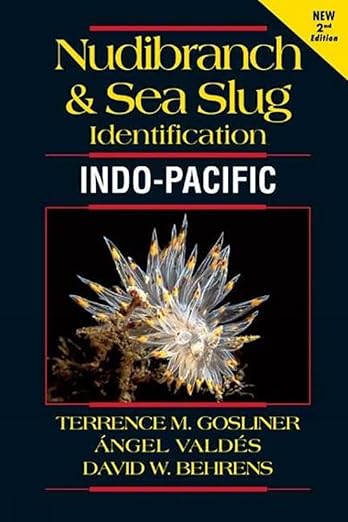
Terrence Gosliner, Ángel Valdés and David Behrens. (2018). Nudibranch and Sea Slug Identification Indo-Pacific 2nd Edition. New World Pubns Inc.
New World Publications
This species, Ceratosoma trilobatum, is included in the book.
View on Amazon PR (Amazon Associates)Seasonality
Shooting Locations
Loading shooting locations...
Photos of Ceratosoma trilobatum
Tag:



















Same Genus Nudibranchs

Similar Colors Nudibranchs

Academic Database
Sea slug observation data is available in international marine biodiversity databases.