Spinophallus falciphallus (Gosliner, 2011)
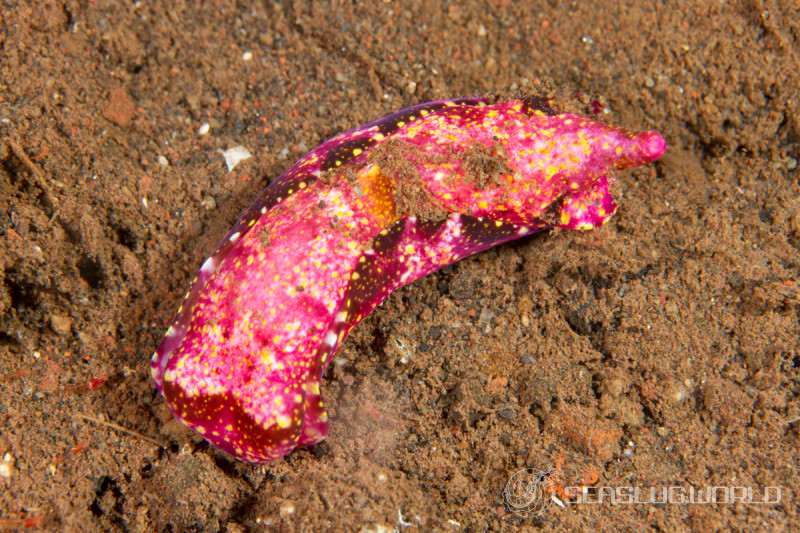
- Location
- Agung, Tulamben, Pulau Bali, Indonesia
- Date
- 2018/01/12
- Length
- 30mm
- Depth
- 16.0m
- Water temperature
- 28.0℃
Description
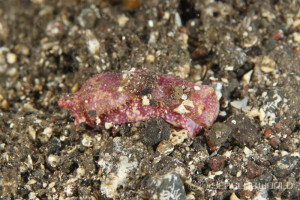
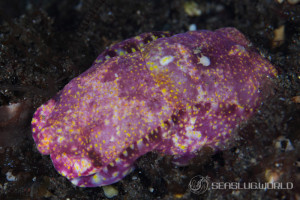
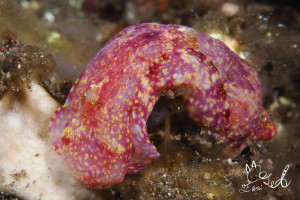
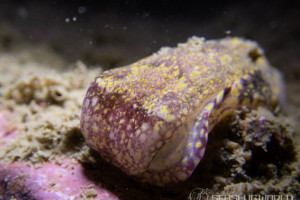
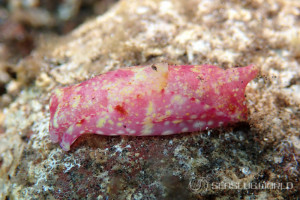
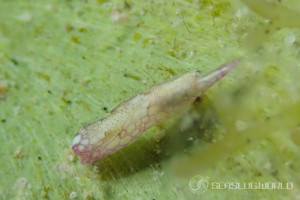
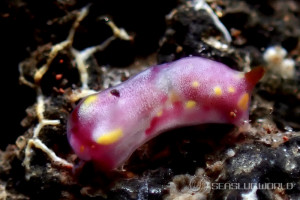
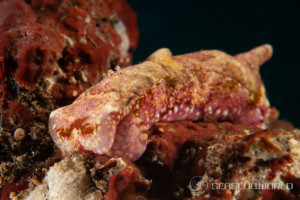
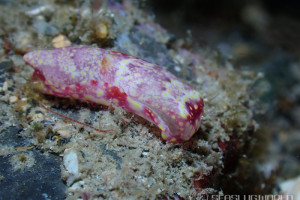
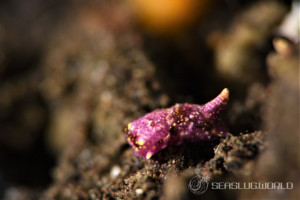
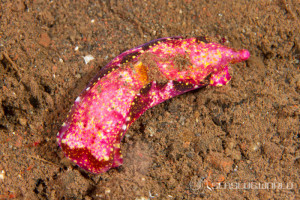
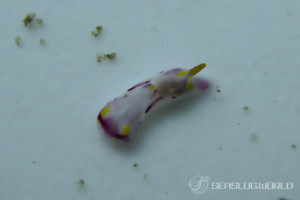
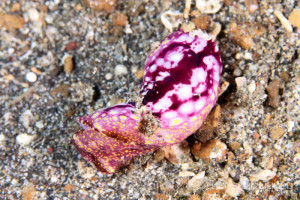
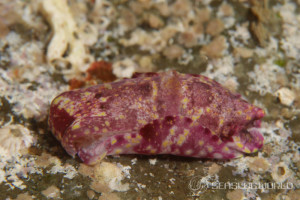
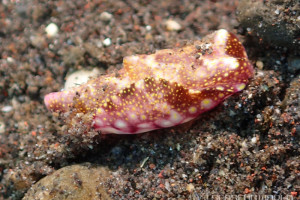
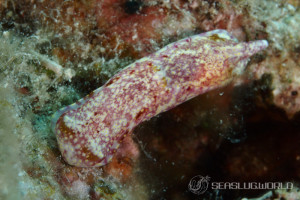
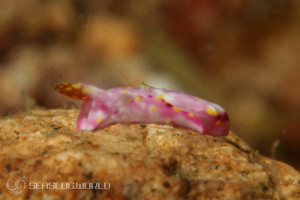
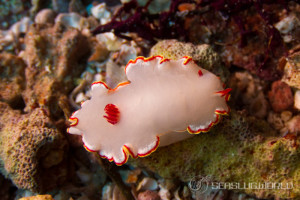
A small head-shield slug 9–25 mm long and 5–12 mm wide. The general body colour of living animals is light pinkish to wine red, with darker red to maroon pigment on the anterior portion of the head, along the parapodial margins, and at the base of the posterior projection of the posterior shield. The entire dorsal and lateral surfaces are ornamented with scattered irregular yellow spots and a few whitish patches. Marshall Islands specimens are paler with dorsal and lateral whitish pigment and a few maroon spots. The ventral surface (Philippine specimens) is pale pink to wine red with a midventral longitudinal maroon line and two additional lateral lines that may be interrupted as maroon spots. The foot bears a few large yellow spots.The cephalic shield is roughly rectangular with a blunt quadrangular anterior end, terminating posteriorly with a short rounded papilla. The posterior shield is slightly rounded anteriorly and ends in a medial, elongate conical posterior projection that is well-elevated from the base of the shield. Its two lateral posterior lobes are short and simply rounded. The penis is armed: large penial spines are scattered over the surface of the penial papilla, and a large curved, sickle-shaped chitinous spine extends from the right base of the papilla. This is the only species of the Philinopsis group with an armed penis.
Distribution
Widely distributed in the tropical Indo-Pacific. Recorded from the Marshall Islands, the Philippines (Mainit Bubbles, Batangas Province, Luzon), Indonesia, Madagascar, and the Red Sea. Type locality: Mainit Bubbles, Mabini, Batangas Province, Luzon, Philippines (12 m). Found on coral rubble at 5–15 m depth, depositing egg masses at the base of Halimeda plants. A Red Sea specimen has been observed feeding on polyclad flatworms.Etymology
The name "falciphallus" combines Latin falcis ("sickle") and Greek phallos ("penis"), referring to the sickle-shaped chitinous spine of the penis.Remarks
Originally described as Philinopsis falciphallus, the species was transferred to a new genus Spinophallus by Zamora-a 2017 revision of Aglajidae based on molecular phylogenetic analysis, becoming the type species of the genus. Originally described in Gosliner T. 2011 Zootaxa 2751: 1-24.References
- ハナイロキセワタ(新称), 中野理枝. (2011). 高知県大月町西泊地区から記録された後鰓類. Kuroshio Biosphere. 7: 1-35.
- Philinopsis falciphallus n.sp., GOSLINER T. (2011). Six new species of aglajid opisthobranch mollusks from the tropical Indo-Pacific. Zootaxa. 2751(1). https://doi.org/10.11646/zootaxa.2751.1.1
- Philinopsis falciphallus, Terrence Gosliner, Ángel Valdés and David Behrens. (2015). Nudibranch and Sea Slug Identification Indo-Pacific. New World Pubns Inc.
- Andrea Zamora-Silva and Manuel António E. Malaquias Molecular phylogeny of the Aglajidae head-shield sea slugs (Heterobranchia: Cephalaspidea): new evolutionary lineages revealed and proposal of a new classification Zoological Journal of the Linnean Society, 2017
Featured in this book

Terrence Gosliner, Ángel Valdés and David Behrens. (2018). Nudibranch and Sea Slug Identification Indo-Pacific 2nd Edition. New World Pubns Inc.
New World Publications
This species, Spinophallus falciphallus, is included in the book.
View on Amazon PR (Amazon Associates)Seasonality
Shooting Locations
Loading shooting locations...
Photos of Spinophallus falciphallus















Same Genus Nudibranchs
Similar Colors Nudibranchs



Academic Database
Sea slug observation data is available in international marine biodiversity databases.