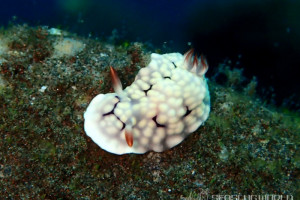
Goniobranchus hintuanensis (Gosliner & Behrens, 1998)
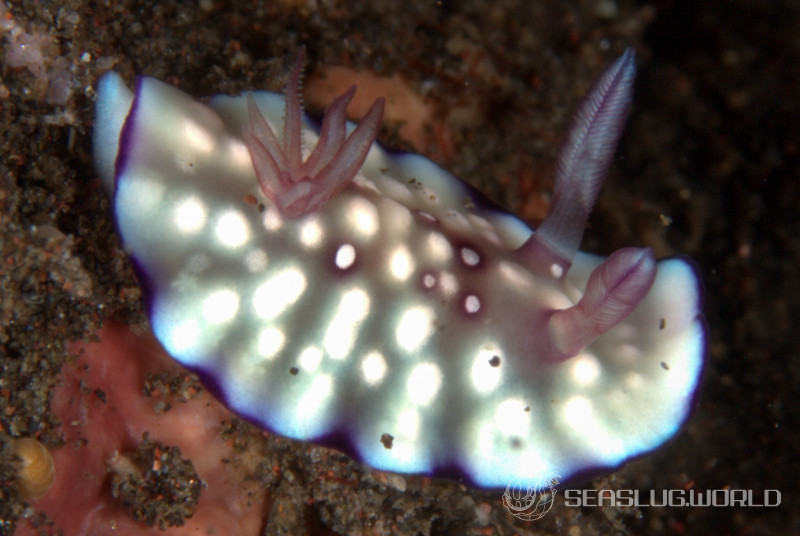
- Location
- USAT Liberty Shipwreck, Tulamben, Pulau Bali, Indonesia
- Date
- 2013/11/20
- Length
- ??mm
- Depth
- ??m
- Water temperature
- ??℃
Description
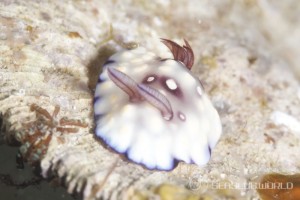
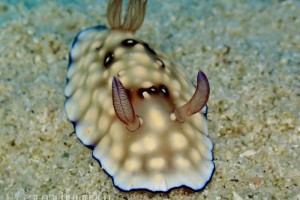
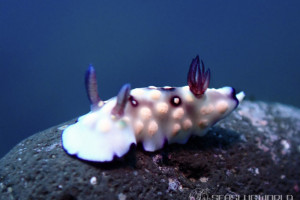
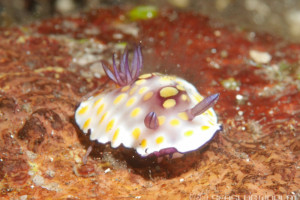
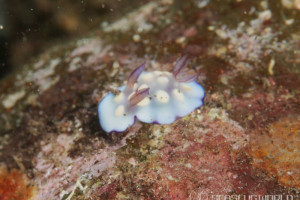
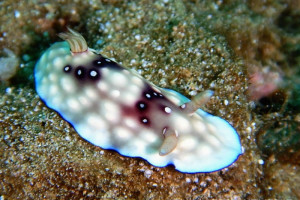
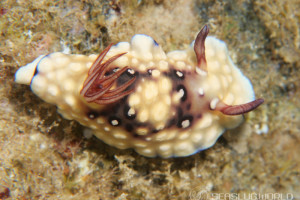
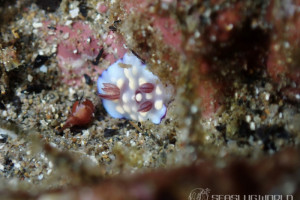
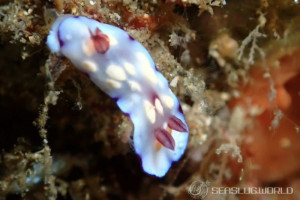
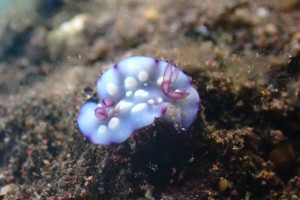
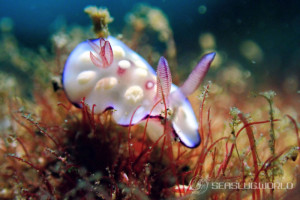
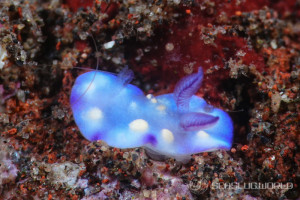
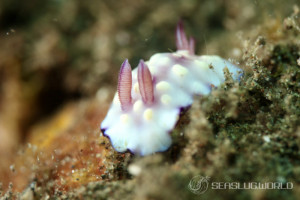
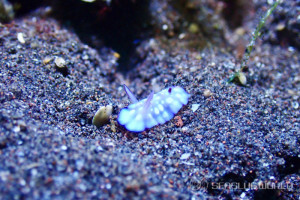
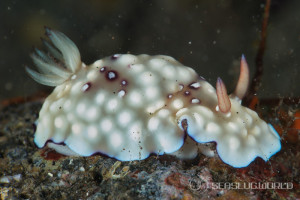
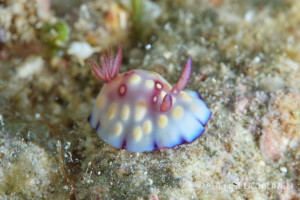
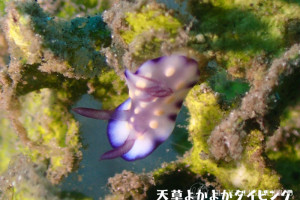
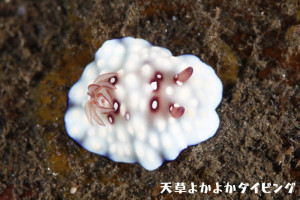
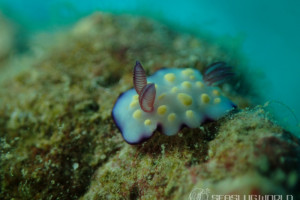
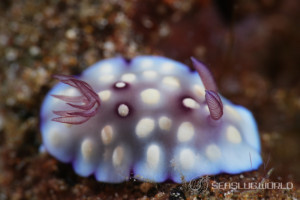
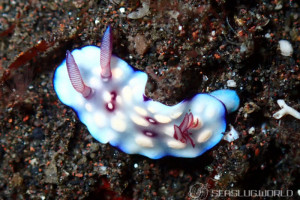
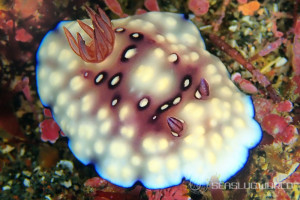
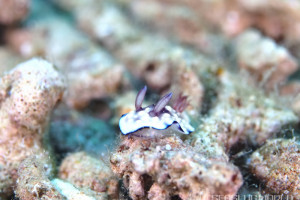
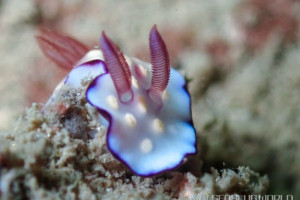
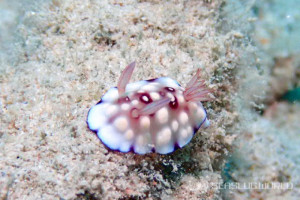
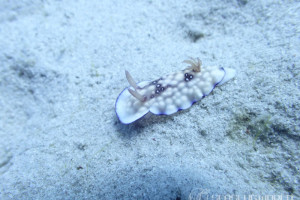
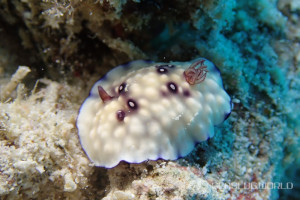
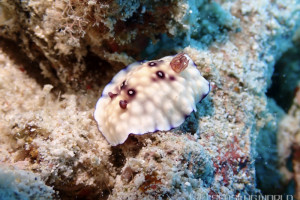
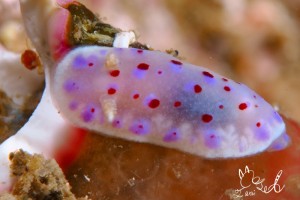
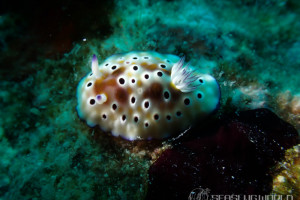
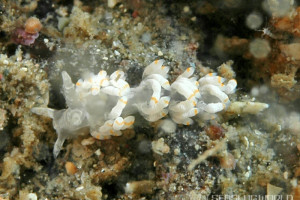
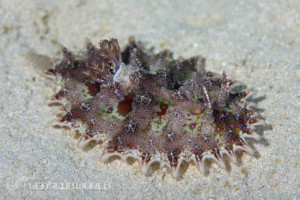
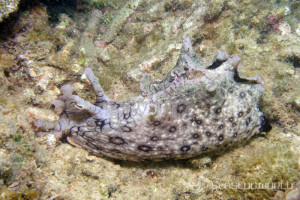
A small chromodorid, 11–16 mm long. The body colour of the living animal is white and the dorsal surface is covered with irregularly-shaped nodules of varying sizes. The mantle margin is edged with deep violet which, in areas of mantle folding, extends inward from the edge to form small patches of color. Small circles of deep magenta outline 5–8 of the small, opaque white, rounded nodules on the medial area of the dorsal surface, and are also found at the base of the rhinophore sheath and gill plume. The outer edges of the circles fade to a plum colour which also forms an irregular network on the notum in the spaces between nodules. The rhinophores and gills are dull plum; crimson lines are present along the longitudinal edges of the gill plumes and on the rachis and lamellae of the rhinophores. There are 10 unipinnate gills, and the perfoliate rhinophores bear 28–34 lamellae. Like G. geometricus and G. conchyliatus, the animal rhythmically raises and lowers the anterior end while crawling.Distribution
Type locality: Bus Stop Reef, Balayan Bay, Luzon, Philippine Islands (Holotype CASIZ 106491, collected 18 April 1996 at 2 m depth by M. Miller). Known from Bali, Indonesia (Debelius 1996); Papua New Guinea (Jim Black photograph); Batangas, Luzon, Philippines; Okinawa, Ryukyu Islands, Japan; and the Andaman Sea, Thailand (Mark Strickland photographs). Commonly encountered in shallow subtidal sandy or silty habitats, where it is observed crawling in the open.Etymology
The name hintuanensis comes from the Tagalog word hintuan, meaning "stopping place," referring to the type locality — dubbed "Bus Stop" by the authors — situated offshore from the waiting shed where buses stop to collect passengers going to Manila.Remarks
Originally described as Chromodoris hintuanensis; transferred to Goniobranchus in a molecular revision based on molecular phylogeny. G. hintuanensis is a member of a group whose anterior body is rhythmically raised and lowered as the animal crawls. Included in this group are G. geometricus (Risbec, 1928) and G. conchyliatus (Yonow, 1984), which are similar in appearance to G. hintuanensis; G. roboi also exhibits this behaviour but lacks the network of lines. Distinguishing characters: the network of pale plum lines (versus dark brown/black in G. geometricus and deep purple in G. conchyliatus); presence of opaque white spots (absent in the other two); deep red lines on rhinophores/gills (versus yellow-green in G. geometricus); 10 gills (versus 5–8 / 7–10); and 28–34 rhinophoral lamellae (versus 18–22 / 28–29).References
- Chromodoris hintuanensis sp. nov., Gosliner, T. M.; Behrens, D. W. (1998). Five new species of Chromodoris (Molluscs: Nudibranchia: Chromodorididae) from the tropical Indo-Pacific Ocean. Proceedings of the California Academy of Sciences. 4(50): 139-165., available online at http://www.biodiversitylibrary.org/page/15659747 page(s): 145-150
- クロモドリス・ヒントゥアネンシス, 殿塚孝昌. (2003). ウミウシガイドブック〈3〉. TBSブリタニカ.
- クロモドーリス・ヒントゥアネンシス, 小野篤司. (2004). 沖縄のウミウシ. ラトルズ.
- クロモドーリス・ヒントゥアネンシス, 中野理枝. (2004). 本州のウミウシ. ラトルズ.
- Goniobranchus hintuanensis, Johnson R.F. & Gosliner T.M. (2012). Traditional taxonomic groupings mask evolutionary history: a molecular phylogeny and new classification of the chromodorid nudibranchs. PLoS ONE 7(4): e33479.
- Goniobranchus hintuanensis, Terrence Gosliner, Ángel Valdés and David Behrens. (2015). Nudibranch and Sea Slug Identification Indo-Pacific. New World Pubns Inc.
Featured in this book
Terrence Gosliner, Ángel Valdés and David Behrens. (2018). Nudibranch and Sea Slug Identification Indo-Pacific 2nd Edition. New World Pubns Inc.
New World Publications
This species, Goniobranchus hintuanensis, is included in the book.
View on Amazon PR (Amazon Associates)Seasonality
Shooting Locations
Loading shooting locations...
Photos of Goniobranchus hintuanensis
Tag:






















Same Genus Nudibranchs
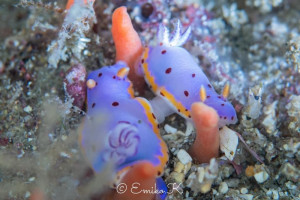

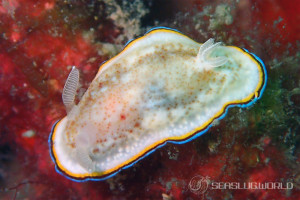
Similar Colors Nudibranchs

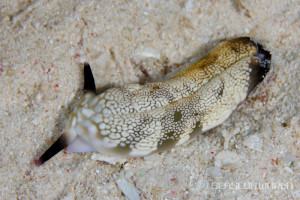
Academic Database
Sea slug observation data is available in international marine biodiversity databases.