Goniobranchus kuniei (Pruvot-Fol, 1930)
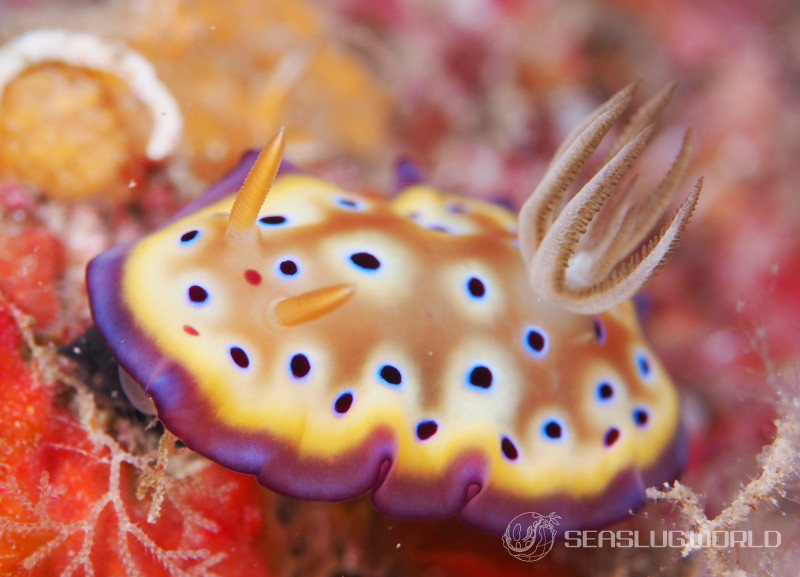
- Location
- Maouno kyuuden, Miyakojima, Okinawa, Japan
- Date
- 2017/11/12
- Length
- 40mm
- Depth
- 18.0m
- Water temperature
- 26.2℃
Description
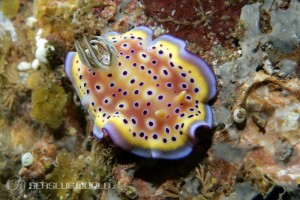
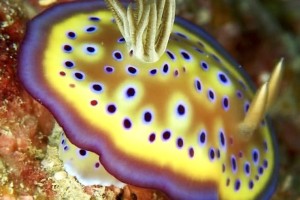
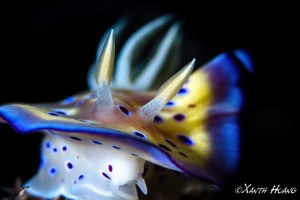
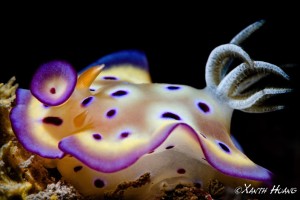
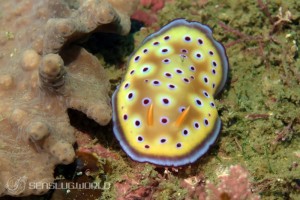
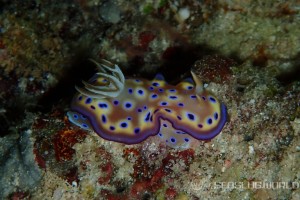
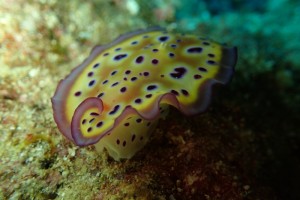
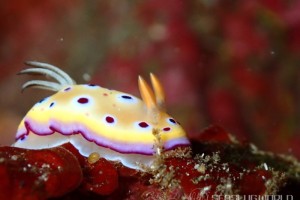
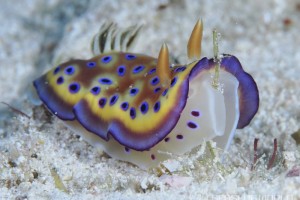
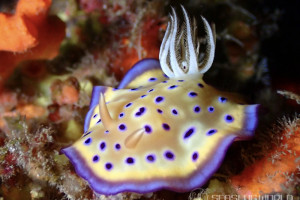
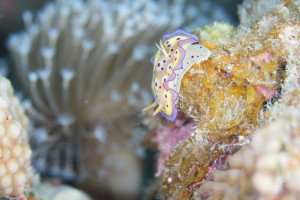
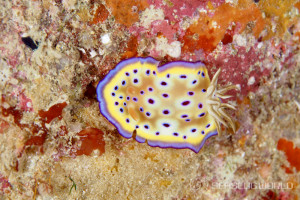
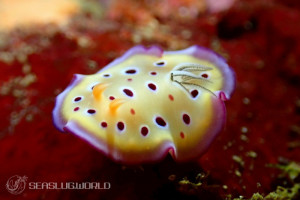
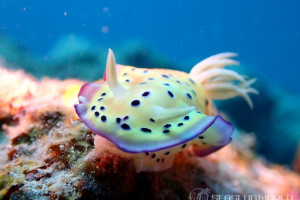
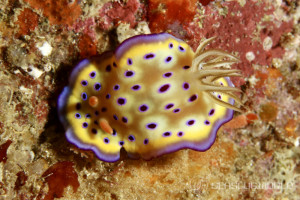
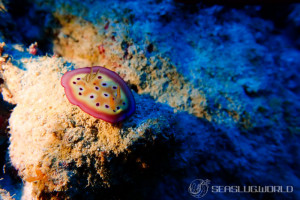
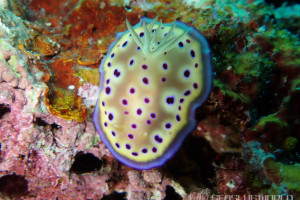
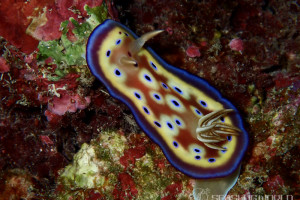
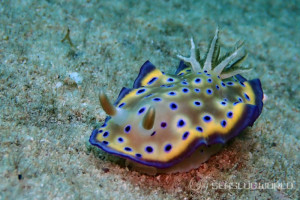
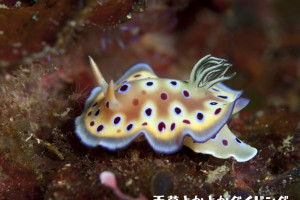
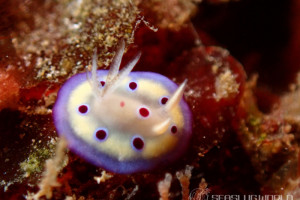
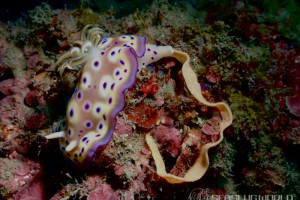
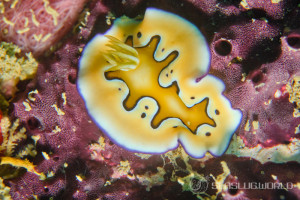
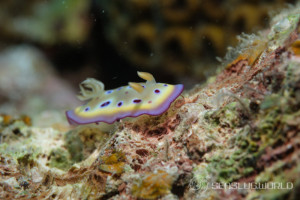
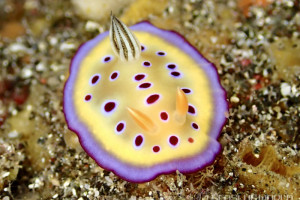
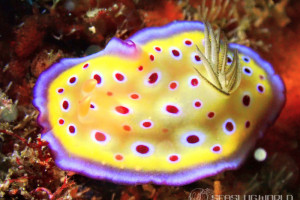
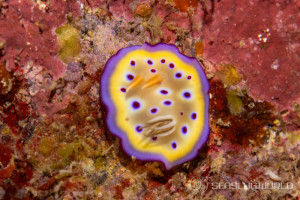
A large chromodorid reaching 75 mm in body length. According to the original description, the body is broad like Chromodoris marginata Pease, with an ample mantle. The mantle border is dark violet, becoming bluish towards the inner side. The rhinophores and gills are also violet. The centre of the dorsum is reddish brown, becoming ochreous outwards and white at the edges, irregularly spotted with dark purple points each surrounded by a clear areola. Beneath the mantle border are ochreous spots, and a line of dark purple points runs along the junction of the flank and the mantle. The mantle margin is observed to undulate up and down rhythmically.Distribution
Type locality: Kuto Bay, Île des Pins, New Caledonia, based on specimens collected by Mme A. Pruvot-Fol in 1929. The species has subsequently been recorded across the Indo-West Pacific and central Pacific, with reports from Christmas Island, Australia, Tonga, New Caledonia, Papua New Guinea, Indonesia, the Philippines, Guam, Japan, and the Marshall Islands.Etymology
The original Etymology section (Pruvot-Fol, 1930, p.229) reads: "Du nom indigène de l'île des Pins" (from the indigenous name of the Île des Pins). The specific epithet kuniei derives from "Kunié", the Kanak (indigenous New Caledonian) name for the Île des Pins where the type specimens were collected.Remarks
In the original description Pruvot-Fol placed the species in Chromodoris. The species was later transferred to Goniobranchus on the basis of a molecular phylogeny of the Chromodorididae (the parentheses in the author citation reflect this generic transfer). The Japanese vernacular name "オトヒメウミウシ" ("Otohime sea slug") evokes the elegant violet-edged appearance and ample body, likening it to the robes of the legendary Otohime, princess of the dragon-king's undersea palace.References
- Chromodoris kuniei n. sp., Pruvot-Fol A. (1930). Diagnoses provisoires (incomplètes) des espèces nouvelles et liste provisoire des Mollusques nudibranches recueillis par Mme A. Pruvot-Fol en Nouvelle-Calédonie (Île des Pins). Bulletin du Muséum National d'Histoire Naturelle, Paris. (2)2(2): 229-233.
- クニエイ, 小野篤司. (1999). ウミウシガイドブック. TBSブリタニカ.
- クロモドリス・クニエイ, 殿塚孝昌. (2003). ウミウシガイドブック〈3〉. TBSブリタニカ.
- オトヒメウミウシ, 小野篤司. (2004). 沖縄のウミウシ. ラトルズ.
- オトヒメウミウシ, 中野理枝. (2004). 本州のウミウシ. ラトルズ.
- オトヒメウミウシ, 小野篤司 & 加藤昌一. (2009). ウミウシ. 誠文堂新光社.
- Goniobranchus kuniei, Johnson R.F. & Gosliner T.M. (2012). Traditional taxonomic groupings mask evolutionary history: a molecular phylogeny and new classification of the chromodorid nudibranchs. PLoS ONE 7(4): e33479.
A Kindle field guide by the site author
Kimoto N. (2026). Sea Slugs of Japan & the Indo-Pacific, 2nd Edition.
Kindle Edition
View on Amazon PR (Amazon Associates)Seasonality
Shooting Locations
Loading shooting locations...
Photos of Goniobranchus kuniei
Tag:






















Same Genus Nudibranchs

Similar Colors Nudibranchs


Academic Database
Sea slug observation data is available in international marine biodiversity databases.