Gymnodoris bernardae De Souza-Canal & Valdés, 2025
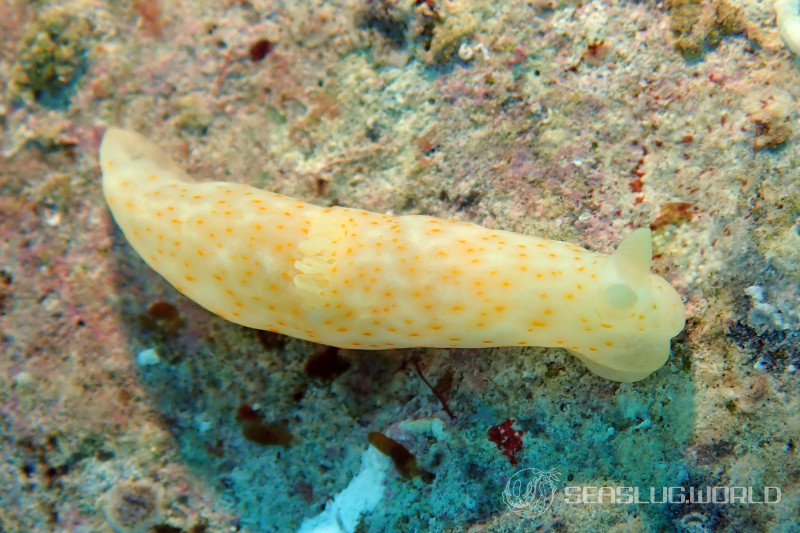
- Location
- Ishikiri(Awa), Okinawa Island (Motobu and Northern area), Okinawa, Japan
- Date
- 2024/05/08
- Length
- 6mm
- Depth
- 10.0m
- Water temperature
- 24.0℃
Description
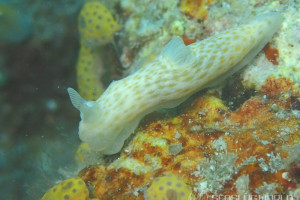
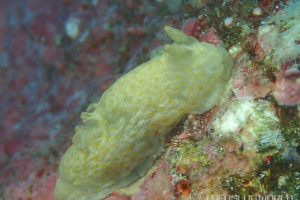
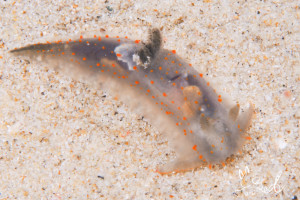
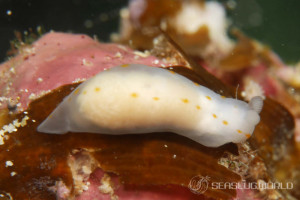
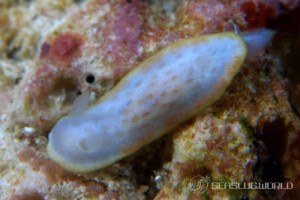
Body narrow, elongate, smooth, with numerous small conical tubercles. Velum distinct but narrow, forming an anterior protuberance bearing four small tubercles; notal rim absent, velum fusing with the dorsum behind the rhinophores. Color translucent dirty-white with a network of opaque white pigment; tubercles yellow-orange. Posterior end of foot translucent and similarly pigmented. Internal organs not visible through the body wall. Rhinophores bulbous, with 9 lamellae, opaque white. Gill consisting of 9 small, bipinnate, translucent leaves arranged in a row anterior to the anus. Foot narrower than notum, opaque white; oral tentacles absent. Radular formula 6 × 9.0.9 in the 4 mm preserved holotype; all teeth similar in size, with broad bases and elongate, slightly curved blunt cusps. Reproductive system with a short, broad ampulla; bursa copulatrix spherical, about three times as large as the ovoid seminal receptacle. Penial spines triangular to elongate (about 20-80 µm), with narrow bases.Distribution
Apparently endemic to New Caledonia and currently known only from the type locality, Koumac, North Province, New Caledonia, at 10 m depth.Etymology
Verbatim from De Souza-Canal & Valdés 2025:This species is name in honor of Carole Bernard, who led the educational and outreach programs during the Koumac expeditions, to stress the importance of sharing the value of biodiversity with local and broader communities.
Remarks
Externally very different from the other members of its clade, including G. feyae sp. nov., G. striata and Gymnodoris sp. 60 (sensu Gosliner et al. 2018), which all bear longitudinal ridges on the body. Gymnodoris bernardae sp. nov. instead has a smooth body covered with small conical tubercles. No species illustrated in Yonow 2008, Gosliner et al. 2018, Nakano 2018 or Knutson & Gosliner 2022 resembles this species.References
- Gymnodoris bernardae, Knutson V.L. & Gosliner T.M. (2022). The first phylogenetic and species delimitation study of the nudibranch genus Gymnodoris reveals high species diversity (Gastropoda: Nudibranchia). Molecular Phylogenetics and Evolution. 171: 107470. https://doi.org/10.1016/j.ympev.2022.107470
- Gymnodoris bernardae De Souza-Canal & Valdés sp. nov., SOUZA-CANAL J.D. & VALDÉS Á. (2025). The genus Gymnodoris Stimpson, 1855 (Mollusca, Nudibranchia) in New Caledonia, with descriptions of eleven new species. Zootaxa. 5710(1): 1-73. https://doi.org/10.11646/zootaxa.5710.1.1
A Kindle field guide by the site author
Kimoto N. (2026). Sea Slugs of Japan & the Indo-Pacific, 2nd Edition.
Kindle Edition
View on Amazon PR (Amazon Associates)Seasonality
Shooting Locations
Loading shooting locations...
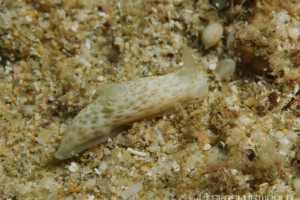
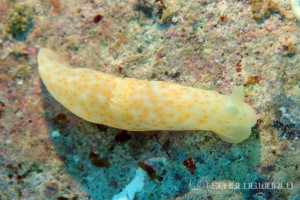
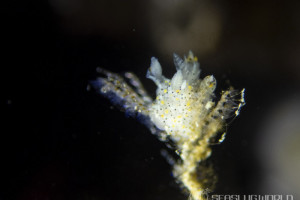
Photos of Gymnodoris bernardae



Same Genus Nudibranchs

Similar Colors Nudibranchs
Academic Database
Sea slug observation data is available in international marine biodiversity databases.