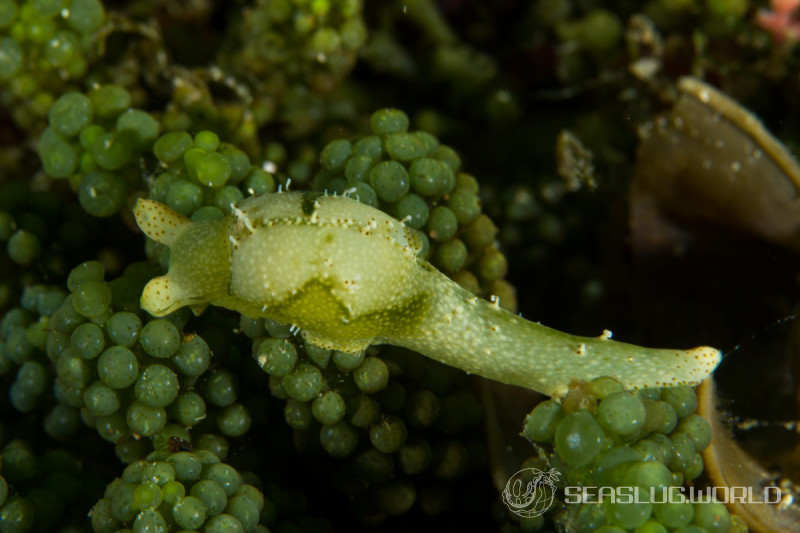
Oxynoe kabirensis Hamatani, 1980
- Location
- Sokodo(Sanmata), Hachijo Island, Tokyo, Japan
- Date
- 2016/07/12
- Length
- 20mm
- Depth
- 4.0m
- Water temperature
- 21.0℃
Description
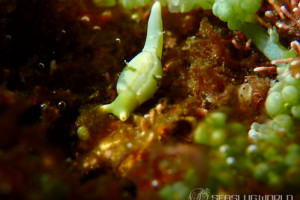
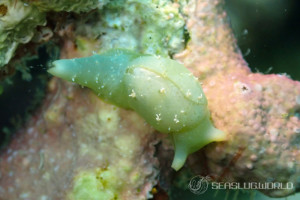
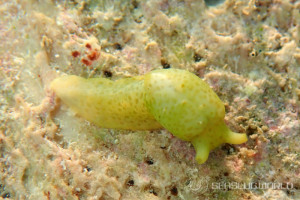
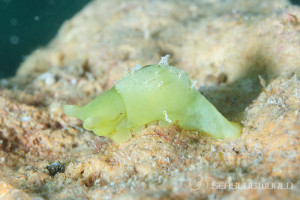
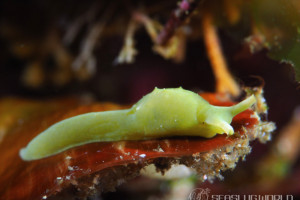
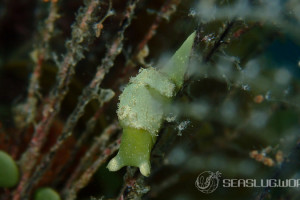
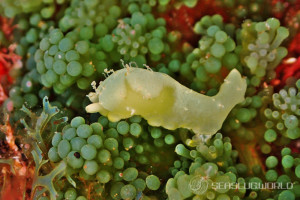
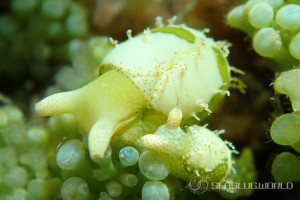
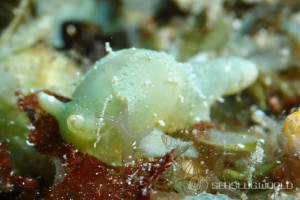
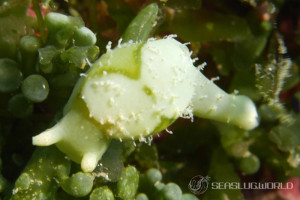
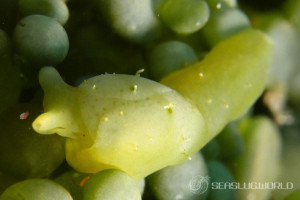
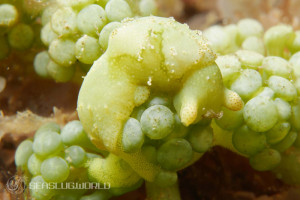
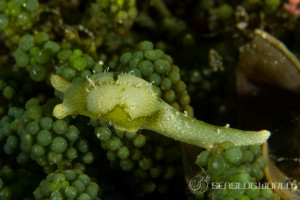
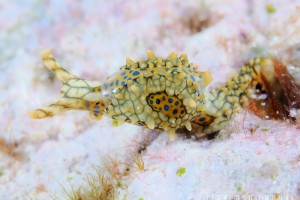
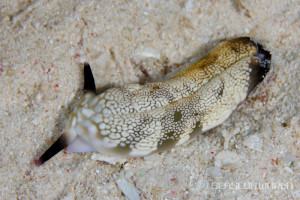
A sap-sucking sacoglossan of the family Oxynoidae. Living animals are limaciform and superficially resemble Oxynoe viridis; the body is 20-30 mm long when extended (holotype 25 mm), with a slightly smaller head and a very long, somewhat flattened tail whose margins undulate and whose dorsal midline lacks a longitudinal crest. Several to about a dozen delicate, usually bifid or trifid papillae are scattered over the dorsal surface of the body, but only rarely on the tail. The shell siphon is usually displaced slightly to the right of the body midline.Ground colour varies from greenish yellow through pale green and dull yellow green to pale yellow. A large triangular area, deep green in the holotype and paratypes 1 and 4 and light green in paratypes 2, 3 and 5, lies on the outside of the parapodium with its base along the parapodial base and its apex near the middle of the parapodial free margin. Small light brownish spots are scattered over the dorsal surface, except on the head, the greenish parapodial triangle and the basal half of the rhinophores; the papillae bear a few small chocolate-brown spots. The shell is calcified but thin and fragile, milky white and glossy, similar in shape and size to that of O. viridis, but readily separable by the sutural panel: its free margin extends out from the sunken apex within the hollow collared by the outer lip in a gentle arc, without the recurvature seen in O. viridis.
Distribution
Type locality: Kabira Bay, Ishigaki-jima Island, Yaeyama Islands, Okinawa, Japan (27°27.5′N, 124°08.6′E). The original type series comprises four specimens from Kabira Bay and adjacent Kuro-shima Island (Yaeyama Islands, March-May 1977) and one specimen from Bansho-zaki near the Seto Marine Biological Laboratory, Wakayama Prefecture, central Japan (collected by K. Kitao, 30 July 1979), demonstrating a continuous range from the Yaeyama Islands to the central Pacific coast of Honshu.Etymology
The specific epithet kabirensis is a toponymic adjective referring to the type locality, Kabira Bay (川平湾) on Ishigaki-jima Island, Okinawa Prefecture, Japan.Notes
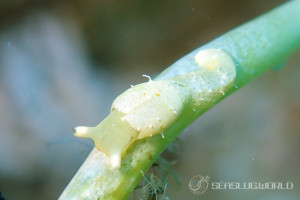
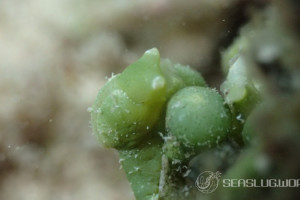
Like its congeners, Oxynoe kabirensis is tightly associated with the green alga Caulerpa racemosa, on which it feeds. The Yaeyama specimens were collected from colonies of C. racemosa var. clarifera f. macrophysa growing at the low water level on projecting reefs, while the Wakayama specimen was obtained from C. racemosa var. occidentalis at 1.5 m depth. As in other species of the genus, the tail is readily autotomised and a regenerated tail develops from the remaining basal portion. Hamatani 1980 distinguishes this species from O. viridis by features of the soft body and papillae, the shell sutural panel, and internal anatomy.References
A Kindle field guide by the site author
Kimoto N. (2026). Sea Slugs of Japan & the Indo-Pacific, 2nd Edition.
Kindle Edition
View on Amazon PR (Amazon Associates)Seasonality
Shooting Locations
Loading shooting locations...
Photos of Oxynoe kabirensis
Tag:








Same Genus Nudibranchs
Similar Colors Nudibranchs


Academic Database
Sea slug observation data is available in international marine biodiversity databases.