Oxynoe viridis (Pease, 1861)
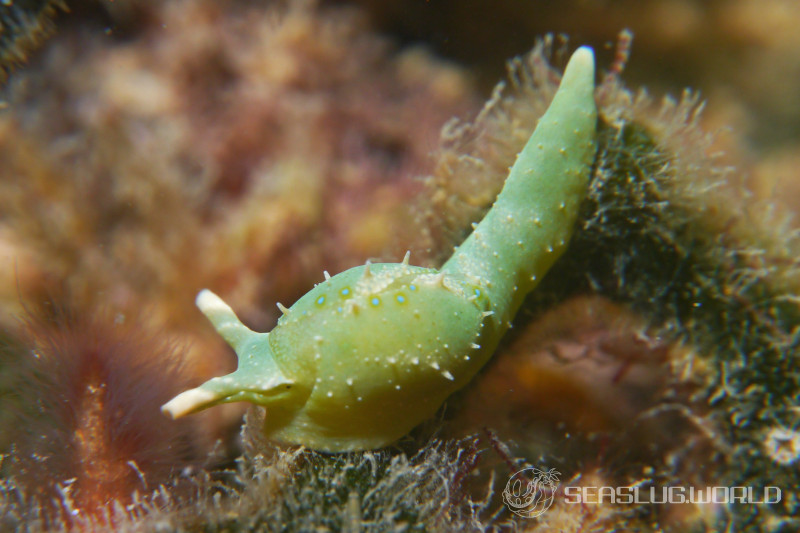
- Location
- Red Beach, Okinawa Island (East coast), Okinawa, Japan
- Date
- 2013/04/06
- Length
- 25mm
- Depth
- 5.0m
- Water temperature
- 22.0℃
Description
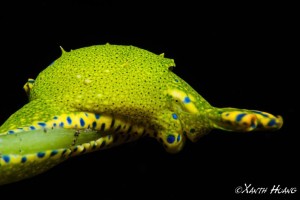
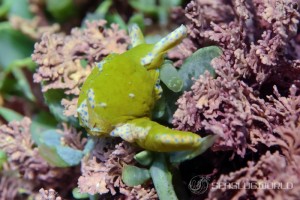
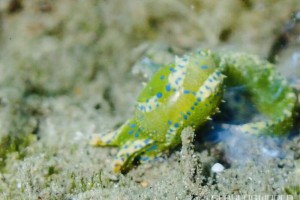
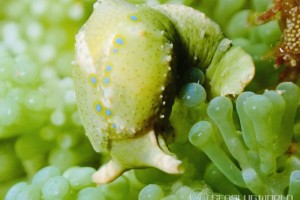
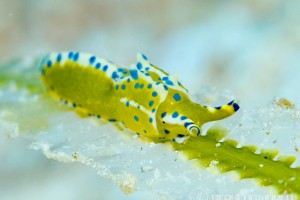
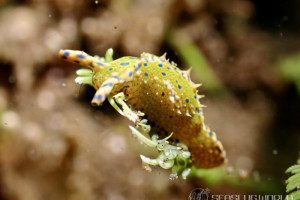
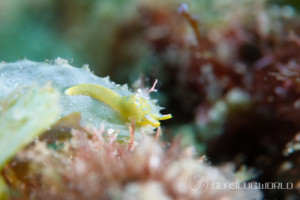
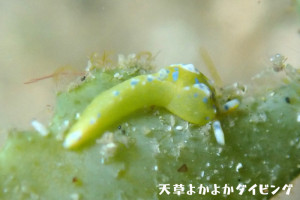
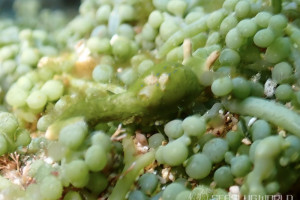
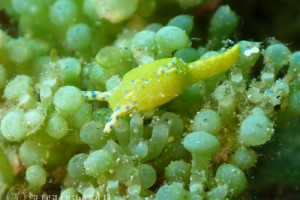
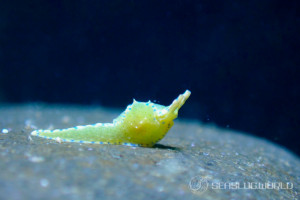
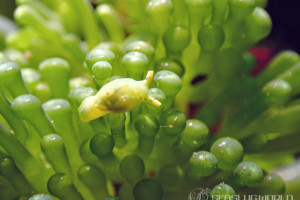
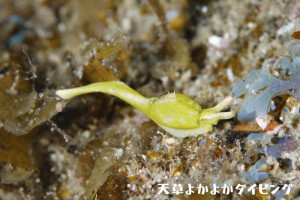
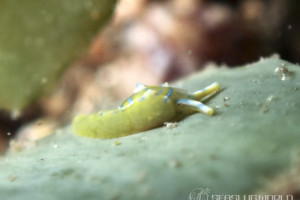
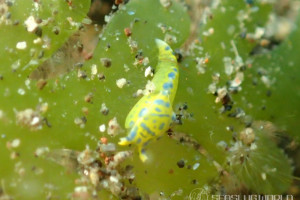
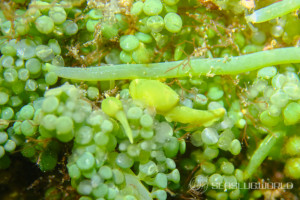
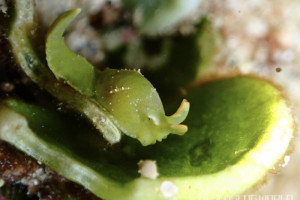
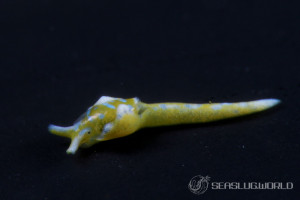
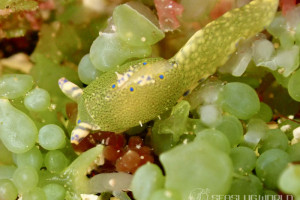
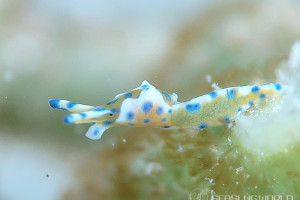
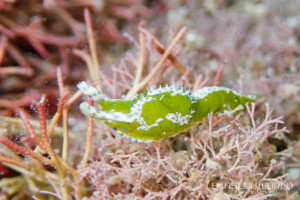
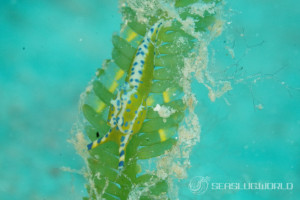
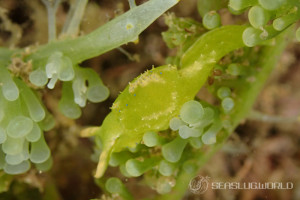
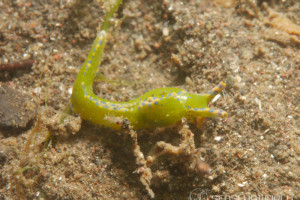
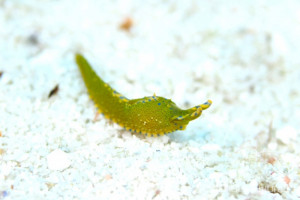
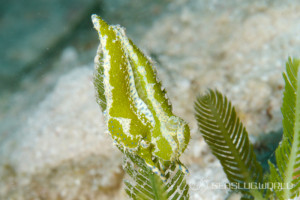
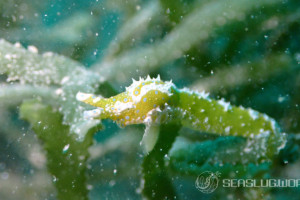
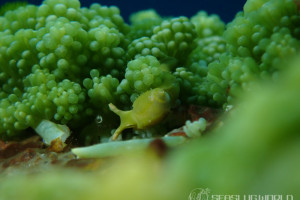
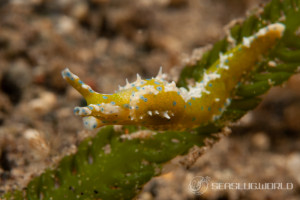
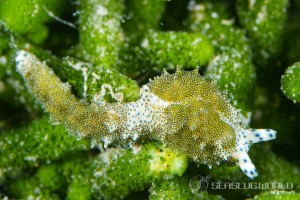
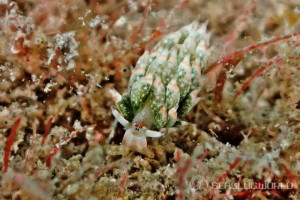
A small sacoglossan reaching about 20 mm in body length. The body is oval or ovate, with the dorsal region elevated. The tentacles are well developed, grooved and truncated. The eyes are immersed immediately behind the tentacles. The lateral lobes are regular in shape, with the outline of the edges convex and not meeting. The foot is linear, adapted for clasping sea-weed, and the whole upper surface is garnished with more or less numerous cirrigerous appendages. In life the ground colour is grass-green, mottled with darker. Some individuals are minutely dotted with brown, and a few blue dots margined with black rings appear along the edge of the lateral lobes and on the neck. The shell is thin, fragile, white, ovate, obliquely striated, convolute; the outer lip is separate from the apex, overlapping the inner posteriorly and produced into a tubular form. Pease's type was found among sea-weed on a sandy bottom in the Pacific Islands. When handled the animal discharges a white viscid fluid.Distribution
Indo-Pacific to the central Pacific. Type locality: Society Islands, on sea-weed beds, based on a specimen collected by Andrew Garrett and described by Pease. Subsequently recorded from the Hawaiian Islands, southern Japan, Taiwan, the Philippines, Indonesia, Guam, the Red Sea and elsewhere.Etymology
The specific epithet viridis is the Latin adjective meaning "green", in reference to the grass-green ground colour.Remarks
Originally placed by Pease in Lophocercus. The genus Lophocercus was later synonymised with Oxynoe Rafinesque, 1814; the parentheses in the author citation reflect this generic transfer. The Japanese name "ナギサノツユ" ("seashore dewdrop") refers to the small green body resembling a dewdrop on sea-weed. The "white viscid fluid" mentioned by Pease is a known defensive secretion of the species.References
- Lophocercus viridis Pease n. sp., Pease W.H. (1861). Descriptions of new species of Mollusca from the Pacific Islands. Proceedings of the Zoological Society of London. 1861: 242-247.
- ナギサノツユ Oxynoe viridis (Pease), 波部忠重. (1949). ナギサノツユ屬 Oxynoe 日本貝類群に加はる. ヴヰナス. 15(5-8): 79-80.
- ナギサノツユ Oxynoe viridis (Pease), 馬場菊太郎. (1949). ナギサノツユ Oxynoe viridis (Pease) 相模湾に産す. ヴヰナス. 15(5-8): 77-78.
- ナギサノツユ, 生物學御研究所編. (1955). 相模湾産後鰓類図譜〈補遺〉. 岩波書店.
- Oxynoe viridis (compared), Jensen K.R. (1980). Oxynoe azuropunctata, n. sp., a new sacoglossan from the Florida Keys (Mollusca: Opisthobranchia). Journal of Molluscan Studies. 46(3): 282-292.
- Nagisano-tsuyu, Hamatani I. (1980). ON THE SPECIES OF THE GENUS OXYNOE RAFINESQUE, 1819 FROM JAPAN, INCLUSIVE OF A NEW SPECIES (OPISTHOBRANCHIA : ASCOGLOSSA). Publications of the Seto Marine Biological Laboratory. 25(5-6): 349-360. https://doi.org/10.5134/176004
- ナギサノツユ, 小野篤司. (1999). ウミウシガイドブック. TBSブリタニカ.
- 高岡生物研究会. (2002). 日本海のウミウシ. 第2版.
- ナギサノツユ, 殿塚孝昌. (2003). ウミウシガイドブック〈3〉. TBSブリタニカ.
- ナギサノツユ, 小野篤司. (2004). 沖縄のウミウシ. ラトルズ.
- ナギサノツユ, 中野理枝. (2004). 本州のウミウシ. ラトルズ.
- ナギサノツユ, 小野篤司 & 加藤昌一. (2009). ウミウシ. 誠文堂新光社.
- Oxynoe viridis, Terrence Gosliner, Ángel Valdés and David Behrens. (2015). Nudibranch and Sea Slug Identification Indo-Pacific. New World Pubns Inc.
- Krug P.J., Berriman J.S. & Valdés Á. (2018). Phylogenetic systematics of the shelled sea slug genus Oxynoe Rafinesque, 1814 (Heterobranchia : Sacoglossa), with integrative descriptions of seven new species. Invertebrate Systematics. 32(4): 950-1003. https://doi.org/10.1071/is17080
- ナギサノツユ, 中野理枝. (2018). 日本のウミウシ. 文一総合出版.
Featured in this book
Terrence Gosliner, Ángel Valdés and David Behrens. (2018). Nudibranch and Sea Slug Identification Indo-Pacific 2nd Edition. New World Pubns Inc.
New World Publications
This species, Oxynoe viridis, is included in the book.
View on Amazon PR (Amazon Associates)Seasonality
Shooting Locations
Loading shooting locations...
Photos of Oxynoe viridis
Tag:





















Same Genus Nudibranchs
Similar Colors Nudibranchs

Academic Database
Sea slug observation data is available in international marine biodiversity databases.