Platydoris cruenta (Quoy & Gaimard, 1832)
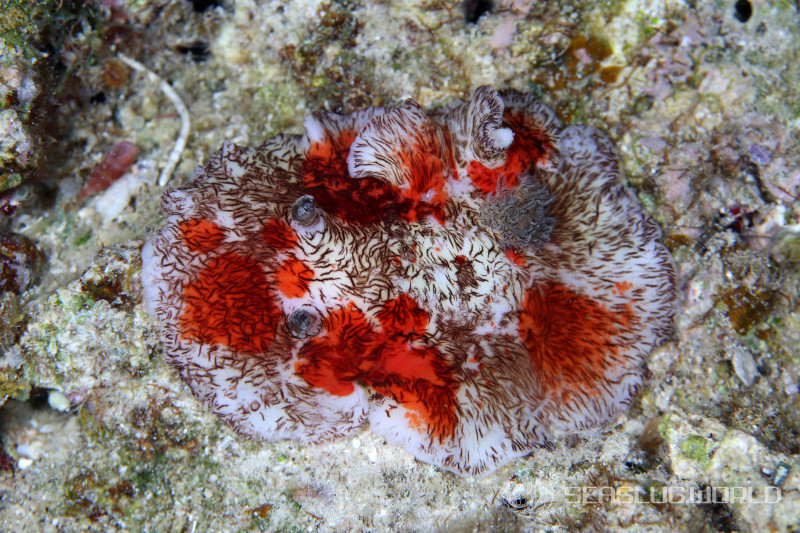
- Location
- Cape Maeda, Okinawa Island (Onna and Yomitan area), Okinawa, Japan
- Date
- 2015/06/28
- Length
- 100mm
- Depth
- 3.0m
- Water temperature
- 29.0℃
Description
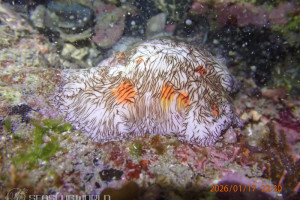
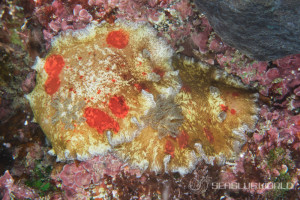
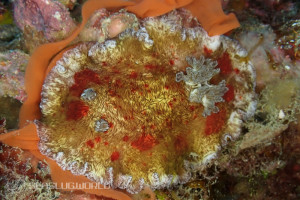
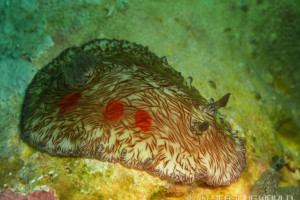
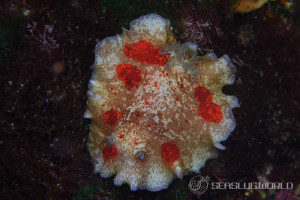
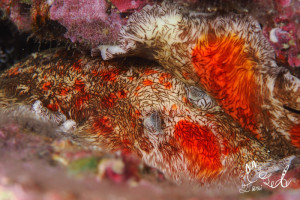
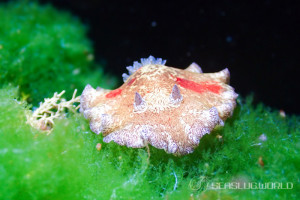
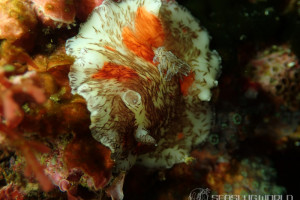
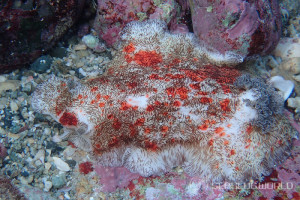
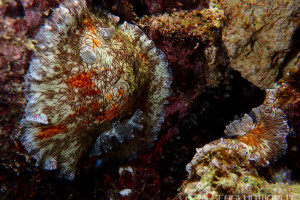
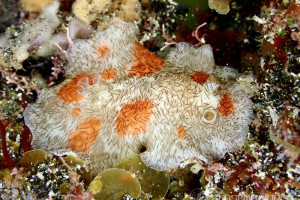
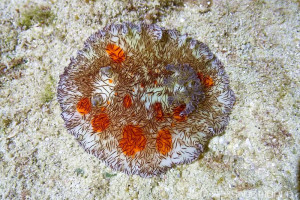
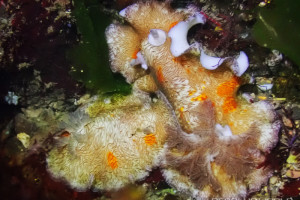
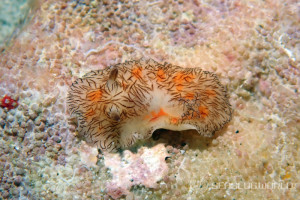
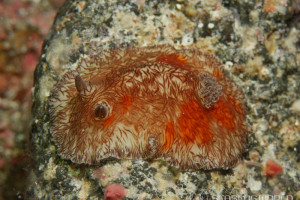
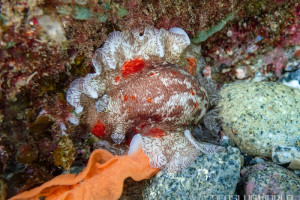
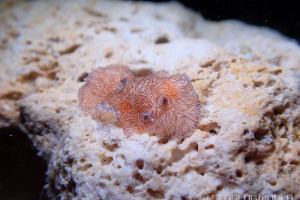
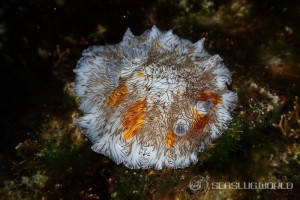
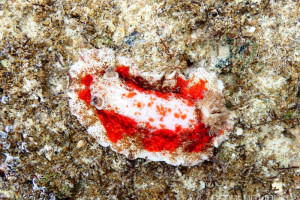
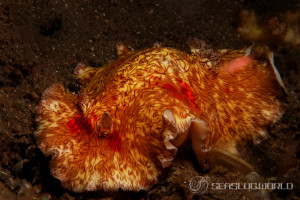
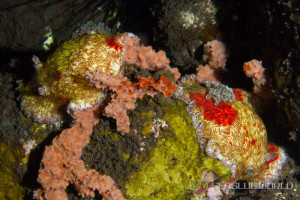
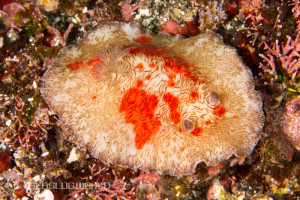
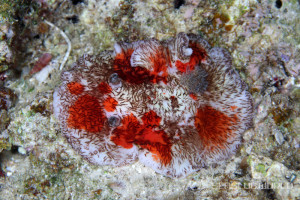
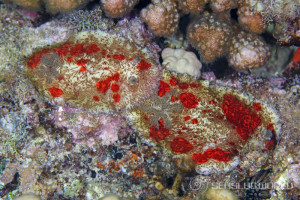
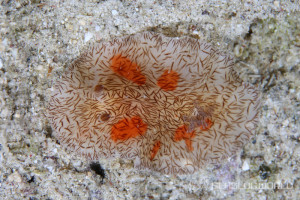
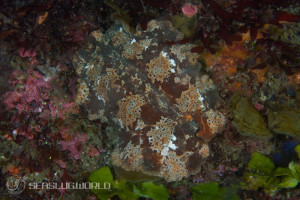
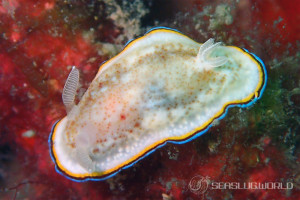
The body is flat and broadly oval, reaching up to 100 mm in length. The dorsum is densely covered with small caryophyllidia, and the background colour is white to cream. Numerous short, thin, wavy brown lines run across the dorsum, forming the distinctive pattern of this species. Some specimens also bear large red blotches on the dorsum and ventral surface, particularly around the foot. The perfoliate rhinophores carry approximately 37 lamellae, and the branchial leaves and rhinophores match or are slightly darker than the dorsum, with irregular dark lines along the rachises.Distribution
Widely distributed throughout the tropical Indo-Pacific. Originally recorded from New Guinea, with subsequent records spanning South Africa, Sri Lanka, Indonesia, Australia (Western Australia to New South Wales), Papua New Guinea, Fiji, the Marshall Islands, New Caledonia, Vietnam, the Philippines, and Japan.Etymology
The specific epithet cruenta is Latin for "bloody" or "stained with blood", referring to the red blotches present on the dorsum of the original specimens.Remarks
The Japanese vernacular name "yuzen umiushi" likens the dense wavy brown lines on the dorsum to the patterns of yuzen, a traditional Japanese silk-dyeing technique. Doris striata Kelaart, 1858 and Platydoris arrogans Bergh, 1877 are regarded as synonyms. The species is nocturnal and shelters in rock crevices during the day.References
- ユウゼンウミウシ(新稱), 馬場菊太郎 & 濱谷巌. (1952). 紀州産後鰓類目録. 南紀生物. Supplement 1: 1-11.
- ユウゼンウミウシ, 奥谷喬司. (2000). 日本近海産貝類図鑑. 東海大学出版会.
- Dorgan K.M., Valdés Á. & Gosliner T.M. (2002). Phylogenetic systematics of the genus Platydoris (Mollusca, Nudibranchia, Doridoidea) with descriptions of six new species. Zoologica Scripta. 31(3): 271-319. https://doi.org/10.1046/j.1463-6409.2002.00105.x
- ユウゼンウミウシ, 小野篤司. (2004). 沖縄のウミウシ. ラトルズ.
- ユウゼンウミウシ, 中野理枝. (2004). 本州のウミウシ. ラトルズ.
- ユウゼンウミウシ, 中野理枝. (2018). 日本のウミウシ. 文一総合出版.
- Platydoris cruenta, Terrence Gosliner, Ángel Valdés and David Behrens. (2018). Nudibranch and Sea Slug Identification Indo-Pacific 2nd Edition. New World Pubns Inc.
Featured in this book
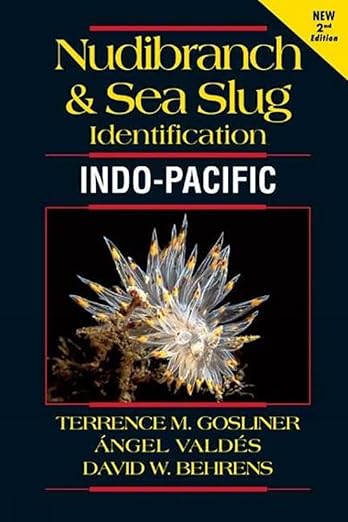
Terrence Gosliner, Ángel Valdés and David Behrens. (2018). Nudibranch and Sea Slug Identification Indo-Pacific 2nd Edition. New World Pubns Inc.
New World Publications
This species, Platydoris cruenta, is included in the book.
View on Amazon PR (Amazon Associates)Seasonality
Shooting Locations
Loading shooting locations...
Photos of Platydoris cruenta
Tag:





















Same Genus Nudibranchs
Similar Colors Nudibranchs
Academic Database
Sea slug observation data is available in international marine biodiversity databases.