Platydoris formosa (Alder & Hancock, 1864)
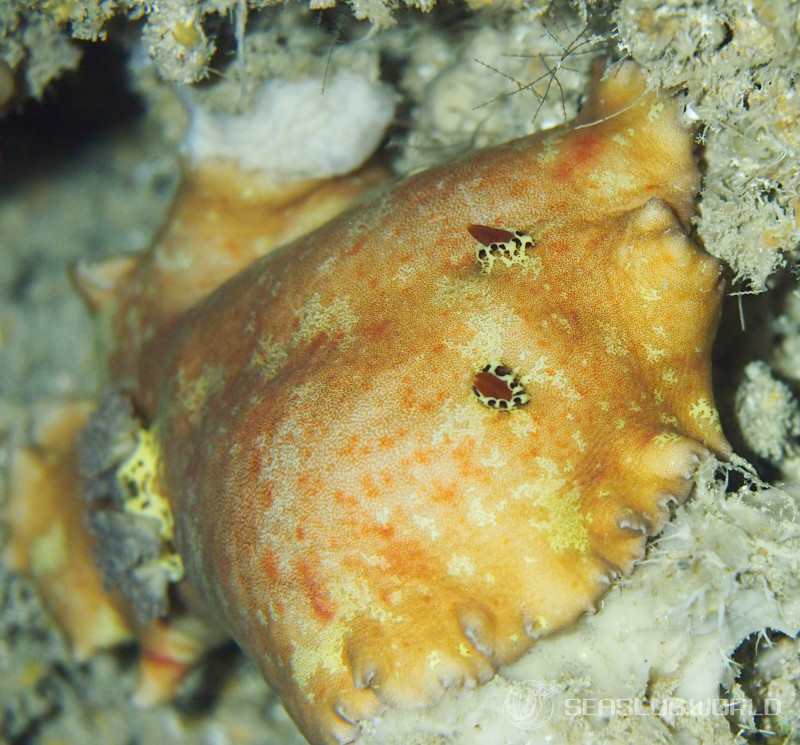
- Location
- Cows are scary, Miyakojima, Okinawa, Japan
- Date
- 2013/09/04
- Length
- 250mm
- Depth
- 16.0m
- Water temperature
- 29.0℃
Description
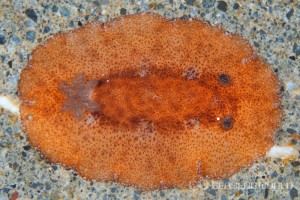
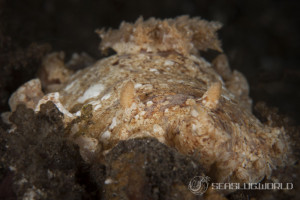
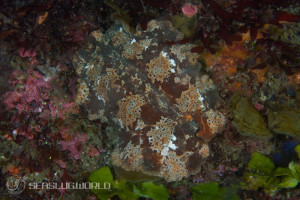
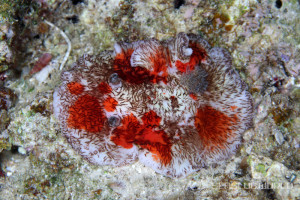
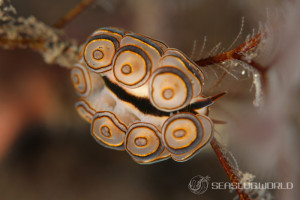
A large dorid reaching 3.4 inches (ca. 8.6 cm) in body length. The body is oval and much depressed. The mantle is coriaceous, very ample and with the edges deeply sinuated; yellowish-olive-coloured, beautifully marbled and blotched with scarlet, and minutely freckled with dark brown. The under side is white, with large scarlet-orange spots and blotches, with a minute dark freckling near the foot, and pale minute transverse lines, indicating probably the presence of muscles. The dorsal tentacles are clavate, yellowish; the margins of the orifices a little raised and whitish, spotted with brown. The oral tentacles are linear, rather stout, with the dorsal surface grooved, giving them a folded or ear-like appearance, freckled with brown. The branchial plumes are six, tripinnate; the margin of the cavity produced into six lobes or leaf-like processes, which fold down over the branchiae when retracted; they are white, with conspicuous brown spots. The foot is rather narrow, dilated in front, where it is laminated and deeply notched, and rounded posteriorly; it is white, with minute brown freckles over the surface. The radula is similar to that of Doris tuberculata Cuvier, with very numerous, smooth, stout, strongly hooked lateral teeth, diminishing in size towards the centre, and without a central tooth. Alder & Hancock regarded this species as the type of a group of Indo-Pacific dorids with an ample coriaceous mantle and six branchial plumes retractile within a six-lobed cavity, the latter character used by Ehrenberg to erect the genus Actinocyclus (though the present authors maintained the species in Doris). Some individuals have the markings much fainter, with the spots on the under side yellow.Distribution
Type locality: Waltair, near Vizagapatam, Coromandel coast, Madras Presidency, India (now Visakhapatnam, Andhra Pradesh). Based on specimens collected by Walter Elliot in 1853–1854.Etymology
The specific epithet formosa is Latin for "beautiful, well-formed, handsome", in reference to the species' striking marbled scarlet colouration on the mantle.Remarks
In the original description Alder & Hancock placed the species in Doris. The species was later transferred to Platydoris Bergh, 1877 (the parentheses in the author citation reflect this generic transfer). In Japan the species has been illustrated under the Japanese name "ホンカワウミウシ", but this name has been applied in confusion with Platydoris cinerobranchiata Dorgan, Valdés & Gosliner, 2002 — the two can be distinguished by the colour of the rhinophores (yellowish-white in P. formosa, dull grey in P. cinerobranchiata).References
- Doris Formosa n. sp., Alder J. & Hancock A. (1864). Notice of a collection of nudibranchiate Mollusca made in India by Walter Elliot Esq., with descriptions of several new genera and species. Transactions of the Zoological Society of London. 5(3): 113-147.
- プラチドリス・フォルモサ, 殿塚孝昌. (2003). ウミウシガイドブック〈3〉. TBSブリタニカ.
- ホンカワウミウシ(左下), 小野篤司. (2004). 沖縄のウミウシ. ラトルズ.
- ホンカワウミウシ, 中野理枝. (2018). 日本のウミウシ. 文一総合出版.
- Platydoris formosa, Terrence Gosliner, Ángel Valdés and David Behrens. (2018). Nudibranch and Sea Slug Identification Indo-Pacific 2nd Edition. New World Pubns Inc.
Featured in this book
Terrence Gosliner, Ángel Valdés and David Behrens. (2018). Nudibranch and Sea Slug Identification Indo-Pacific 2nd Edition. New World Pubns Inc.
New World Publications
This species, Platydoris formosa, is included in the book.
View on Amazon PR (Amazon Associates)Seasonality
Shooting Locations
Loading shooting locations...
Photos of Platydoris formosa

Same Genus Nudibranchs
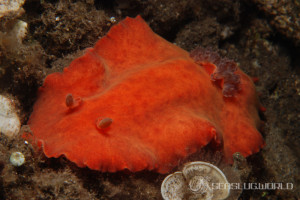
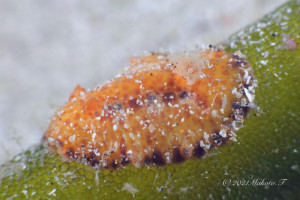
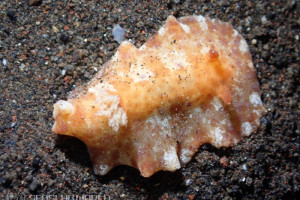
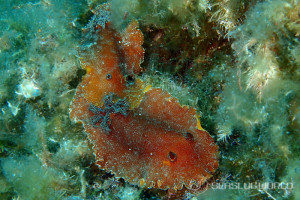
Similar Colors Nudibranchs
Academic Database
Sea slug observation data is available in international marine biodiversity databases.