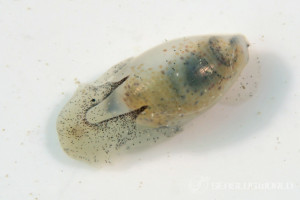
Pleurobranchaea brockii Bergh, 1897
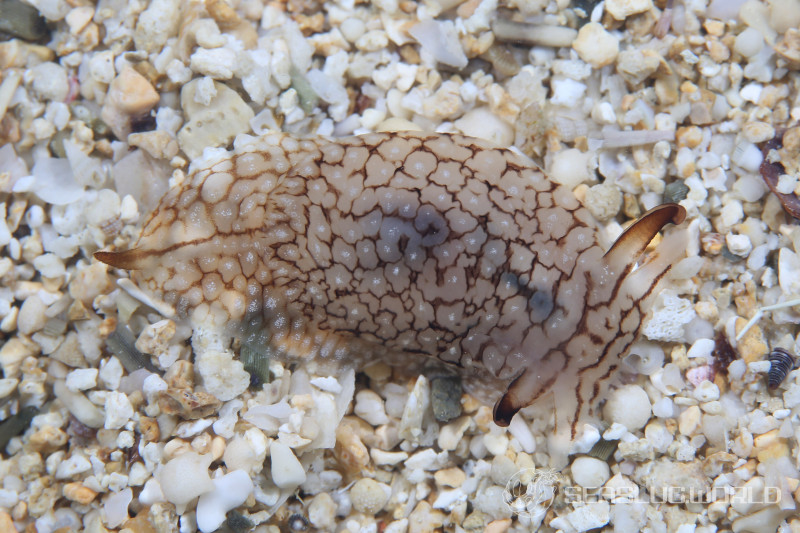
- Location
- Umisaboten, Okinawa Island (Oura Bay), Okinawa, Japan
- Date
- 2015/04/19
- Length
- 25mm
- Depth
- 10.0m
- Water temperature
- 22.0℃
Description
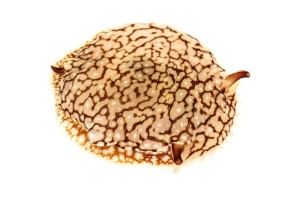
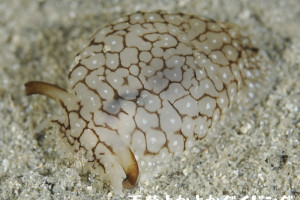
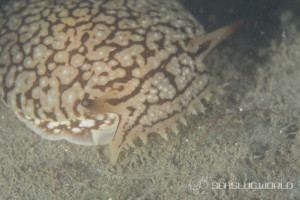
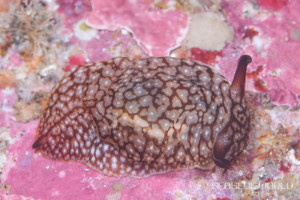
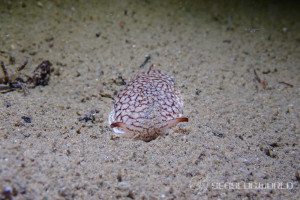
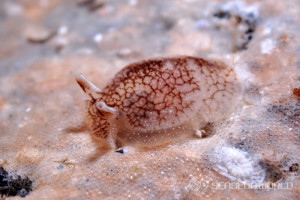
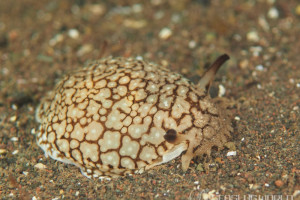
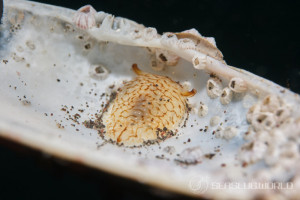
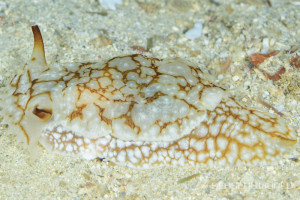
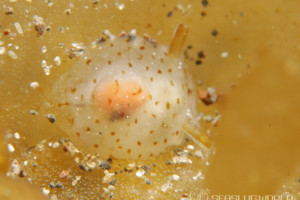
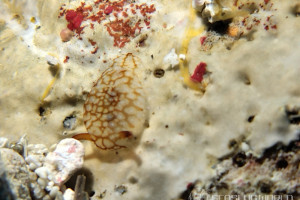
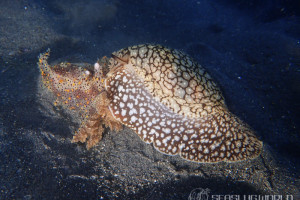
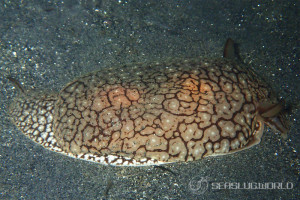
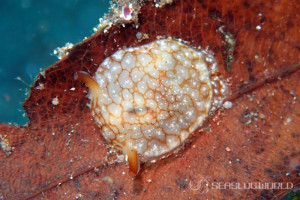
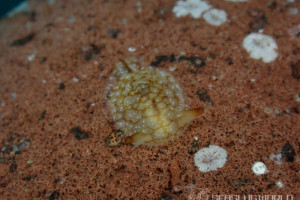
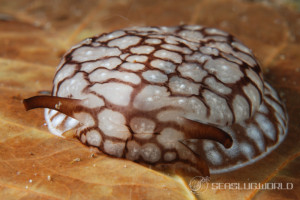
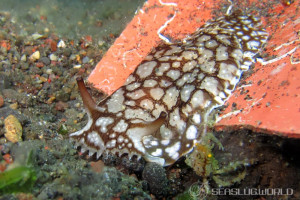
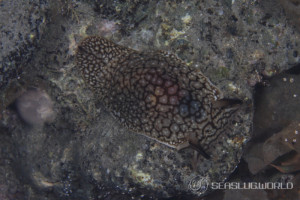
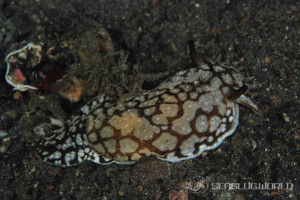
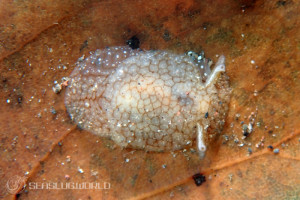
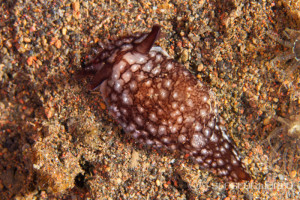
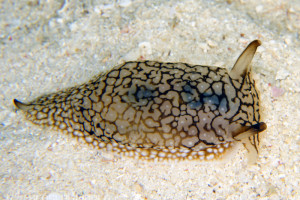
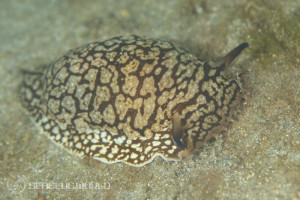
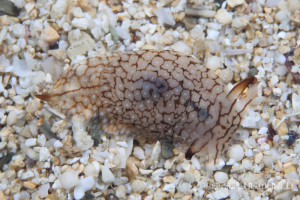
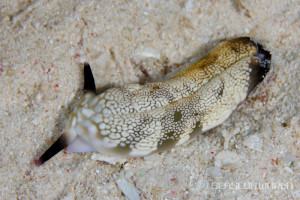
A large pleurobranchid sea slug, reaching over 100 mm in body length. The dorsal surface of the mantle, foot and oral veil bears a fine reticulate sculpture, dark brown markings on a yellowish-grey ground. The outer margin of the foot, the anterior edge of the oral veil and the tips of the rhinophores are creamy white. The foot sole is dark brownish purple with a velvety appearance.The large oral veil is trapezoidal and lined with 17 to 22 small papillae along its anterior edge. The rhinophores arise widely separated from each other between the mantle and the oral veil, each with a longitudinal slit on its outer side. The gill is suspended on the right body wall by a short membrane and bears 37 to 39 pinnae on each side.
The most reliable external character separating this species from congeners is a fleshy, blunt-tipped, conical caudal spur on the dorsal posterior end of the foot — also the basis of the Japanese vernacular name "tsuno-umifukurou" (horned umifukurou). The radula lacks a rachidian tooth and consists of sword-like lateral teeth only.
Distribution
Widely distributed in the Indo-West Pacific. The type locality is Ambon Island, Indonesia (Bergh, 1897). Records include the eastern coast of South Africa, the East and South China Seas, Hainan and the Paracel Islands, Hong Kong, the Banda Sea, and the Pacific coast of Japan (Tosa Bay, Suruga Bay).Etymology
The specific epithet brockii is the Latin genitive form of the surname "Brock", honouring Mr. Brock. Bergh first mentioned the species under the name Pleurobranchillus brockii in 1892 (a nomen nudum); the formal description appeared in the 1897 Pleurobranchidae monograph in Semper's "Reisen im Archipel der Philippinen".Remarks
A benthic carnivore-scavenger of soft sandy and muddy substrates from shallow water down to several tens of metres. The gut contents of the Tosa Bay specimen examined by a 1992 study included an intact cephalaspidean (Philine sp.), a small teuthoid squid, and numerous fish scales, indicating predation on molluscs and other soft-bodied prey.Japanese records had long been treated as Pleurobranchaea sp. (Baba, 1949, 1969). A 1992 study redescribed two specimens from Tosa Bay and Suruga Bay and concluded that they are conspecific with Bergh's P. brockii, on the basis of the caudal spur, the row of papillae along the front of the oral veil, and the genital morphology. The other Japanese congener Pleurobranchaea japonica lacks a caudal spur and possesses a small rachidian tooth, distinguishing it both externally and anatomically.
References
A Kindle field guide by the site author
Kimoto N. (2026). Sea Slugs of Japan & the Indo-Pacific, 2nd Edition.
Kindle Edition
View on Amazon PR (Amazon Associates)Seasonality
Shooting Locations
Loading shooting locations...
Photos of Pleurobranchaea brockii
Tag:
























Same Genus Nudibranchs

Similar Colors Nudibranchs
Academic Database
Sea slug observation data is available in international marine biodiversity databases.