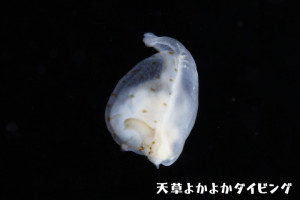
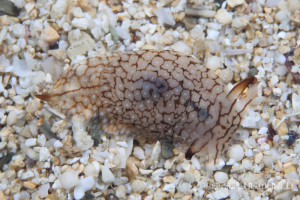
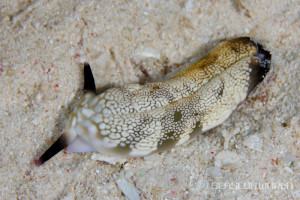
Pleurobranchaea japonica Thiele, 1925
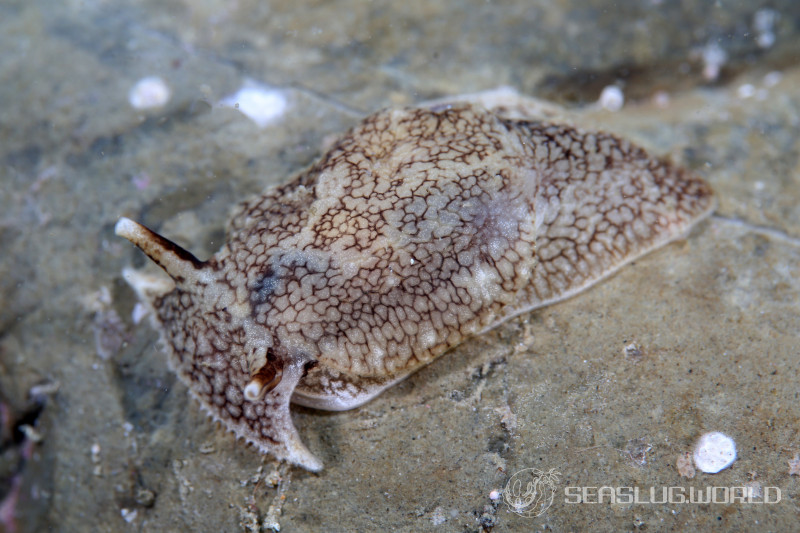
- Location
- Gontarou Rock, Hayama, Kanagawa, Japan
- Date
- 2014/06/10
- Length
- 15mm
- Depth
- 10.0m
- Water temperature
- 21.0℃
Description
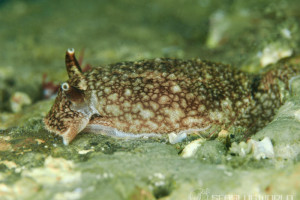
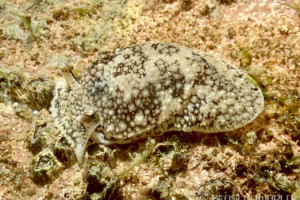
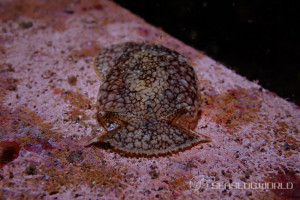
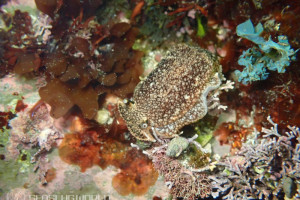
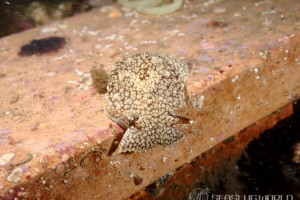
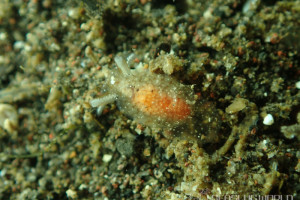
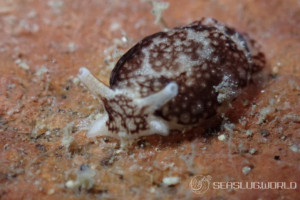
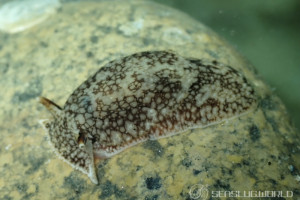
Adult body length exceeds 100 mm; examined specimens range from 12 to 70 mm. The shell is absent.The mantle is oval and slightly narrower than the foot. Its anterior border is continuous with the oral veil, and its posterior border is fused with the dorsal surface of the foot, while both lateral margins are free.
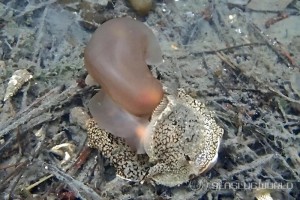
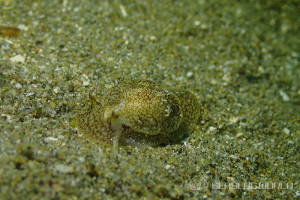
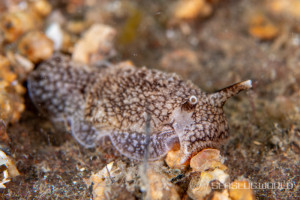
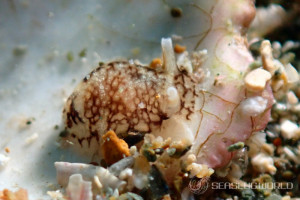
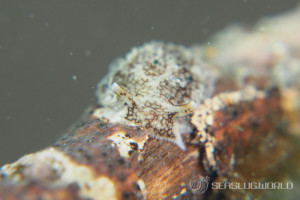
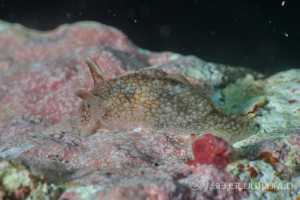
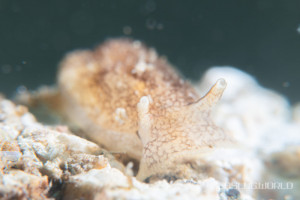
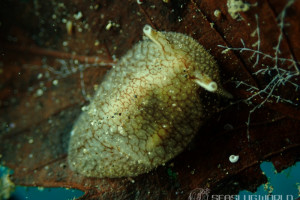
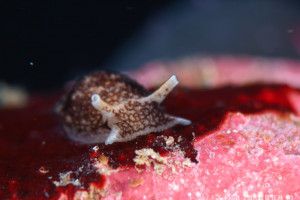
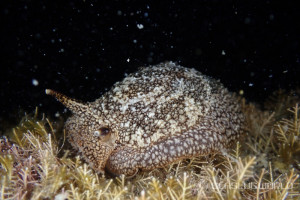
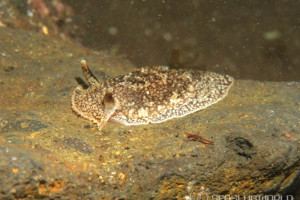
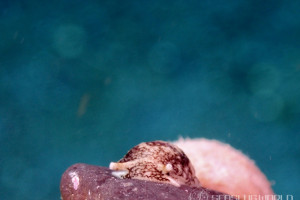
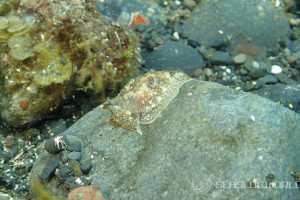
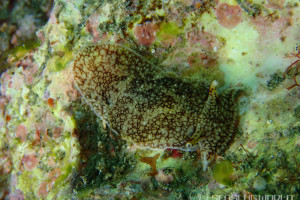
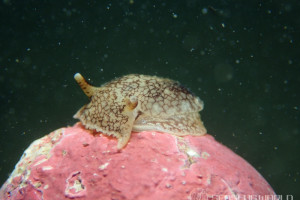
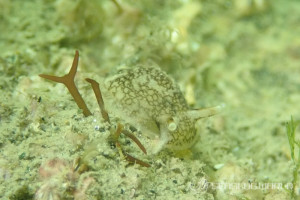
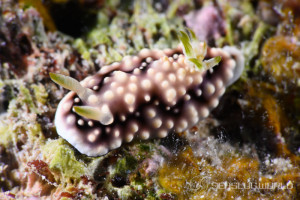
The dorsal ground color is yellowish gray. The mantle, foot, and oral veil are reticulated with minute wrinkles and overlaid with a dark brown network. The outer margin of the foot, the anterior edge of the oral veil, and the tips of the rhinophores are creamy white. The foot sole is dark brownish purple with a velvety appearance.
The large oral veil is trapezoidal, extending beyond the antero-lateral corners of the foot when crawling. Its lateral margins are rolled, and small pustules line the dorsal and ventral surfaces of the anterior edge.
The rhinophores are rolled, with a slit along the outer lateral side; they thicken proximally with transverse wrinkles and are widely separated, inserted between the mantle and the oral veil.
The gill is attached to the right body wall under the mantle by a short suspensory membrane and bears 24 to 32 pinnae on each upper and lower side.
A voracious generalist predator, feeding on crustaceans, other sea slugs, and carrion such as dead fish.
Distribution
Type locality: Kôbe, Japan (Thiele, 1925). Recorded along the coasts of Honshu, Shikoku, and Kyushu, from the Seto Inland Sea and Izu Peninsula through Tokyo Bay to off Kinkazan in Miyagi Prefecture, as well as from the Yellow Sea (Tsingtao / Qingdao). It inhabits muddy and sandy flats in calm coastal waters, ranging from the intertidal zone down to about 400 m depth.Etymology
The specific epithet japonica is Latin for "of Japan", referring to the type locality of Kôbe.Remarks
The Japanese vernacular name "Umifukuro" alludes to the rounded, bag-like body.Japanese specimens were long recorded under the name Pleurobranchaea novaezealandiae Cheeseman, 1878, but a 1992 study re-established P. japonica as a valid species on the basis of differences in the position and shape of the female genital aperture, foot-sole color, larval shell morphology, and pelagic period. P. novaezealandiae is now treated as a synonym of Pleurobranchaea maculata.
Externally and internally, P. japonica resembles Pleurobranchaea maculata, but is distinguished by a female genital opening that is independent of the male opening and atrium and protrudes as a short tube, by a blunt, balloon-shaped penis at the tip of a long male atrium, and by a dark brownish-purple foot sole. The other Japanese congener, Pleurobranchaea brockii, is readily separated by a fleshy caudal spur on the posterior end of the foot.
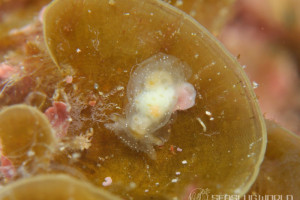
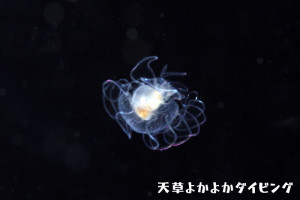
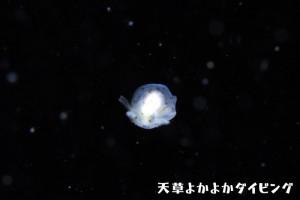
The larva is planktotrophic and requires at least 15 days from hatching to settlement (Tsubokawa & Okutani, 1991).
References
- ウミフクロウ, Pleurobranchaea novaezealandiae, Baba K. (1949). Opisthobranchia of Sagami Bay collected by His Majesty the Emperor of Japan (相模湾産後鰓類図譜). Iwanami Shoten, Tokyo. 4+2+194+7 pp., pls. 1-50.
- Pleurobranchaea novaezealandiae Cheeseman Umifukuro, Baba, K. 1957. A revised list of the species of Opisthobranchia from the northern part of Japan, with some additional descriptions. J. Fac. Sci., Hokkaido Univ.,ser. 6, Zool. 13(1-4):8-14.
- Pleurobranchaea japonica Thiele, 1925, 坪川涼子, Willan R.C. & 奥谷喬司. (1992). 日本産Pleurobranchaea属2種の分類について. 貝類学雑誌. 50(4): 249-263. https://doi.org/10.18941/venusjjm.50.4_249
- ウミフクロウ, 鈴木敬宇. (2000). ウミウシガイドブック〈2〉. TBSブリタニカ.
- 高岡生物研究会. (2002). 日本海のウミウシ. 第2版.
- ウミフクロウ, 中野理枝. (2004). 本州のウミウシ. ラトルズ.
- ウミフクロウ, 中野理枝. (2019). 日本のウミウシ. 第二版. 文一総合出版.
Featured in this book
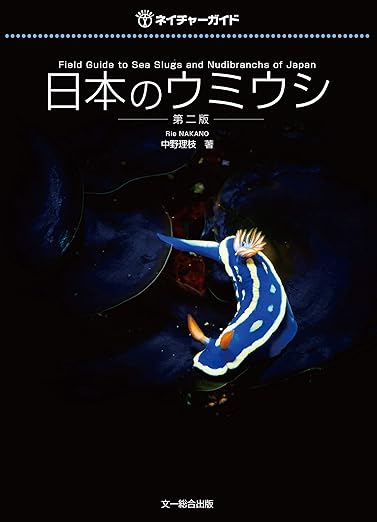
中野理枝. (2019). 日本のウミウシ. 第二版. 文一総合出版.
文一総合出版
This species, Pleurobranchaea japonica, is included in the book.
View on Amazon PR (Amazon Associates)Seasonality
Shooting Locations
Loading shooting locations...
Photos of Pleurobranchaea japonica
Tag:






















Same Genus Nudibranchs
Similar Colors Nudibranchs
Academic Database
Sea slug observation data is available in international marine biodiversity databases.