Rostanga lutescens (Bergh, 1905)
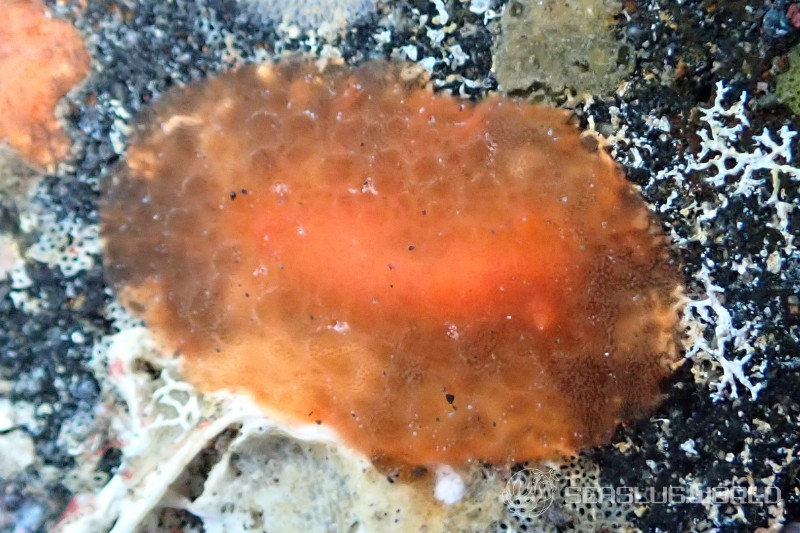
- Location
- MINA point, Tulamben, Pulau Bali, Indonesia
- Date
- 2025/12/01
- Length
- 20mm
- Depth
- 5.0m
- Water temperature
- 29.0℃
Description
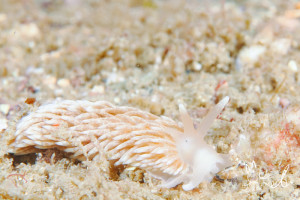
From the original description (Bergh 1905, p.107), the preserved type specimen measures 14 mm in length, 7 mm in width and 3 mm in height; mantle border 2 mm wide, foot 12 mm long and 2 mm wide, tail 3 mm long. Bergh writes:Die Farbe war durchgehends gelblich, das Rückengebräm zeigte zahlreiche schwärzliche Punkte. Die Eingeweide schimmerten dunkelgrau durch.— the colour is yellowish throughout, the mantle border bears numerous fine blackish dots, and the viscera show through the dorsum as dark grey.
The body is elongate-oval with a broad mantle border; the anterior end is slightly narrower than the posterior. The dorsum is flat. The small gill consists of about six apparently tripinnate leaves about 1.5 mm high. The rhinophores are small and knobby-conical. The narrow foot has a rounded anterior margin with a marginal furrow; the tail is not particularly short and projects beyond the mantle margin posteriorly. Bergh's wording: "Die Form war länglich-oval, mit breitem Rückengebräm, das Vorderende ein wenig schmäler als das Hinterende; der Rücken eben. Die kleine Kieme von, wie es schien, 6 vielleicht tripinnaten Blättern von 1,5 mm. Höhe gebildet. Die Tentakel klein, höckerartig. Der schmale Fuss vorne gerundet, mit Randfurche; der Schwanz nicht kurz, hinten das Rückengebräm überragend."
The eyes are 0.14 mm in diameter with large yellow lenses; the otocysts somewhat smaller. Under the microscope the dorsal skin shows fine rounded cones; long, weakly calcified spicules about 0.013 mm in diameter are densely packed in the integument. The oral tube and pharyngeal bulb are about equal in length (each 2 mm), and the radular sheath projects slightly behind. The labial plates are yellowish, up to 0.14 mm wide, built of rod-shaped elements 0.05 mm long and 0.008 mm thick (Fig. 22). The radula has 25 rows (plus 29 in the sheath, the hindmost six immature), with very many teeth per row. The innermost teeth (about 40 of them) are of usual hooked form with a small denticle near the hook tip (Fig. 23); moving outward the hook becomes progressively taller and resolves into a brush of three or four points (Fig. 24); then the hook tip becomes bifid (Fig. 26); at the outer end the form returns to the inner type with or without a denticle (Fig. 27, 28). The teeth are nearly colourless; the long ones reach 0.20 mm in straight-line height, the outermost only about 0.06 mm.
Distribution
Type locality: a reef between Nusa Besi and the north-eastern tip of Timor, Lesser Sunda Islands, Indonesia (Siboga Expedition station 282, collected 17 January from a single specimen). The species ranges across the tropical Indo-West Pacific.Etymology
The specific epithet lutescens is the present participle of the Latin verb lutescere ("to become yellow"), meaning "yellowish, becoming yellow", in reference to the yellowish ground colour of the preserved specimen.Remarks
Bergh originally described the species as Discodoris ? lutescens, querying the generic placement himself. He remarked: "Diese Form wird durch ihre eigenthümlichen Zahnplatten wahrscheinlich später wieder erkennbar sein. Ob sie der Gattung Discodoris gehört, ist sehr zweifelhaft; nicht einmal die Beschaffenheit der Kiemenblätter konnte mit Sicherheit eruirt werden." (This form will probably be recognised again later by its peculiar radular teeth. Whether it belongs to the genus Discodoris is very doubtful; not even the structure of the gill leaves could be determined with certainty.) The species was later transferred to Rostanga Bergh, 1879, establishing the current combination — the parentheses in the author citation reflect this transfer. The Corrigenda of the original monograph notes "Seite 107 statt: Disc. lutcsccus, lese man: lutescens." — correcting a misprint in the body-text heading.References
Featured in this book
Terrence Gosliner, Ángel Valdés and David Behrens. (2018). Nudibranch and Sea Slug Identification Indo-Pacific 2nd Edition. New World Pubns Inc.
New World Publications
This species, Rostanga lutescens, is included in the book.
View on Amazon PR (Amazon Associates)Seasonality
Shooting Locations
Loading shooting locations...
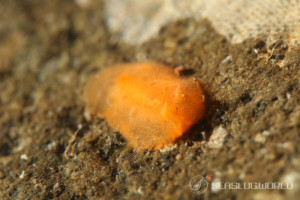
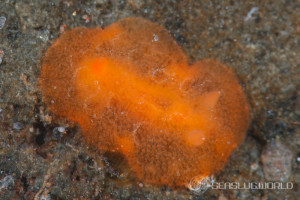
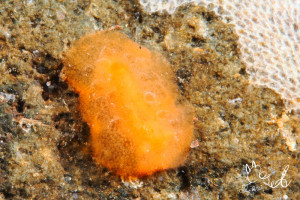
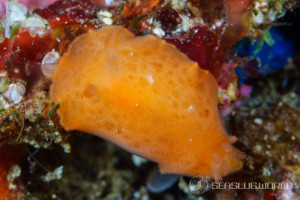
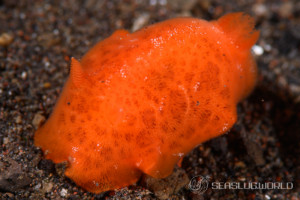
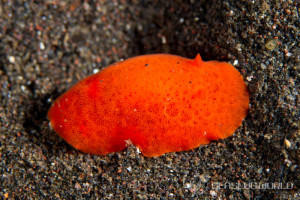
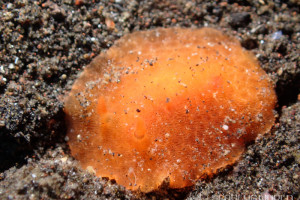
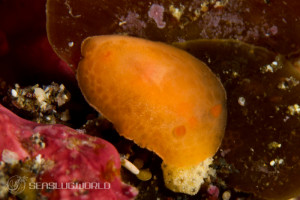
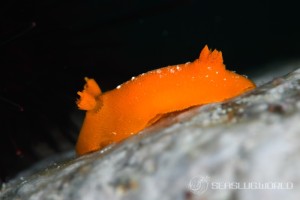
Photos of Rostanga lutescens







Same Genus Nudibranchs
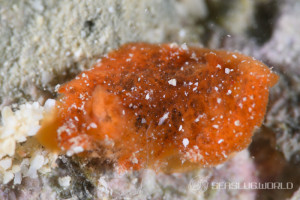
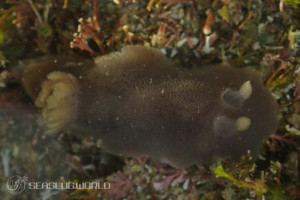
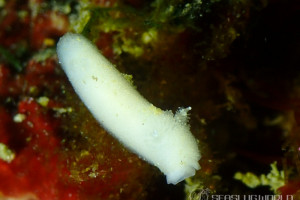
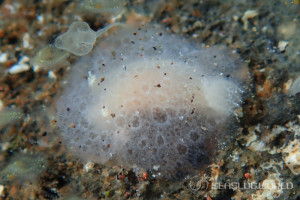
Similar Colors Nudibranchs

Academic Database
Sea slug observation data is available in international marine biodiversity databases.