Sebadoris nubilosa (Pease, 1871)
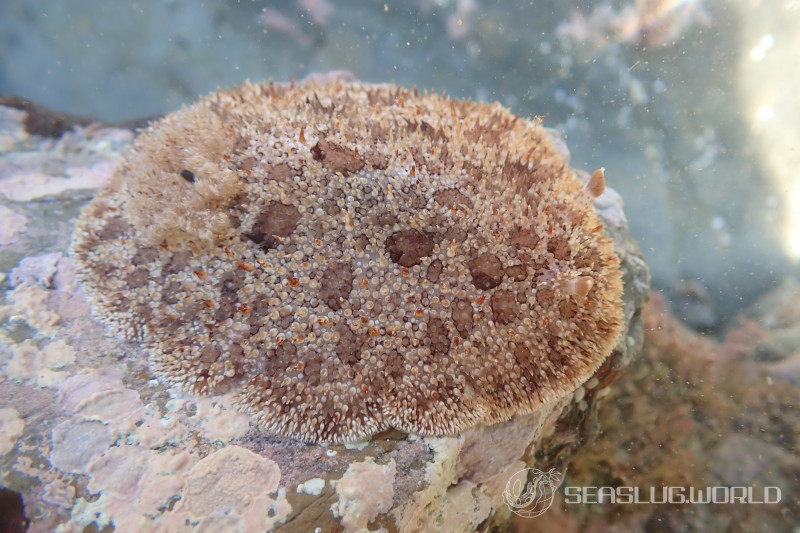
- Location
- Sangashita, Hayama, Kanagawa, Japan
- Date
- 2025/09/07
- Length
- 60mm
- Depth
- 0.2m
- Water temperature
- 29.0℃
Description
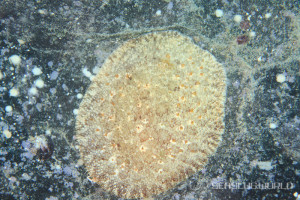
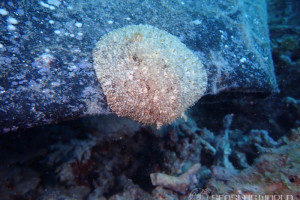
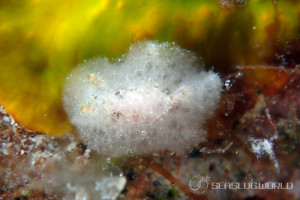
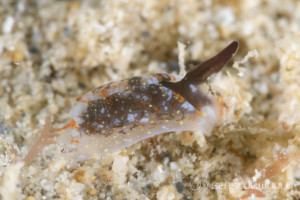
A large dorid reaching about 165 mm in body length. The body is flaccid and oblong, convexly rounded above, widest on the posterior half, with both ends rounded. The mantle covers the foot and has thin, irregularly minutely gashed margins. The dorsum is studded with closely set, unequal-sized, soft papillae interspersed with small tentacular processes. The rhinophores are small, ovate, very finely and obliquely lamellate, retractile into tubular papillose cavities. The oral tentacles are small and finger-shaped. The gill is large, but not as wide as the mantle, of six broad recumbent quadripinnate leaves retractile into a common cavity. The anal papilla is a prominent slender tapering tube with a crenulate orifice. The foot is oblong-oval, rounded behind, truncately rounded in front, much smaller than the mantle. In life the dorsum is beautifully mottled with different shades of brown and grey, the brown forming two dorsal longitudinal rows of large cloud-like spots. The rhinophores are pale and tipped with white. The under surface of the mantle and the foot are pale cinereous, with closely set small yellowish-white spots which scatter outwards and are mixed with irregular chocolate spots, those along the margin running into one another. The locomotive disk is yellowish-white closely spotted with pale chocolate-brown; the upper surface of the foot is mottled pale brown. Pease's type was about 6 1/2 inches (≈ 16.5 cm) long. Pease noted that, in confinement, the animal cast off large portions of its mantle, in the same manner as species of Harpa cast off their foot.Distribution
Central and western Pacific. Type locality: Huahine, Society Islands, based on a specimen collected by Andrew Garrett and described by Pease. Subsequently recorded from the Hawaiian Islands, Guam, the Marshall Islands, southern Japan, the Philippines, Indonesia, the Red Sea and elsewhere.Etymology
The specific epithet nubilosa is the feminine of Latin nubilosus ("cloudy, full of clouds"), in reference to the cloud-like brown and grey mottling of the dorsum. Pease did not state an etymology, but the meaning is consistent with his "beautifully mottled with different shades of brown and grey, the former color assuming two dorsal longitudinal rows of large cloud-like spots".Remarks
Originally placed by Pease in Doris. Later transferred to Sebadoris; the parentheses in the author citation reflect this generic transfer. The Japanese name "オオトゲツヅレウミウシ" refers to the large size and the papillose dorsum. The autotomy of the mantle reported by Pease is one of the defensive responses observed in some members of this genus.References
- Doris nubilosa Pease n. sp., Pease W.H. (1871). Descriptions of new species of Nudibranchiate Mollusca inhabiting Polynesia. No. 2. American Journal of Conchology. 7(1): 11-19, pls. III-IX.
- Discodoris nubilosa (Pease), Allan J.K. (1947). Nudibranchia from the Clarence River Heads, north coast, New South Wales. Records of the Australian Museum, 21(8): 433-463, pls. xli-xliii and map. https://doi.org/10.3853/j.0067-1975.21.1947.561
- Sebadoris nubilosa, Terrence Gosliner, Ángel Valdés and David Behrens. (2015). Nudibranch and Sea Slug Identification Indo-Pacific. New World Pubns Inc.
- Sebadoris nubilosa, Terrence Gosliner, Ángel Valdés and David Behrens. (2018). Nudibranch and Sea Slug Identification Indo-Pacific 2nd Edition. New World Pubns Inc.
- オオトゲツヅレウミウシ(新称), 佐藤宏樹, 柏木千夏 & 長坂忠之助. (2025). オオトゲツヅレウミウシ(新称) Sebadoris nubilosa (Pease, 1871) の千葉県および小笠原諸島からの初記録. ちりぼたん. 55(1-2): 42-51.
Featured in this book
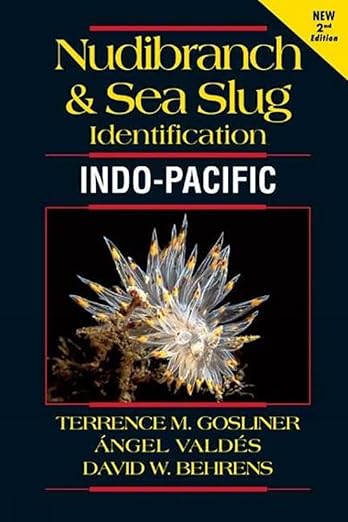
Terrence Gosliner, Ángel Valdés and David Behrens. (2018). Nudibranch and Sea Slug Identification Indo-Pacific 2nd Edition. New World Pubns Inc.
New World Publications
This species, Sebadoris nubilosa, is included in the book.
View on Amazon PR (Amazon Associates)Seasonality
Shooting Locations
Loading shooting locations...
Photos of Sebadoris nubilosa




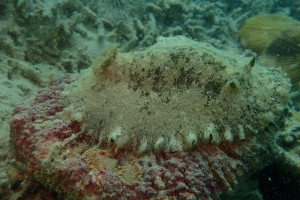
Same Genus Nudibranchs
Similar Colors Nudibranchs

Academic Database
Sea slug observation data is available in international marine biodiversity databases.