Siphopteron quadrispinosum Gosliner, 1989
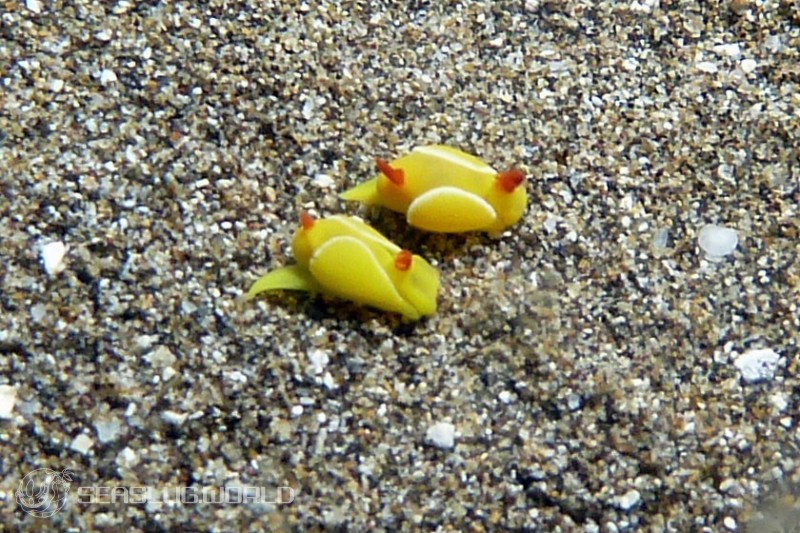
- Location
- White Rock, Maui, Hawaii, United States
- Date
- 2019/04/20
- Length
- ??mm
- Depth
- ??m
- Water temperature
- ??℃
Description
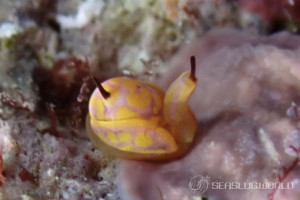
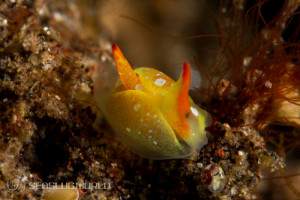
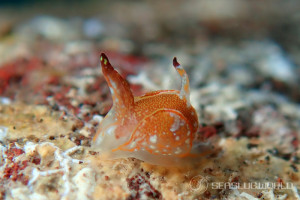
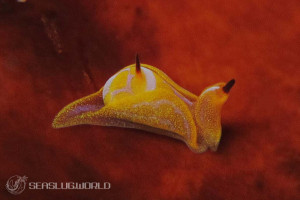
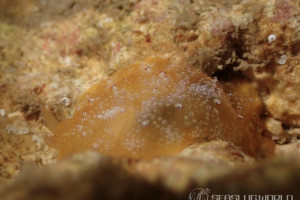
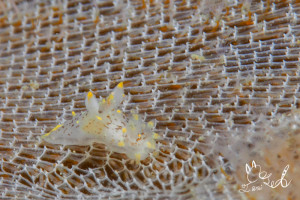
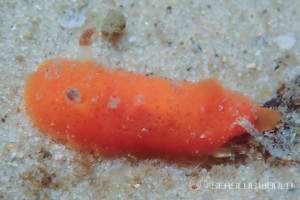
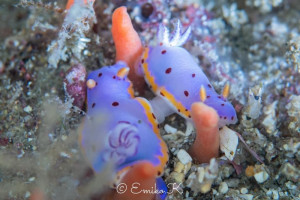
A small gastropterid 3–5 mm in length. The body is bright yellow with a red-orange siphon and flagellum. In specimens from Papua New Guinea, the red-orange pigment extends from the siphon along the posterior margin of the head shield and from the flagellum as a transverse line on the dorsal surface of the visceral hump, and much of the visceral hump is milky white rather than uniformly yellow. The parapodial margin is opaque white in Hawaiian animals but uniformly yellow in New Guinea animals. The parapodia are tall enough that their margins overlap dorsally in resting animals, and the species is capable of prolonged swimming (up to five minutes) by flapping its parapodia. The gill, on the right side of the body, consists of 4–6 simple plicae. The radular formula is 18–20 × 4–6·1·0·1·4–6, and the inner lateral teeth bear a pair of triangular denticles on their inner masticatory margin. The penis is complex, with three different sets of cuticular spines: an elongate reticulate spine in the penial papilla, four large golden chitinous spines within the penial bulb (two with capitate apices, two acutely curved), and a more distal fleshy papilla bearing rows of spines along each margin.Distribution
Known from the Hawaiian Islands (Sand Island, Kaneohe Bay on Oahu; Hookena on the Kona coast of Hawaii; Molokini Crater off Lanai) and from Madang, Papua New Guinea. The type locality is Sand Island, Kaneohe Bay, Oahu. Living animals have been collected on sand flats from 2–3 m to 30 m depth, and in Papua New Guinea on the undersides of dead coral heads.Etymology
Verbatim from the original description (Gosliner, 1989, p.353):The epithet quadrispinosum refers to the four prominent chitinous spines in the penial bulb, which characterize this species.
Remarks
Described as a new species in Gosliner, T.M. 1989 The Veliger 32(4):333-381. In the Discussion the author noted that "The radular morphology, with a pair of triangular denticles on the inner surface of the inner lateral tooth, is similar to that found in Sagaminopteron Tokioka & Baba, 1964 ... However, species of Sagaminopteron can be distinguished from members of Siphopteron by the presence of a large bipinnate or tripinnate ctenidium, broader, more numerous outer lateral teeth, and simple penis. The fact that Siphopteron quadrispinosum has a separate duct leading to a distinct penial papilla confirms that it is more closely allied to other Indo-Pacific species of Siphopteron than to Sagaminopteron" (p.355). The combination of a yellow body with red-orange siphon and flagellum, the consistently paired triangular denticles on the inner lateral tooth, and three distinct sets of penial cuticular spines together distinguish this species from all other known Gastropteridae.References
- Siphopteron quadrispinosum Gosliner, sp. nov., Gosliner T.M. (1989). Revision of the Gastropteridae (Opisthobranchia: Cephalaspidea) with descriptions of a new genus and six new species. The Veliger 32(4): 333-381.
A Kindle field guide by the site author
Kimoto N. (2026). Sea Slugs of Japan & the Indo-Pacific, 2nd Edition.
Kindle Edition
View on Amazon PR (Amazon Associates)Seasonality
Shooting Locations
Loading shooting locations...
Photos of Siphopteron quadrispinosum
Tag:

Same Genus Nudibranchs
Similar Colors Nudibranchs

Academic Database
Sea slug observation data is available in international marine biodiversity databases.