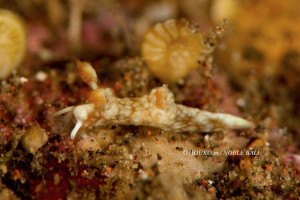
Trapania reticulata Rudman, 1987
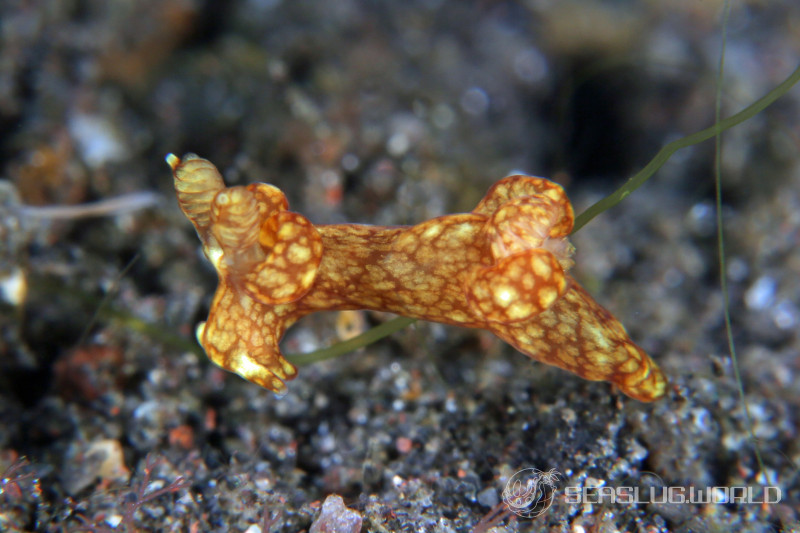
- Location
- USAT Liberty Shipwreck, Tulamben, Pulau Bali, Indonesia
- Date
- 2015/11/15
- Length
- 5mm
- Depth
- 19.0m
- Water temperature
- 30.0℃
Description
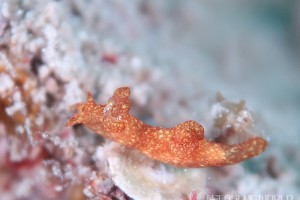
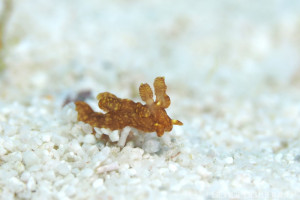
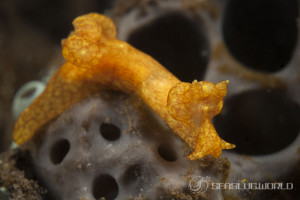
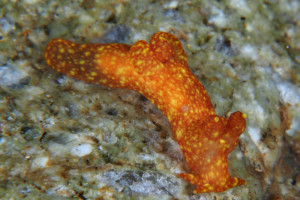
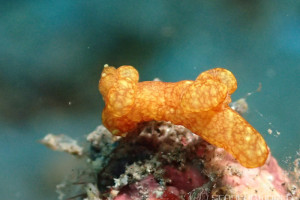
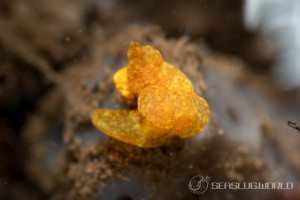
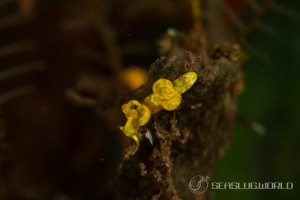
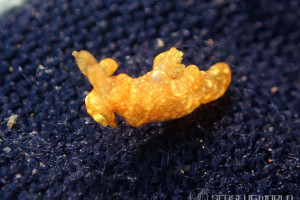
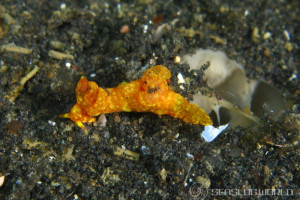
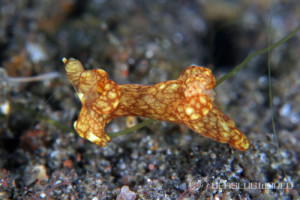
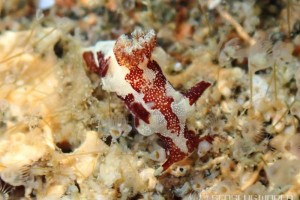
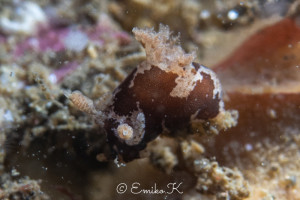
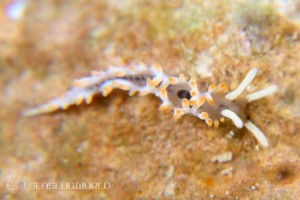
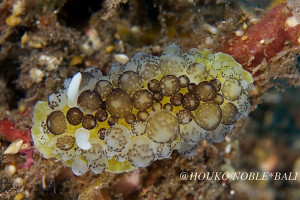
Body translucent brown, covered by a fine dark brown reticulate pattern. Within each space of the reticulation sits a large yellow spot that almost fills the cell. Rhinophore stalk brown with small yellow specks; rhinophore club translucent brown with each lamella edged in dark brown and a whitish tip. Gills translucent, edged with brown and bearing yellow spots. The four lateral processes flanking the rhinophores and gills are characteristic of the genus Trapania. Body length 18 mm alive (holotype).Distribution
Type locality is Blue Hole Reef, Great Barrier Reef, Queensland, Australia (21°12′S, 152°20′E; 12-14 m depth, January 1985). Originally known only from a single Queensland specimen; subsequent records extend to Indonesia.Etymology
The specific epithet reticulata is derived from the Latin reticulum (a net), meaning net-like, in reference to the reticulate brown pattern on the dorsum (verbatim from the original description).Remarks
The reticulate brown pattern with yellow-filled cells is unique within the genus. The Brazilian Trapania maringa Marcus, 1957 also has "an irregular net of dark brown pigment" but differs in body shape. Radular morphology resembles that of European Trapania fusca, Trapania graeffei, and Trapania tartanella, and of Trapania darvelli (Hong Kong, described in the same paper), but the colour pattern allows immediate external identification. Trapania species are typically associated with mixed sponge/bryozoan/hydroid colonies and feed on entoprocts (Loxosomatidae) growing on these substrata.References
- Trapania Pruvot-Fol, 1931 (genus), Pruvot-Fol A. (1931). Notes de systematique sur les Opisthobranches. Bulletin du Muséum National d'Histoire Naturelle, Paris. (2)3(3): 308-316.
- Trapania reticulata Gosliner & Fahey, 2004, Fahey S.J. (2004). A new species of Trapania (Nudibranchia: Goniodorididae) from Western Australia with comparisons to other Indo-West Pacific Trapania. Zootaxa. 514: 1-12.
- Trapania reticulata (compared), Hermosillo A. & Valdés Á. (2004). Two new species of dorid nudibranchs (Mollusca, Opisthobranchia) from Bahía de Banderas and La Paz, Mexico. Proceedings of the California Academy of Sciences, Series 4. 55(28): 550-560.
- Trapania reticulata (compared), Valdés Á. (2009). A new species of Trapania Pruvot-Fol, 1931 (Mollusca, Gastropoda, Opisthobranchia, Nudibranchia) from the Caribbean Sea with an analysis of its phylogenetic relationships. Caribbean Journal of Science. 45(1): 30-37.
- Smirnoff D.S., Donohoo S.A. & Gosliner T.M. (2022). Extra-branchial processes manifest extra diversity: systematics of the genus Trapania (Nudibranchia: Goniodorididae) and nine new species descriptions. Zoological Journal of the Linnean Society. 196(1): 270-313. https://doi.org/10.1093/zoolinnean/zlac009
- Paz-Sedano S., Moles J., Smirnoff D., Gosliner T.M. & Pola M. (2024). A combined phylogenetic strategy illuminates the evolution of Goniodorididae nudibranchs (Mollusca, Gastropoda, Heterobranchia). Molecular Phylogenetics and Evolution. 192: 107990. https://doi.org/10.1016/j.ympev.2023.107990
A Kindle field guide by the site author
Kimoto N. (2026). Sea Slugs of Japan & the Indo-Pacific, 2nd Edition.
Kindle Edition
View on Amazon PR (Amazon Associates)Seasonality
Shooting Locations
Loading shooting locations...
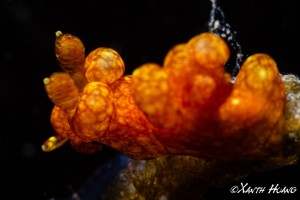
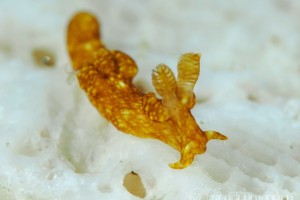
Photos of Trapania reticulata










Same Genus Nudibranchs
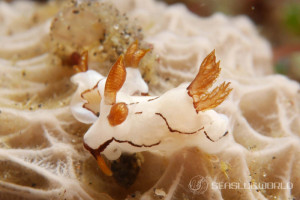
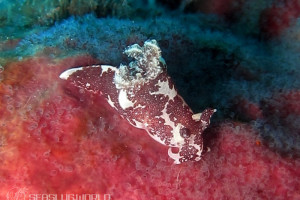
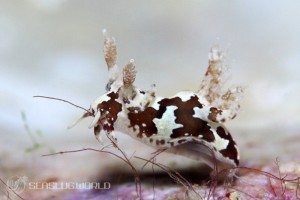
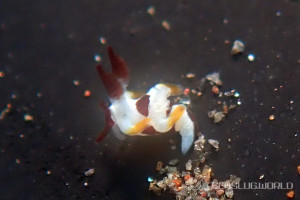
Similar Colors Nudibranchs

Academic Database
Sea slug observation data is available in international marine biodiversity databases.