33 Questions for the Creator of SEASLUG.WORLD
I'm Mayu, a diver who once interviewed the author of the field guide *New Edition: Sea Slugs* here on this blog. On my own personal blog I also interviewed Kimoto, the person running SEASLUG.WORLD, and this time I wanted to dig even deeper into the nudibranch side of things — so I went at him with a whole barrage of questions.
If you've been thinking "I want to try nudibranch diving!" or "I want to get more into nudibranchs!", this might be just the read for you.
Our interviewee… Kimoto. The person behind SEASLUG.WORLD. Currently 10 years into diving, certified AOW (PADI), with 790 logged dives. A programmer by trade. Our interviewee… Kimoto. The person behind SEASLUG.WORLD. Currently 10 years into diving, certified AOW (PADI), with 790 logged dives. A programmer by trade.
A nudibranch diver is someone who keeps hunting for sea slugs even on big-fish dives
—— One thing that stuck with me from our previous interview was that Kimoto has seen plenty of big-animal action at dive sites all over the world — and yet, even in those waters, he never forgets to search for nudibranchs. Just how much of his life is poured into them? I asked him for the real numbers.
Q1. Out of your 790 total dives, what share are nudibranch dives?
Around 50%, I'd say. Within Japan, it's close to 100%.
Q2. How many species of nudibranch have you seen in total?
About 1,100 species.
Q3. How many countries have you seen nudibranchs in?
Japan, the Philippines, Indonesia, Malaysia, the Maldives, Mexico, Fiji, and Palau — so eight countries.
Even at German Channel in Palau, I was watching mantas and still picking out nudibranchs.
Q4. What's the most nudibranchs you've ever found in a single day?
I wasn't counting, so I'm not sure — but maybe around 100 individuals in a day?
Q5. Tell us your top three favorite nudibranchs!
As I'll get into later, I honestly love them all without being picky. But if I had to pick three:
- Hypselodoris bullockii (zōge-iro umiushi)
- Kaloplocamus acutus (hime-eda umiushi)
- Eubranchus mimeticus (tsumaguro-mino umiushi)
Q6. Which nudibranchs would let you brag "yeah, I've seen that one" to fellow enthusiasts?
- Melibe colemani (ito-kuzu Melibe): It's featured in older overseas field guides, and for any nudibranch fan it's a species you'd want to see at least once. Finding a spot where you can see them with high probability, arranging the whole trip myself and going — that's a great memory.
- Trinchesia yamasui (futogaya-mino umiushi): I think there are hardly any people who've seen the real thing. I saw it on a night dive in Raja Ampat, then checked the field guide and was like "no way, really?"
- Hancockia sp.: Occasionally seen on cold-season night dives at Ukishima in west Izu. I went looking for it, found it myself, and got super excited underwater — though no one else seemed to share the excitement, lol.
- Ceratosoma sp. (hanae-nishiki umiushi): An Ogasawara endemic. Photographing this one was basically the whole reason I went.
Q7. What's the one nudibranch you absolutely want to see before you die?
- Melibe leonina: I want to see all the nudibranchs of the US west coast, and this one is a must.
- Dirona albolineata: Also on the US west coast, apparently found in the same places as Melibe.
- Elysia crispata: The so-called lettuce sea slug. Found in the Caribbean and nearby — I looked for it in Mexico but came up empty.
- Australian nudibranchs: Suddenly broad, I know, but I want to see them all. Sydney looks like a good spot, so I'd love to go once the pandemic is behind us.
- Nudibranchs of the Indian Ocean: Thailand, South Africa, and so on — the appeal is that they show up literally anywhere in the world.
Q8. What nudibranch mystery would you most like to see solved while you're still alive?
There are so many.
For example, Australia and Japan are home to nudibranchs that look astonishingly alike — are they the same species or not? And if they are the same, why on earth does that happen?
Q9. Anyone you'd like to meet through your nudibranch connection?
- Mr. Nishida of Io World Kagoshima Aquarium
- The guides running nudibranch diving in various regions
- Mr. Yamada
- Mr. Imamoto
- Sakana-kun
Q10. What have nudibranchs given you?
A hobby that feels like it will never end.
Q11. How much have you spent on nudibranchs in total…?
I'm dropping enough every year to buy a car, so… I'd rather not think about it.
The world of nudibranch diving
—— What do you bring on a nudibranch dive? Which dive operators should you go with? I asked him all sorts of things!
Q12. Tell us everything you take underwater on a nudibranch dive!
A camera, a light, a poker stick ("Hojihoji-kun"), cable ties, a brush I've added recently, a pill case, and a rubber sheet.
The poker stick, cable ties, and brush are for making tiny nudibranchs easier to photograph. The pill case is for moving them. The rubber sheet too — all of it is for photographing nudibranchs that are hard to shoot.
Q13. How do you keep records of the nudibranchs you've seen?
I take photos, register them on SEASLUG.WORLD, and write blog posts.
Q14. When you find a nudibranch, how do you observe it?
First I stare at it with my naked eye. For ones too small to see that way, I look through my camera. Then, once I've got a rough grasp of which way its head is facing and what species it roughly is, I start shooting.
Q15. What do you keep in mind when photographing nudibranchs?
I try to capture all the diagnostic features in a single shot, with the whole animal in focus and as little blur as possible. Usually around f/16.
Q16. Do you have a favorite nudibranch photo of your own?
Q17. Who are your usual nudibranch dive guides and buddies?
For guides: Umi-no-Annainin Chibisuke and Umiushi Hunters.
For buddies: my wife, or Kakegawa-san, whom I met through SEASLUG.WORLD.
Q18. Any recommendations if we want to book a nudibranch guide?
In the Kanto region:
In the Kansai region:
If you prefer warmer waters:
- Ocean Blue (Okinawa)
- Aquastar (Miyakojima)
- DIVE SERVICE WATANABE (Ishigaki Island)
- Noble Bali (Bali)
Beyond that, guides who post to SEASLUG.WORLD are scattered all over Japan, so use the site as a reference.
I'm not a pro myself so I can't guide, but if you call me out, I'm happy to go searching for nudibranchs together.
Q19. Who do you geek out with about nudibranchs?
Ikeda-san of Umiushi Hunters, Yui-san of Chibisuke, and Kakegawa-san. Also folks in Kansai like Leptin-san.
I also answer questions that pop up on Facebook and Twitter all the time, so I end up chatting about nudibranchs with all sorts of people.
Q20. What gear or books are you hoping to get for nudibranch diving going forward?
A black light.
A macro lens around 60mm — life-size or better would be even nicer.
Overseas nudibranch field guides.
I've heard chloroplasts glow under black light, so I'd love to see that.
The 90mm lens I use now is a bit too long for nudibranchs, so I think a 60mm that works without a close-up lens would make life easier. The hard part is that right now there's no camera-and-lens combo that quite fits.
Books from overseas are useful because you can see how people in that country identify species.
Q21. So, what's the real charm of nudibranch diving?
The fact that zero visibility doesn't matter. Too much particulate in the water makes photos hard, sure, but for just enjoying the dive, it doesn't really matter — which makes it perfect for diving in Japan.
Behind the scenes of SEASLUG.WORLD
—— By the way, Kimoto currently runs SEASLUG.WORLD single-handedly. Let's also hear about what goes on behind the scenes of this web service!
Q22. The SEASLUG.WORLD logo — which nudibranch is that?
It's Hypselodoris babai (chigire-yukiiro umiushi).
Imagawa-san, who was the initial administrator when the site launched, picked his favorite.
The design is by Yukiyo Yasunari, who also designed the Chibisuke logo.
Q23. What is Imagawa-san (of Ocean Blue) up to these days?
With a child in the family, he's gotten really busy, so these days he's barely involved with SEASLUG.WORLD. He couldn't make it this year because of COVID, but he normally heads to Okinawa every year.
Q24. Tell us the story behind naming "SEASLUG.WORLD."
We wanted to gather not just the nudibranchs of Japan but of the whole world, so we went with "SEASLUG.WORLD."
Q25. What's the concept of SEASLUG.WORLD?
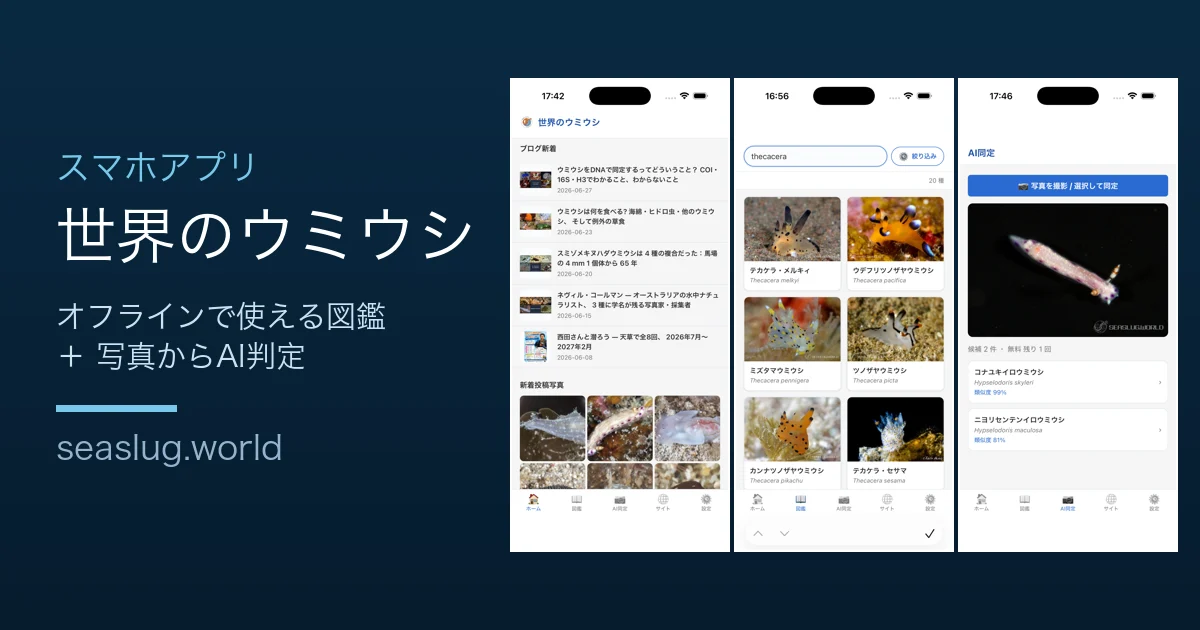
If you post, your submissions get identified and you basically build your own nudibranch field guide of what you've seen.
Bundle everyone's together, and you end up with nudibranch data from all over the world.
On a separate track, I'm also adding data so you can trace when and where each Japanese common name was given, and how it has changed over time.
Q26. What moments make you glad you run SEASLUG.WORLD?
When I go diving and someone tells me they use SEASLUG.WORLD.
And when a species I've been wishing I had photos of finally gets posted.
[A little detour] Questions from our followers about the mystery that is Kimoto
—— Leptin-san sent in some questions for Kimoto, the person behind SEASLUG.WORLD, so I'll share them here! He really is like a human AI…
Q. When you see a nudibranch, I'd love to know the path you take to arrive at its scientific name. I'm guessing you're not just memorizing names by rote, but rather judging family and genus from morphology — yet both of those are enormous in variety. So what exactly are the points you use to get there? Q. When you see a nudibranch, I'd love to know the path you take to arrive at its scientific name. I'm guessing you're not just memorizing names by rote, but rather judging family and genus from morphology — yet both of those are enormous in variety. So what exactly are the points you use to get there?
First I check whether it's already registered on SEASLUG.WORLD.
→ I have a rough grasp of every species registered there, so one look at the photo and I can usually guess what it is.
If it's not registered,
→ I check Gosliner's field guide.
If it is registered but the entry seems suspect,
→ I go back and look for papers and other sources.
If it's still not in there,
→ I look in other field guides, or search the web. The question assumes "you're not memorizing names by rote, but judging family and genus from morphology" — but honestly, if a species has a name, I've probably got it mostly memorized. When there's no name and no photo in any field guide, I guess the family or genus from its appearance and do a Google image search. That tends to turn up completely unrelated but fascinating nudibranchs, and time just evaporates.
Q. How did you memorize the scientific names? This isn't unique to nudibranchs, but I've always found it mysterious. Q. How did you memorize the scientific names? This isn't unique to nudibranchs, but I've always found it mysterious.
If you look at enormous numbers of nudibranch photos every day, you learn them whether you like it or not… I'd guess I'm pretty close to world-class when it comes to the sheer volume of nudibranch photos I look at.
Q. The speed at which you pick up the latest papers. You catch them the moment they drop. And you read papers incredibly fast. Are you using translation software? Q. The speed at which you pick up the latest papers. You catch them the moment they drop. And you read papers incredibly fast. Are you using translation software?
Most of it comes through Facebook. As soon as something shows up in a group I follow, I look it up. I also search WoRMS for nudibranchs that got scientific names in 2020 — new papers often turn up that way. For translation, I've been using DeepL lately and skimming through. Reading books used to be my hobby, so I'm good at skim-reading.
Q. When you come across what looks like an undescribed species, how do you decide whether it's variation, a cryptic species, diet-driven change, or a genuinely undescribed species? Q. When you come across what looks like an undescribed species, how do you decide whether it's variation, a cryptic species, diet-driven change, or a genuinely undescribed species?
This one also comes down to having looked at so many photos… I don't really trust color at all; I go by the shape of the rhinophores, the patterns, the markings on the back, the shape of the secondary gills, and so on. But those change a lot with growth, so if I happen to see something that fills the gap between two forms, I'll go "ah, these two might be the same species" and fix the entry. I'm not running anything strict — it's all by feel. What you're seeing is the result of human deep learning.
—— Human deep learning… that's amazing.
Nudibranchs Kimoto recommends for different kinds of people
—— Nudibranchs are so diverse that tastes must vary wildly too. I asked Kimoto for his picks from the angle of "I want this kind of person to see this one."
Q27. The one nudibranch you absolutely have to see first?
Hypselodoris festiva (ao-umiushi).
It's actually a rare species — endemic to the seas around Japan and not seen anywhere else.
Q28. A nudibranch to show someone who loves beautiful creatures?
Aside from the brownish ones and the flat ones, pretty much all nudibranchs are colorful and beautiful. The name isn't exactly glamorous, but Petalifera ramosa (fusa-umi-namekuji) is really gorgeous.
Q29. A nudibranch for someone who loves quirky creatures?
Glaucus atlanticus (ao-mino umiushi).
True to its nickname "blue dragon," it looks like something straight out of Final Fantasy — metallic colors on a living creature, with personality off the charts.
Q30. A nudibranch for someone who loves rare creatures?
Phylliroe bucephala (konoha-umiushi).
A pelagic nudibranch that swims like a fish. At Osezaki around November to December, depending on tide and wind, you can catch one.
Q31. A nudibranch for someone who enjoys telling look-alikes apart?
- Cinderella umiushi (Hypselodoris apolegma) and Kaguya-hime umiushi
- Sentenro-umiushi (Hypselodoris placida) and niyori-sentenro-umiushi
It's a world of "is there a white spot on the rhinophore or not," "is there one line or not" — so it might be just the thing for people who are serious about spot-the-difference puzzles.
For those who want to learn more about nudibranchs
—— For readers who want to get into nudibranchs but are worried about relying on anything less than trustworthy sources. I also asked him which references to check!
Q32. Any recommended books on nudibranchs?
*New Edition: Sea Slugs (Atsushi Ono)* and *Nudibranch & Sea Slug Identification (Terrence M. Gosliner)*.
Q33. Which SNS accounts or web pages should we follow to keep up with the latest nudibranch news?
Please see the article I wrote previously.
Related: How to gather information about nudibranchs
So, what did you think?
If there's something else you'd like to ask about nudibranchs or about Kimoto himself, please reach out to him directly!
Enjoyed this post? You can tip the author directly —
Tip this post