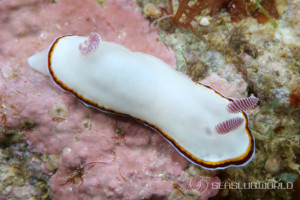
Hypselodoris apolegma (Yonow, 2001)
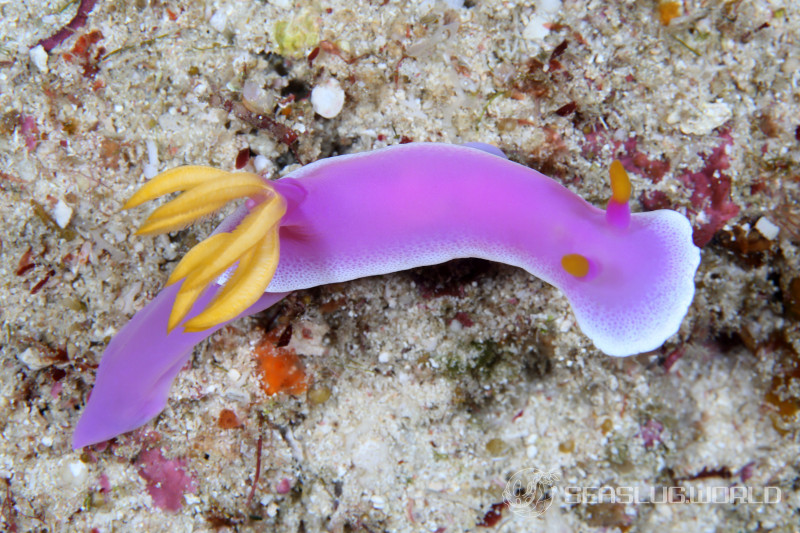
- Location
- Horse Shoes, Okinawa Island (Onna and Yomitan area), Okinawa, Japan
- Date
- 2015/12/21
- Length
- 80mm
- Depth
- 30.0m
- Water temperature
- 23.0℃
Description
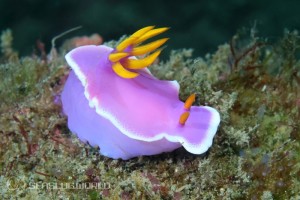
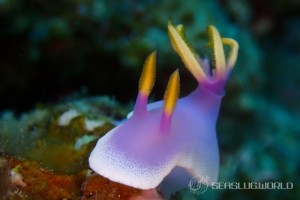
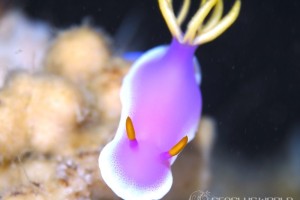
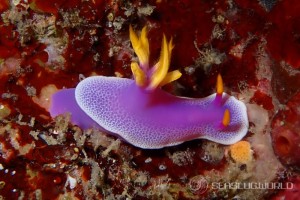
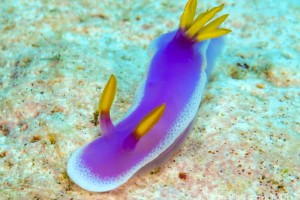
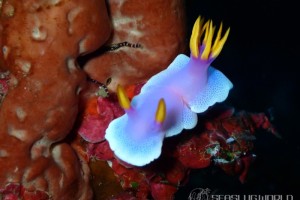
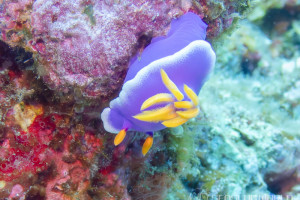
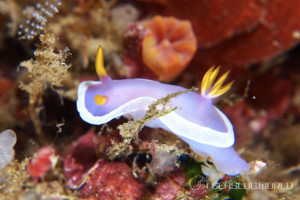
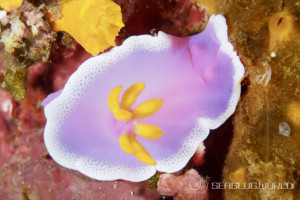
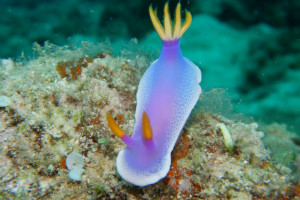
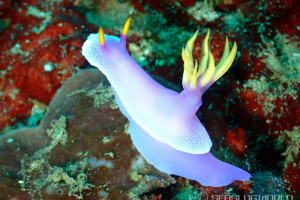
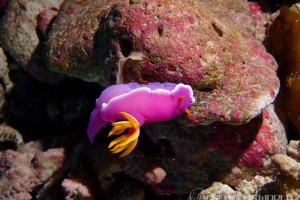
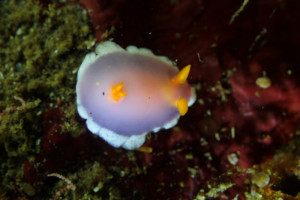
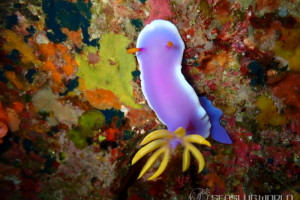
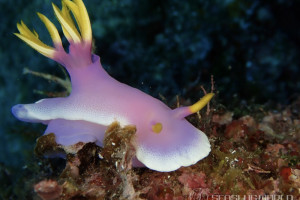
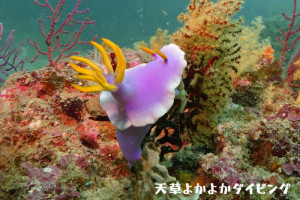
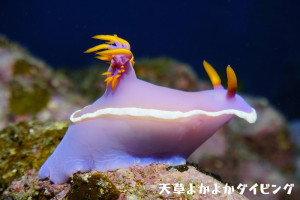
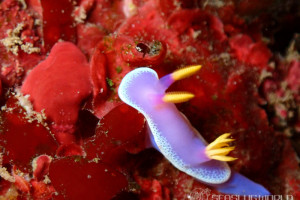
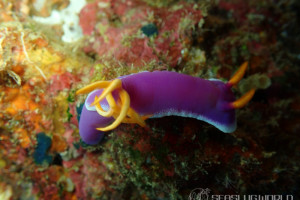
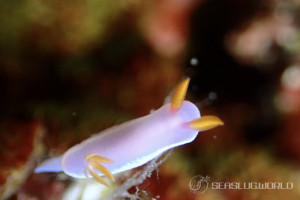
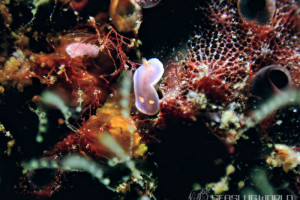
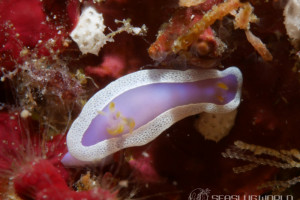
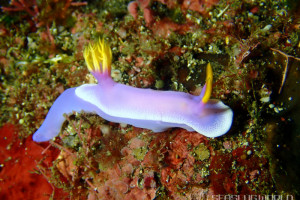
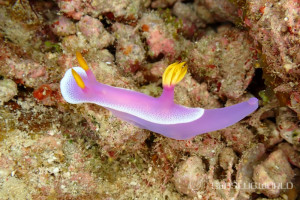
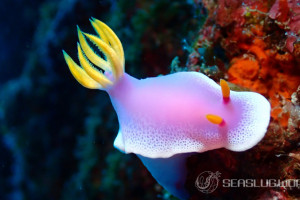
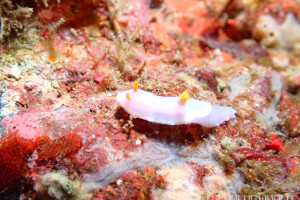
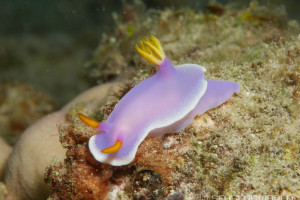
A large chromodorid reaching about 100 mm in body length. In life the ground colour is an almost luminescent deep magenta-pink to violet. The colour of the mantle is connected to an opaque white margin by a region of violet stippling combined with white reticulations, so that the boundary between the violet mantle and the white edge is diffuse. The mantle is elongate, fairly spatulate anteriorly, with a crinkled edge. The body is high and fleshy but firm, with a definite but reduced mantle overlap. The foot is large and firm, extending beyond the mantle posteriorly. The rhinophores are deep orange-yellow with purple peduncles; the holotype has 25 lamellae on the club, while one extended rhinophore of an FMMME specimen had 27 and 29 lamellae on the two sides. The five tripinnate gills are yellow with violet stalks, located far back on the dorsum and held very high. The rhinophores and gills issue from pockets with a raised rim, the rim being the same colour as the mantle. The gill pocket is very high in life, almost tubular, with a pimpled surface. The foot is uniformly coloured, a shade more purple than the mantle, with no banding around the edge. The foot is bilaminate; neither lamina is notched but the edges are crumpled. In all three preserved specimens the sides of the foot bear characteristic folds, with a main fold just beyond the head and smaller undulating folds posteriorly. The oral tentacles are just visible on each side of the head. The radula bears rows of hooked and serrated teeth, all similar along the row, increasing rapidly in size for the first 5–6 teeth and remaining more or less constant to the last few laterals, which have reduced cusps. There is no central rachidian or thickening visible. The first lateral bears 4–5 denticles on the outer side, as do the remaining laterals; there are no denticles medially. Each cusp has 4–6 serrations (rarely 7 or 8) along the bottom of the cuspar. The radular formula of the 80 mm specimen (Mal. 23) is 90 (+6) × min. 121.0.121.Distribution
Western Pacific to western Australia. Type locality: Het Suikerbroodje, Hitu, Ambon, Maluku, Indonesia, 4–5 m depth, based on the holotype (RBE Stn 39, 46 × 22 mm preserved) collected by W. Kolvoort on 9 December 1990. Paratypes from the same station and from Cape Nusanive, Leitimur, 24 m depth, collected by B.W. Hoeksema on 21 November 1996 (80 mm). Subsequently widely recorded from Malaysia, the Philippines, Japan and other tropical and sub-tropical western Pacific localities.Etymology
The original Etymology section (Yonow, 2001, p.43) reads: "Apolegma is Greek for the hem of a robe, referring to the white margin which is not sharply distinct from the violet mantle." The specific epithet apolegma derives from the Ancient Greek word for the hem or border of a garment, in reference to the diffuse white edge of the violet mantle.Remarks
In the original description Yonow placed the species in Risbecia. The species had previously been confused with Hypselodoris bullocki in Wells & Bryce 1993, Strack 1998, Allen & Steene 1994, Debelius 1996, Colin & Arneson 1995 and Gosliner et al. 1996. Risbecia was subsequently synonymised with Hypselodoris Stimpson, 1855, and this species was transferred to Hypselodoris; the parentheses in the author citation reflect this generic transfer. The Japanese name "シンデレラウミウシ" ("Cinderella slug") refers to the bright violet colour evoking a princess's dress and glass slippers.References
- シンデレラウミウシ(仮称), 益田一. (1999). 海洋生物ガイドブック. 東海大学出版会.
- シンデレラウミウシ, 益田一. (1999). 海洋生物ガイドブック. 第2刷. 東海大学出版会.
- シンデレラウミウシ(仮称), 小野篤司. (1999). ウミウシガイドブック. TBSブリタニカ.
- Risbecia apolegma spec. nov., Yonow N. (2001). Results of the Rumphius Biohistorical Expedition to Ambon (1990). Part 11. Doridacea of the families Chromodorididae and Hexabranchidae (Mollusca, Gastropoda, Opisthobranchia, Nudibranchia), including additional Moluccan material. Zoologische Mededelingen Leiden. 75(1): 1-50, figs 1-12, colour pls 1-5.
- ヒプセロドリス・ブロッキィ, 殿塚孝昌. (2003). ウミウシガイドブック〈3〉. TBSブリタニカ.
- シンデレラウミウシ, 小野篤司. (2004). 沖縄のウミウシ. ラトルズ.
- シンデレラウミウシ, 中野理枝. (2004). 本州のウミウシ. ラトルズ.
- シンデレラウミウシ, 小野篤司 & 加藤昌一. (2009). ウミウシ. 誠文堂新光社.
- Hypselodoris apolegma, Johnson R.F. & Gosliner T.M. (2012). Traditional taxonomic groupings mask evolutionary history: a molecular phylogeny and new classification of the chromodorid nudibranchs. PLoS ONE 7(4): e33479.
- モモイロウミウシ, 奥谷喬司. (2015). 日本近海産貝類図鑑. 第二版. 東海大学出版部.
A Kindle field guide by the site author
Kimoto N. (2026). Sea Slugs of Japan & the Indo-Pacific, 2nd Edition.
Kindle Edition
View on Amazon PR (Amazon Associates)Seasonality
Shooting Locations
Loading shooting locations...
Photos of Hypselodoris apolegma
Tag:





















Same Genus Nudibranchs

Similar Colors Nudibranchs

Academic Database
Sea slug observation data is available in international marine biodiversity databases.