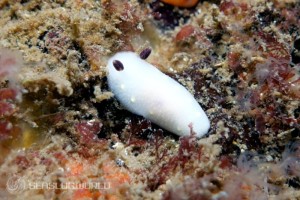
Gymnodoris tuberculosa Knutson & Gosliner, 2014
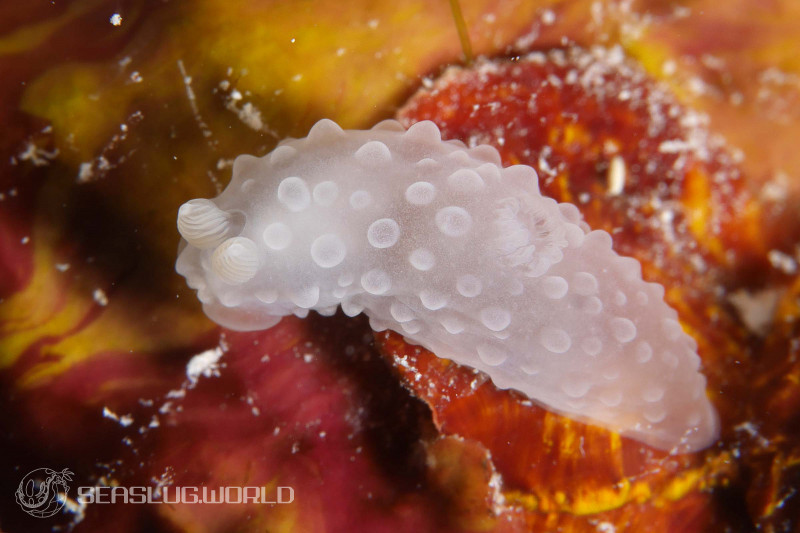
- Location
- Itona Pole side, Ishigaki and Yaeyama, Okinawa, Japan
- Date
- 2018/02/22
- Length
- 10mm
- Depth
- 6.0m
- Water temperature
- 22.0℃
Description
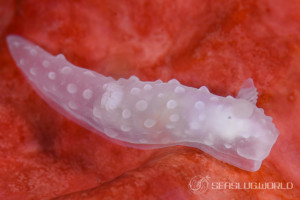
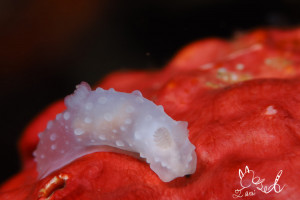
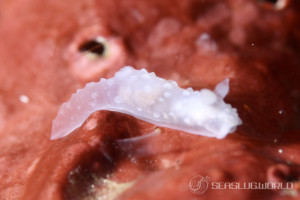
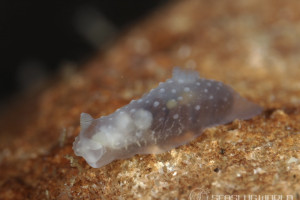
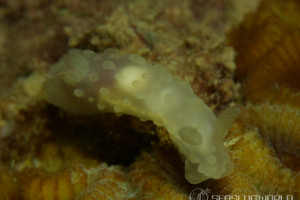
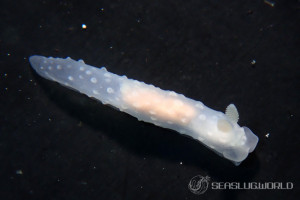
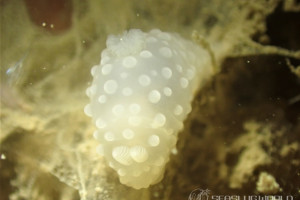
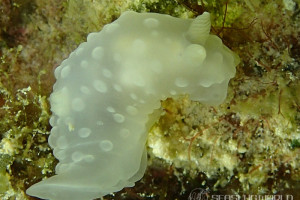
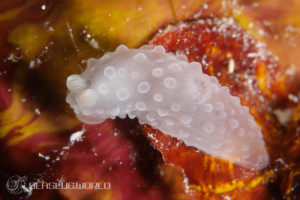
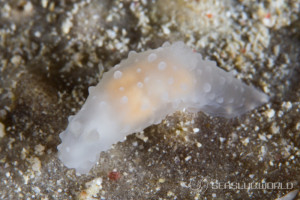
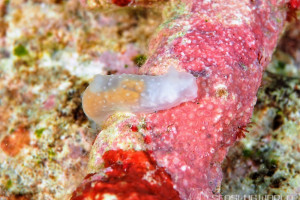
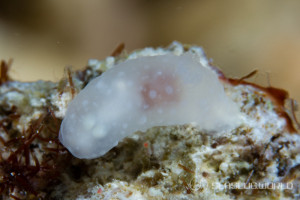
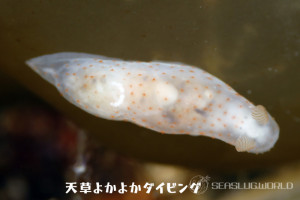
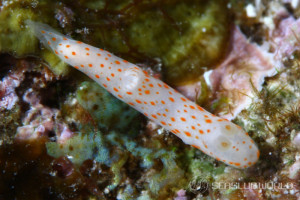
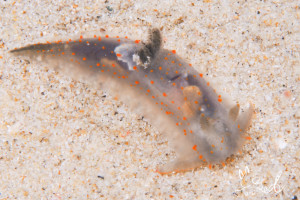
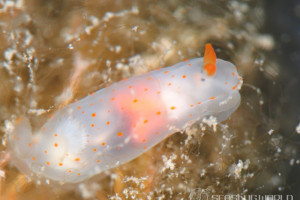
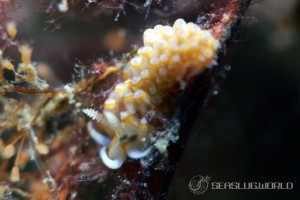
A small gymnodorid nudibranch ranging from 1.6 to 11 mm in preserved length, with a uniformly translucent white body covered all over by small, rounded white tubercles. Internal organs are visible through the translucent skin; the digestive gland varies from bright orange to pink to brown, likely reflecting the animal's diet. Rhinophores are lamellate with 8–13 lamellae, translucent white to cream or pale yellow. Gills are the same colour as the body, with 9–13 main branches arranged in a complete circle around the centrally placed anus, located near the middle of the body. The genital opening lies on the right side, about one third of the distance from the rhinophores to the gills. A deep groove runs across the anterior of the foot, ventral to the mouth. Subcutaneous gland-like structures, presumably defensive, are concentrated on the ventral and lateral sides of the anterior half of the body.Distribution
Type locality: Kranket Fish Market Cove, near Madang Resort, Madang Province, Papua New Guinea (5°12'28"S, 145°48'32"E). The original description (Knutson & Gosliner 2014) recorded the species from Papua New Guinea and the Philippines, and also referred to specimens previously figured as Gymnodoris sp. 3 from the Marshall Islands (Gosliner et al. 2008) and a photograph from Raja Ampat, Indonesia. Japanese records subsequently include Amami-Ōshima.Etymology
From Latin tuberculosus (= warty, covered with tubercles), in reference to the white tubercles covering the body.Japanese vernacular name
The Japanese name "Tsubutsubu-kinuhada-umiushi" (ツブツブキヌハダウミウシ) refers to the small, granular tubercles covering the body.Remarks
Animals of this kind were once suspected to be juveniles of "Shiro-bonbon-umiushi" (Gymnodoris sp. 1 on this site), but the original description (Knutson & Gosliner 2014) established the form as a distinct species. The diet of the species is unknown. The species appears to be active at night and is often found on the undersurface of coral rubble during the day. Other Gymnodoris species bearing prominent tubercles, such as Gymnodoris aurita and Gymnodoris ceylonica, have pigmented (yellow to orange-red) tubercles; Gymnodoris tuberculosa is unique in being uniformly translucent white with translucent white tubercles.References
- Gymnodoris sp. 3, Gosliner T.M., Behrens D.W. & Valdés Á. (2008). Indo-Pacific Nudibranchs and Sea Slugs: A field guide to the world's most diverse fauna. Sea Challengers Natural History Books, 426 pp.
- Gymnodoris tuberculosa sp. nov., Knutson V.L. & Gosliner T.M. (2014). Three new species of Gymnodoris Stimpson, 1855 (Opisthobranchia, Nudibranchia) from the Philippines. The Coral Triangle: The 2011 Hearst Philippine Biodiversity Expedition. pp. 129-143.
- Gymnodoris tuberculosa, Terrence Gosliner, Ángel Valdés and David Behrens. (2015). Nudibranch and Sea Slug Identification Indo-Pacific. New World Pubns Inc.
- ツブツブキヌハダウミウシ(新称), 中野理枝, 朝倉知子, 池田紫, 石川雅教, 今本淳, 岩瀬南美, 西田和記, 堀江諒, 山田久子 & 渡井久美. (2017). 奄美大島北部海域における後鰓類相の調査報告. Kuroshio Biosphere. 13: 1-18 + 6 pls.
Featured in this book

Terrence Gosliner, Ángel Valdés and David Behrens. (2018). Nudibranch and Sea Slug Identification Indo-Pacific 2nd Edition. New World Pubns Inc.
New World Publications
This species, Gymnodoris tuberculosa, is included in the book.
View on Amazon PR (Amazon Associates)Seasonality
Shooting Locations
Loading shooting locations...
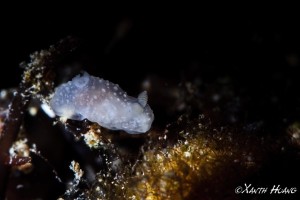
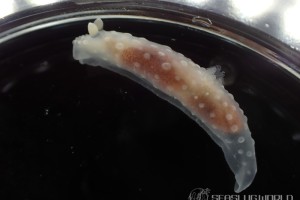
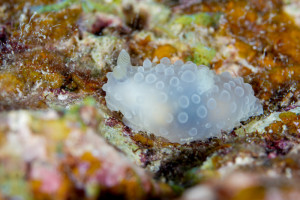
Photos of Gymnodoris tuberculosa














Same Genus Nudibranchs

Similar Colors Nudibranchs
Color:
White
Academic Database
Sea slug observation data is available in international marine biodiversity databases.