Hypselodoris iacula Gosliner & R. F. Johnson, 1999
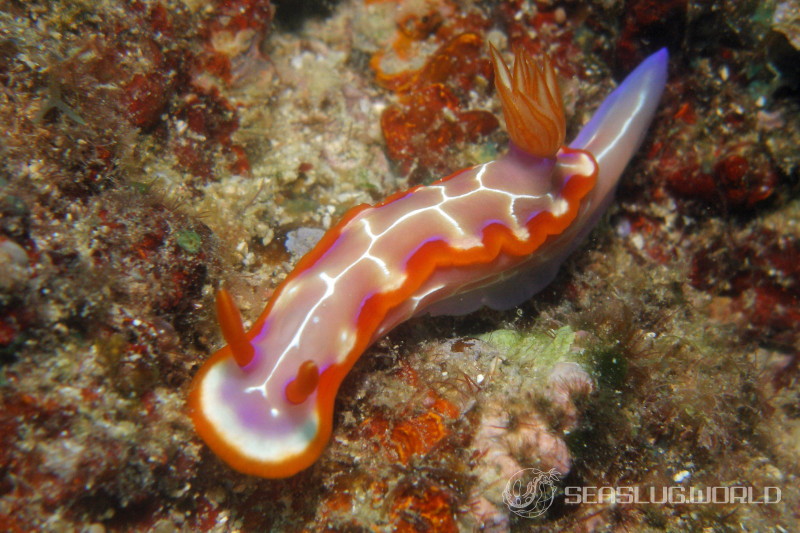
- Location
- Ishikiri(Awa), Okinawa Island (Motobu and Northern area), Okinawa, Japan
- Date
- 2011/12/28
- Length
- 40mm
- Depth
- 18.0m
- Water temperature
- 22.0℃
Description
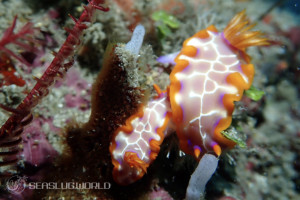
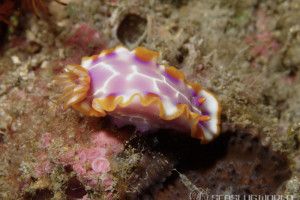
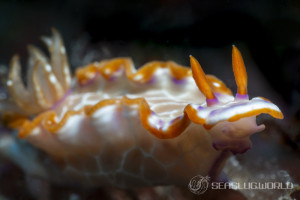
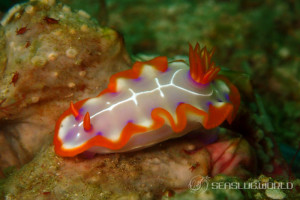
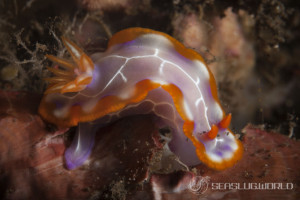
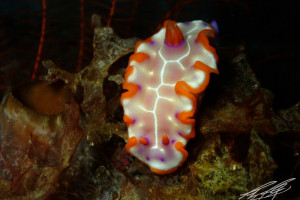
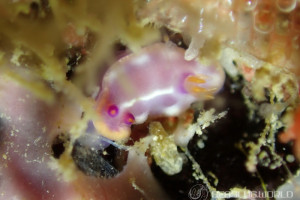
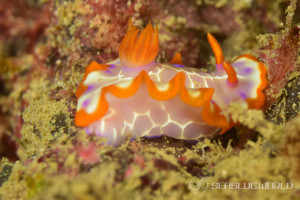
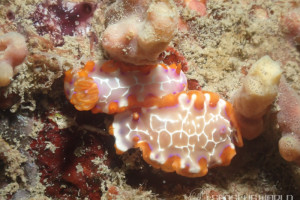
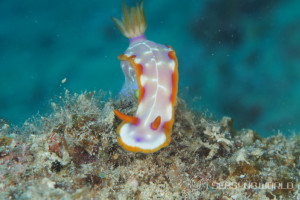
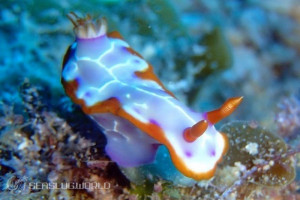
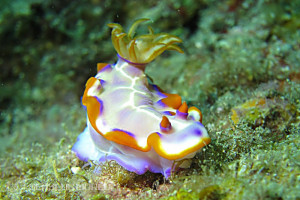
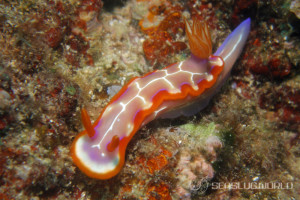
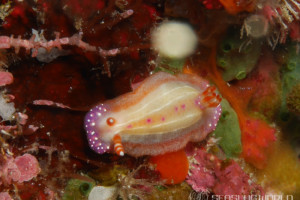
A medium-sized Hypselodoris. The ground colour is pinkish-white. There is a thick, scalloped orange mantle margin, interrupted by opaque white spots. Purple spots mark submarginal points along the orange band. Thin purple lines circle the bases of the rhinophores and the gills. The remainder of the dorsum is covered with an intricate net-like pattern of opaque white, which is maintained on the foot and the sides of the body. The thin rhinophores and eleven simple, unipinnate gills are bright orange, and there is darker orange pigment along the rachis of each gill. Behind the rhinophores are two patches of lighter, more translucent pigment through which the eyes are visible. The mantle overhangs the sides of the body.The mantle glands alternate, a large tear-shaped gland next to a small round gland, and this pattern continues around the entire mantle edge. The radular formula is 74×59.0.59, lacking rachidian teeth. The jaw rodlets are undivided, elongate with quadrangular bases and well-developed lateral flanges at their posterior ends. The inner lateral teeth are bicuspid with the second cusp less developed than the first; one small denticle may occur on the inside of the inner-most tooth and another at the outer base of the second cusp. The middle laterals have 1-2 denticles below the much shorter second cusp, and the outer teeth have 3-5 large rounded denticles. The triaulic reproductive system has a narrow, somewhat bulbous, more elongate penial sac than its congener, and a minute but elongate pyriform receptaculum seminis attached to the middle of the vaginal duct.
Distribution
Known from the type locality at Sepok Point, Batangas, Luzon Island, Philippines (15 m depth) and from Bali, Indonesia.Etymology
Verbatim from the original description (Gosliner, Johnson & Andersson, 1999, Zoological Journal of the Linnean Society 125: p.32):The name iacula comes from the Latin for fishing net, which refers to the beautiful net-like pattern on the dorsum of the animal.
Remarks
Described in a 1999 revision and previously figured as Chromodoris sp. by Debelius 1996. Most closely related to H. purpureomaculosa Hamatani, 1995. Both species are unique among Hypselodoris in having alternating large and small mantle glands around the entire perimeter of the mantle, an elongate but narrow receptaculum seminis, and quadrangular jaw rodlets. H. iacula has a more pink body colour with a network of opaque white lines and purple spots and rings, all of which are absent in H. purpureomaculosa; conversely, H. purpureomaculosa bears wine-red blotches that are absent in H. iacula. Radular morphology and the shape of the penial sac also separate the two species: the inner lateral teeth of H. iacula have fewer denticles, the middle laterals have 1-2 denticles (versus 3-6 in H. purpureomaculosa), and the penial sac of H. iacula is narrower, less bulbous and more elongate.References
- Hypselodoris iacula sp. nov., Gosliner T.M. & Johnson R.F. (1999). Phylogeny of Hypselodoris (Nudibranchia: Chromodorididae) with a review of the monophyletic clade of Indo-Pacific species, including descriptions of twelve new species. Zoological Journal of the Linnean Society. 125: 1-114. https://doi.org/10.1111/j.1096-3642.1999.tb00585.x
- ヒプセロドリス・イアクラ, 殿塚孝昌. (2003). ウミウシガイドブック〈3〉. TBSブリタニカ.
- Hypselodoris iacula, Johnson R.F. & Gosliner T.M. (2012). Traditional taxonomic groupings mask evolutionary history: a molecular phylogeny and new classification of the chromodorid nudibranchs. PLoS ONE 7(4): e33479.
- Hypselodoris iacula, Terrence Gosliner, Ángel Valdés and David Behrens. (2015). Nudibranch and Sea Slug Identification Indo-Pacific. New World Pubns Inc.
- アミダイロウミウシ(新称), 中野理枝. (2018). 日本のウミウシ. 文一総合出版.
Featured in this book
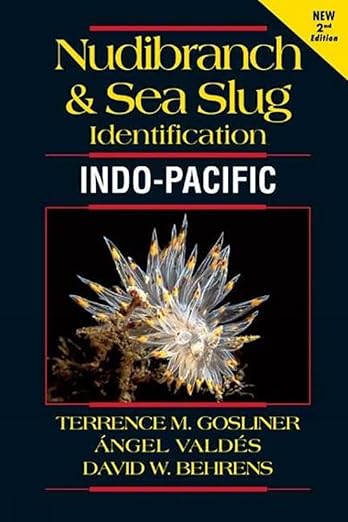
Terrence Gosliner, Ángel Valdés and David Behrens. (2018). Nudibranch and Sea Slug Identification Indo-Pacific 2nd Edition. New World Pubns Inc.
New World Publications
This species, Hypselodoris iacula, is included in the book.
View on Amazon PR (Amazon Associates)Seasonality
Shooting Locations
Loading shooting locations...
Photos of Hypselodoris iacula
Tag:














Same Genus Nudibranchs

Similar Colors Nudibranchs

Academic Database
Sea slug observation data is available in international marine biodiversity databases.