Jorunna funebris (Kelaart, 1858)
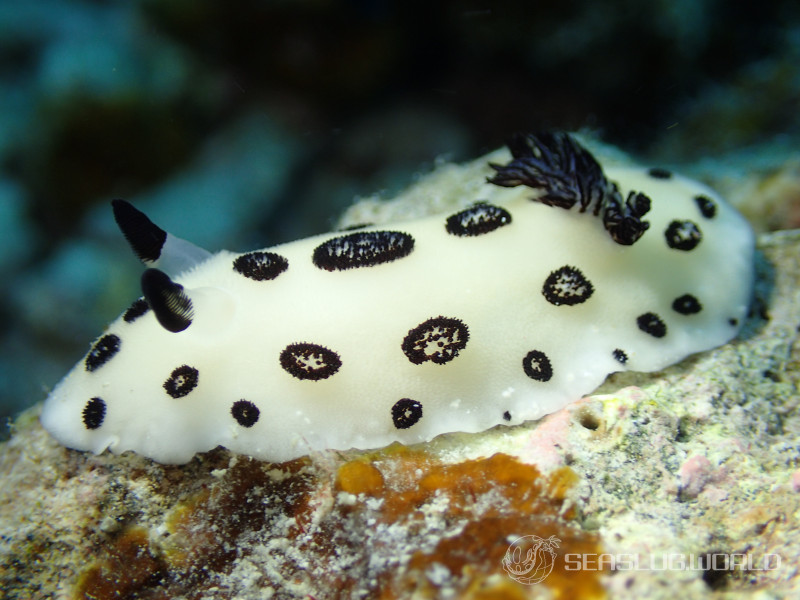
- Location
- Kuroshima Kita, Ishigaki and Yaeyama, Okinawa, Japan
- Date
- 2017/01/24
- Length
- 50mm
- Depth
- 2.0m
- Water temperature
- 24.0℃
Description
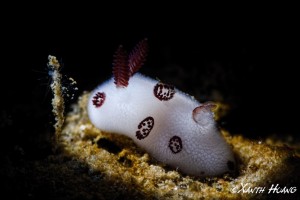
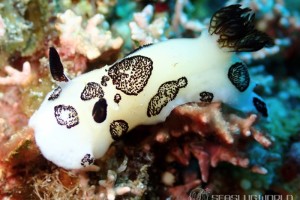
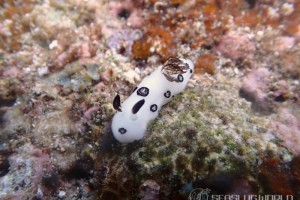
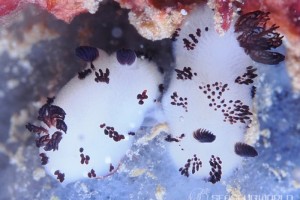
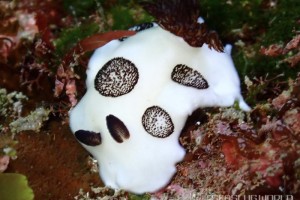
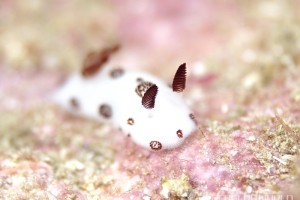
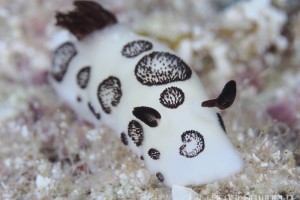
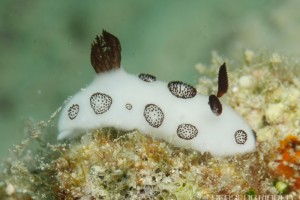
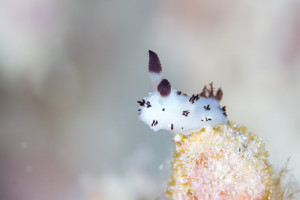
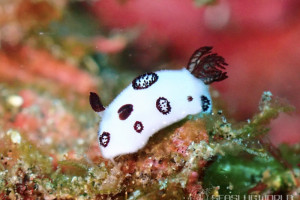
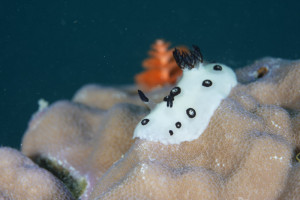
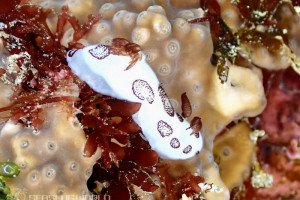
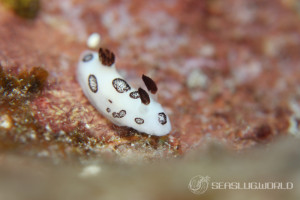
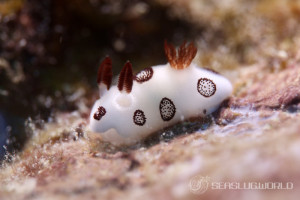
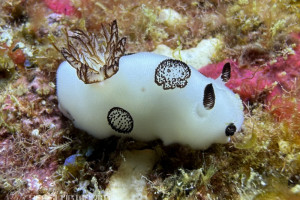
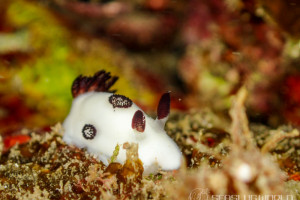
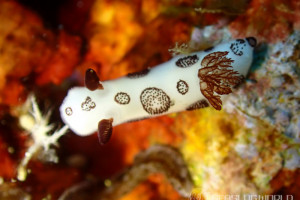
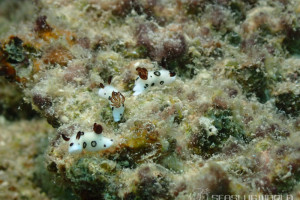
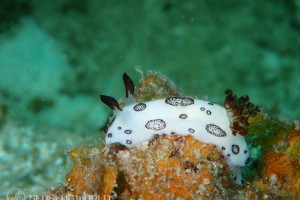
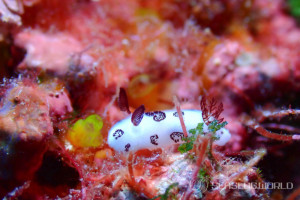
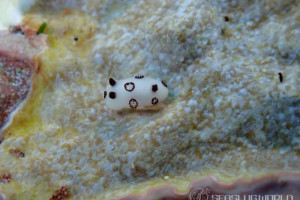
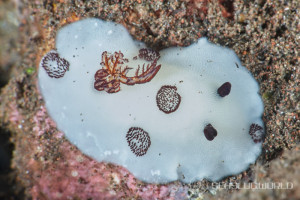
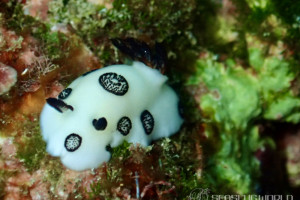
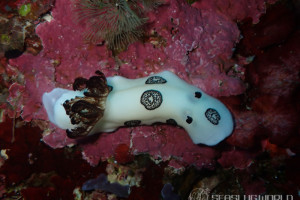
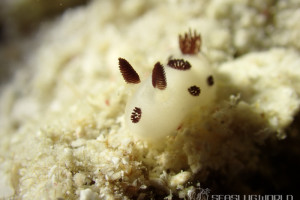
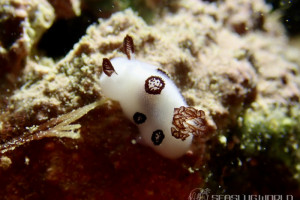
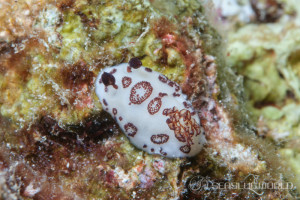
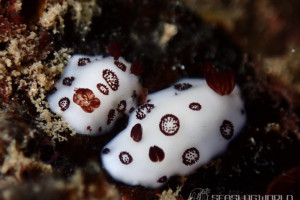
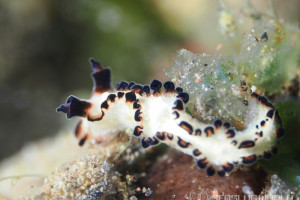
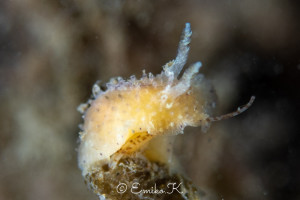
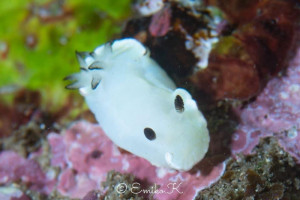
Body firm, with a finely tomentose surface. Background colour of dorsum and foot is white to yellow-cream. The notum bears several dark brown to black rings of varying sizes, larger in the middle of the body. These rings are not simple outlines: their interiors are filled with minute dark brown to black spots, giving them a stippled appearance. Similar dark spots are scattered along the mantle margin, but the sole of the foot is unspotted. A few specimens show small brown spots on the upper lip. Rhinophores are white with black bases and apices, sometimes black-spotted, while the gills are white with black lines along the rachis and the first and second pinnae of each leaf. Preserved animals are typically 20 mm in length, reaching 60-70 mm alive.Labial cuticle smooth, lacking jaw elements. Radular formula 17-21 × (18-21.0.18-21), with no rachidian teeth. Innermost lateral teeth are hamate, shorter than the midlateral teeth and lacking denticles. Midlateral teeth are thick and hamate; outermost teeth are smaller, hamate and also lack denticles. The reproductive system features an accessory gland with a curved, pointed copulatory spine about 717 µm long.
Distribution
Widely distributed across the Indo-West Pacific and central Pacific. Recorded from South Africa, Tanzania, Seychelles, Sri Lanka, India, Thailand, Vietnam, Singapore, the China Sea, the Philippines, the Marshall Islands, Indonesia, Palau, the Caroline Islands, New Caledonia and Japan.Etymology
The specific epithet funebris is Latin for "funereal" or "of mourning." Kelaart 1859 chose this name because the regular black rings on a white body reminded him of mourning attire.Remarks
Originally described by Kelaart 1859 and later assigned to numerous synonyms across the Indo-West Pacific. Camacho-García & Gosliner 2008 treated Bergh's 1876 Kentrodoris annuligera from the Philippines, Eliot's 1906 Kentrodoris maculosa, Allan's 1932 Discodoris wetleyi and Marcus's 1976 Jorunna zania all as synonyms of this species. The species feeds on sponges, particularly purple sponges including species of Xestospongia.References
- Kentrodoris funebris (Kelaart), Allan J.K. (1947). Nudibranchia from the Clarence River Heads, north coast, New South Wales. Records of the Australian Museum, 21(8): 433-463, pls. xli-xliii and map. https://doi.org/10.3853/j.0067-1975.21.1947.561
- フネブリス, 小野篤司. (1999). ウミウシガイドブック. TBSブリタニカ.
- ゼニガタウミウシ, 奥谷喬司. (2000). 日本近海産貝類図鑑. 東海大学出版会.
- ヨルンナ・フネブリス, 殿塚孝昌. (2003). ウミウシガイドブック〈3〉. TBSブリタニカ.
- ブチウミウシ, 小野篤司. (2004). 沖縄のウミウシ. ラトルズ.
- ブチウミウシ, 中野理枝. (2004). 本州のウミウシ. ラトルズ.
- Jorunna funebris (Kelaart, 1859), Camacho-Garcia Y.E. & Gosliner T.M. (2008). Systematic revision of Jorunna Bergh, 1876 (Nudibranchia: Discodorididae) with a morphological phylogenetic analysis. Journal of Molluscan Studies. 74(2): 143-181. https://doi.org/10.1093/mollus/eyn002
- ブチウミウシ, 小野篤司 & 加藤昌一. (2009). ウミウシ. 誠文堂新光社.
- Jorunna funebris, Terrence Gosliner, Ángel Valdés and David Behrens. (2015). Nudibranch and Sea Slug Identification Indo-Pacific. New World Pubns Inc.
Featured in this book
Terrence Gosliner, Ángel Valdés and David Behrens. (2018). Nudibranch and Sea Slug Identification Indo-Pacific 2nd Edition. New World Pubns Inc.
New World Publications
This species, Jorunna funebris, is included in the book.
View on Amazon PR (Amazon Associates)Seasonality
Shooting Locations
Loading shooting locations...
Photos of Jorunna funebris
Tag:
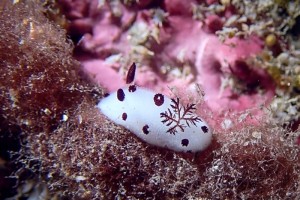

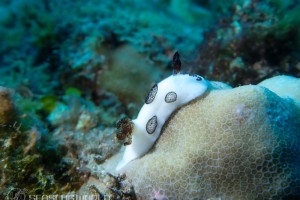




















Same Genus Nudibranchs

Similar Colors Nudibranchs

Academic Database
Sea slug observation data is available in international marine biodiversity databases.