Mexichromis antonii (Bertsch, 1976)
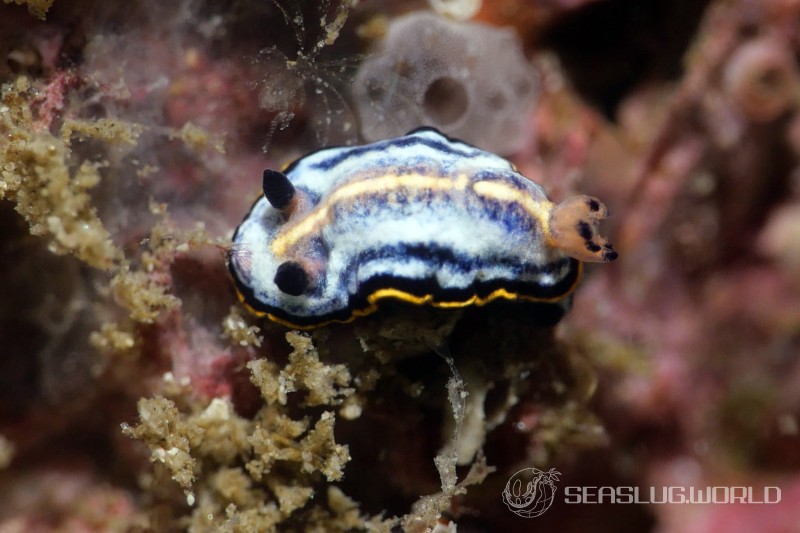
- Location
- La Blanquita, Huatulco, Oaxaca, Mexico
- Date
- 2021/05/17
- Length
- ??mm
- Depth
- ??m
- Water temperature
- ??℃
Description
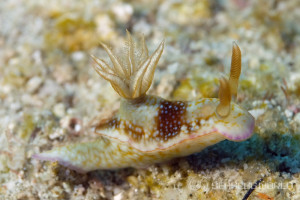
Mexichromis antonii is a small eastern Pacific chromodorid nudibranch, about 10 mm long alive, patterned in light blue, magenta, black, yellow-orange and white. A complete yellow-orange line runs around the rim of the mantle, with a black line immediately inside it. Inside that lies a broad band of light blue, itself divided by a blackish line concentric with the two outer bands. The centre of the back — from between the rhinophores forward of and beside the gills — is light magenta with darker blotches scattered at random, and a thick, broken white line runs lengthwise down the midline, edged with a faint yellowish tinge. The rhinophores are light magenta at the base and black over the distal quarter. There are 6 or 7 pinnate gill plumes, pinkish white at the base and tipped with black, and the rim of the branchial pocket is tinged yellowish. The part of the foot that projects beyond the mantle is rimmed with black, followed by bands of light blue and dark blue, with a small broken white line down its centre. Preserved animals measure 3-4.5 mm.Distribution
Tropical eastern Pacific. The type locality is Punta Aguja near Mulegé, Baja California, Mexico, at about 9 m. The original description also listed Isla San José and Los Islotes in the Gulf of California and Santiago Bay near Manzanillo, Colima, on the Mexican mainland, all subtidal down to 28 m. A 1978 record from Isla Alcatraz, Costa Rica, extended the known range far to the south-east.Etymology
The describer named the species for Antonio J. Ferreira, a malacologist he calls his esteemed friend and fellow worker. Ferreira collected the type material and passed it to the describer, and contributed substantially to the taxonomy of chitons and opisthobranchs.Remarks
This is the type species of Mexichromis. The other species placed in the genus are Indo-West Pacific, and M. antonii is regarded as the only eastern Pacific member.Neptunazurea porterae is similar in overall tone, being blue with a yellow-orange line, but in that species the line encircles the central part of the back, whereas in M. antonii it follows the outermost rim of the mantle and is backed by a black line just inside it. Felimida macfarlandi, violet with a yellow-orange border, is told apart by the three yellowish longitudinal lines along its back, which M. antonii lacks.
References
- Chromodoris antonii Bertsch, spec. nov., Bertsch H. (1976). A new species of Chromodoris (Opisthobranchia: Nudibranchia) from tropical west America. The Veliger. 19(2): 156-158.
- Mexichromis antonii (Bertsch, 1976b), Bertsch H. (1977). The Chromodoridinae nudibranchs from the Pacific coast of America. Part I. Investigative methods and supraspecific taxonomy. The Veliger. 20(2): 107-118.
- Mexichromis antonii (Bertsch, 1976b), comb. nov., Bertsch H. (1978). The Chromodoridinae nudibranchs from the Pacific coast of America. Part III. The genera Chromolaichma and Mexichromis. The Veliger. 21(1): 70-86.
- Mexichromis antonii, Johnson R.F. & Gosliner T.M. (2012). Traditional taxonomic groupings mask evolutionary history: a molecular phylogeny and new classification of the chromodorid nudibranchs. PLoS ONE 7(4): e33479.
- Mexichromis antonii, Behrens D.W., Hermosillo A., Fletcher K. & Jensen G.C. (2022). Nudibranchs & Sea Slugs of the Eastern Pacific. Molamarine.
Featured in this book
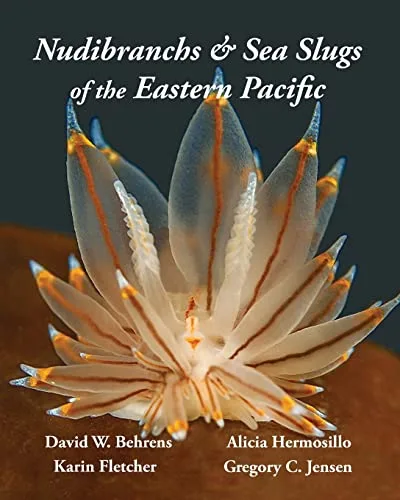
Behrens D.W., Hermosillo A., Fletcher K. & Jensen G.C. (2022). Nudibranchs & Sea Slugs of the Eastern Pacific. Molamarine.
Molamarine
This species, Mexichromis antonii, is included in the book.
View on Amazon PR (Amazon Associates)Seasonality
Shooting Locations
Loading shooting locations...
Photos of Mexichromis antonii

Same Genus Nudibranchs

Similar Colors Nudibranchs

Academic Database
Sea slug observation data is available in international marine biodiversity databases.