Mexichromis similaris (Rudman, 1986)
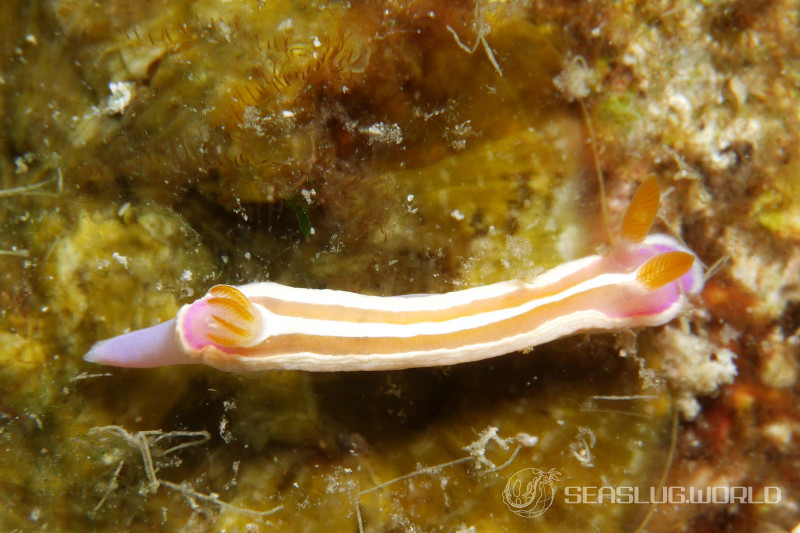
- Location
- Apogama, Okinawa Island (Onna and Yomitan area), Okinawa, Japan
- Date
- 2017/04/05
- Length
- 7mm
- Depth
- 8.0m
- Water temperature
- 21.0℃
Description
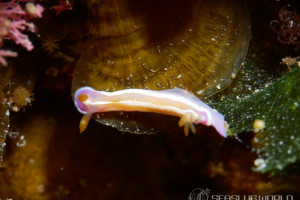
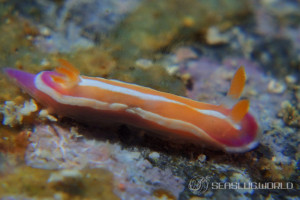
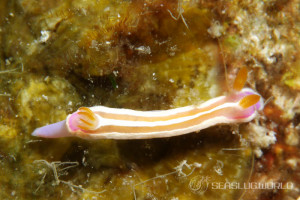
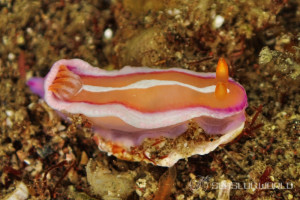
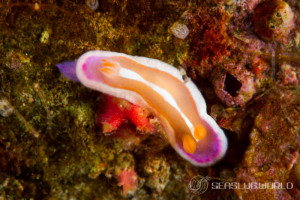
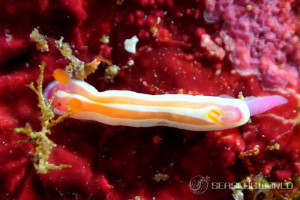
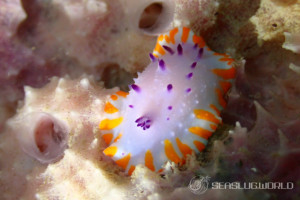
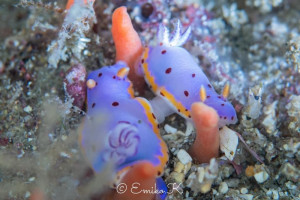
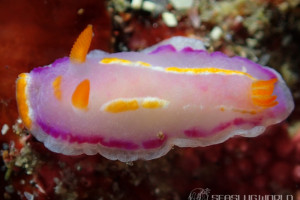
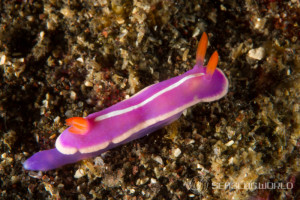
From the original description (Rudman, 1986):The mantle is a pale pinkish-purple colour with a white band around the edge. At the edge of the pinkish-purple region, alongside the white border, are diffuse reddish-purple patches which coalesce anteriorly and posteriorly to form an irregular reddish-purple crescent in front of the rhinophores, and another behind the gill pocket. A median white line runs from between the rhinophores back to and encircling the gill pocket.In one specimen the upper half of the rhinophore club is orange and the lower half and stalk are translucent white; in the other the rhinophore club is deeper orange-red almost to the base, with a translucent pale-purple stalk. In available photographs the upper half of the gill is orange-red, and in the preserved specimen the upper half is bright orange and the lower half translucent. Body elongately ovate with a relatively narrow mantle overlap. "The mantle glands are clearly visible in preserved specimens forming a closely packed series of glands right around the edge of the mantle. They open at the edge of the mantle and correspond to the white marginal mantle band. The glands are twice as large at the posterior end of the mantle." Radular formula 11.0.11 × 23 (specimen 6 mm long preserved); the innermost tooth has a long pointed cusp with two or three prominent pointed denticles outside and one or two inside, the uppermost outer denticle nearly as large as the cusp, giving the tooth a bicuspid appearance. Currently known only from very small specimens, 3-5 mm preserved.
Distribution
Type locality is Buyong Beach, Mactan Is., Cebu, Philippines, 8 m, 20 April 1983 (5 mm long preserved, HOLOTYPE AM C138170). PARATYPE from Wheeler Reef near Townsville, North Queensland, Australia, 30 m, 16 June 1974 (3 mm long preserved, AM C95077). Original series of two specimens only.Etymology
From the original description (Rudman, 1986):The name similaris is a reference to the remarkable similarity in colour between this species and Noumea varians, N. purpurea and Pectenodoris trilineata.
Remarks
Originally described as Durvilledoris similaris. A 1986 monograph discussed the systematic position of Durvilledoris: in D. lemniscata "the mantle glands are of uniform size all around the mantle, typical of the Chromodoris subgroup," whereas in D. similaris "the mantle glands are clearly larger posteriorly as in Hypselodoris" — the small anatomical differences between the two species "help to confirm the phylogenetic position of the genus at a point near where the Hypselodoris subgroup of the family diverged from the Chromodoris subgroup." Subsequently transferred to Mexichromis (currently accepted as Mexichromis similaris on WoRMS). Rudman noted that "at present D. similaris is known only from the Great Barrier Reef, N Australia and the Philippines, but these small species have seldom been adequately collected and its actual distribution is probably much larger than present records suggest."References
- ニタリイロウミウシ(新称), 小野篤司. (2004). 沖縄のウミウシ. ラトルズ.
- Mexichromis similaris, Johnson R.F. & Gosliner T.M. (2012). Traditional taxonomic groupings mask evolutionary history: a molecular phylogeny and new classification of the chromodorid nudibranchs. PLoS ONE 7(4): e33479.
- Mexichromis similaris, Terrence Gosliner, Ángel Valdés and David Behrens. (2015). Nudibranch and Sea Slug Identification Indo-Pacific. New World Pubns Inc.
Featured in this book
Terrence Gosliner, Ángel Valdés and David Behrens. (2018). Nudibranch and Sea Slug Identification Indo-Pacific 2nd Edition. New World Pubns Inc.
New World Publications
This species, Mexichromis similaris, is included in the book.
View on Amazon PR (Amazon Associates)Seasonality
Shooting Locations
Loading shooting locations...
Photos of Mexichromis similaris







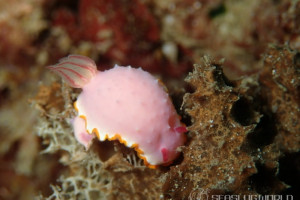
Same Genus Nudibranchs
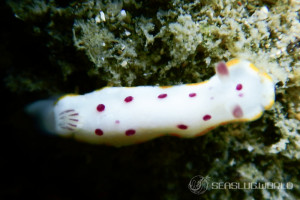

Similar Colors Nudibranchs
Academic Database
Sea slug observation data is available in international marine biodiversity databases.