Notodoris serenae Gosliner & Behrens, 1997
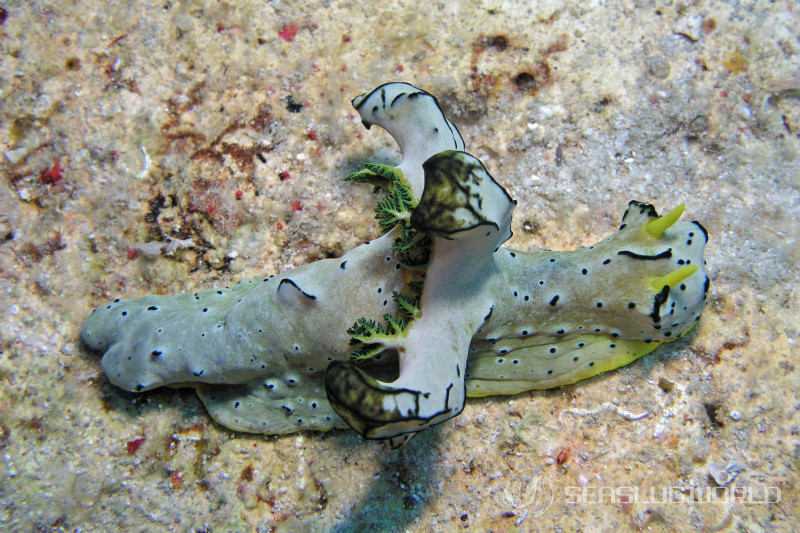
- Location
- Seragaki Out Reef, Okinawa Island (Onna and Yomitan area), Okinawa, Japan
- Date
- 2003/04/29
- Length
- 90mm
- Depth
- 22.0m
- Water temperature
- 22.0℃
Description
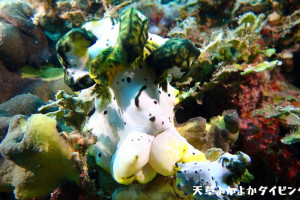
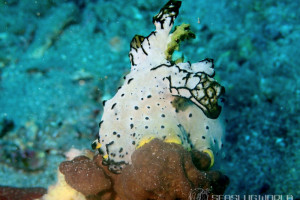
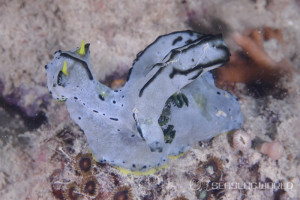
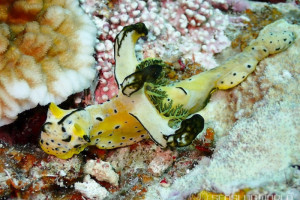
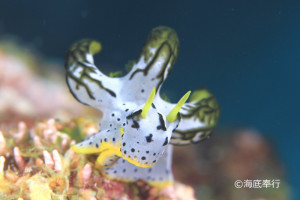
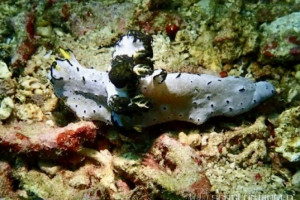
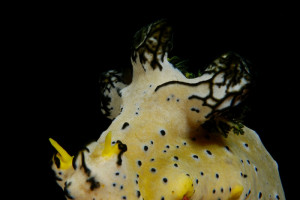
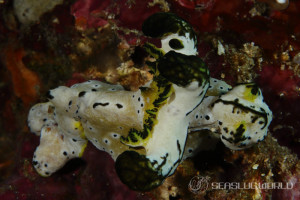
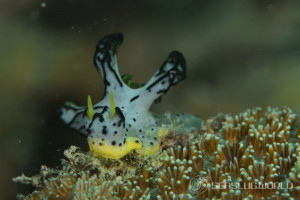
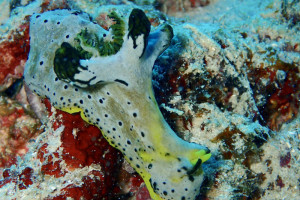
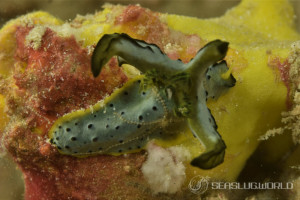
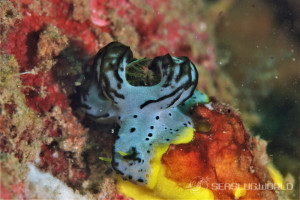
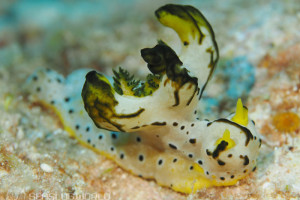
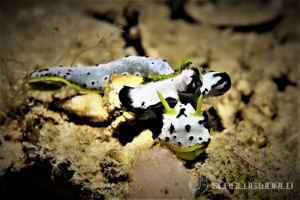
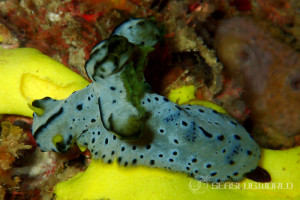
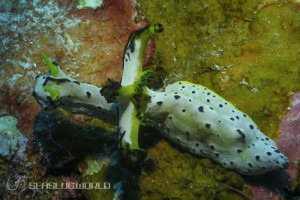
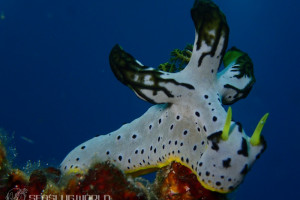
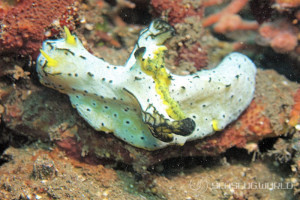
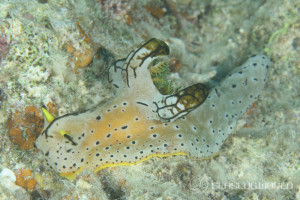
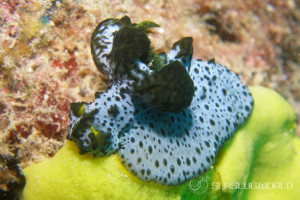
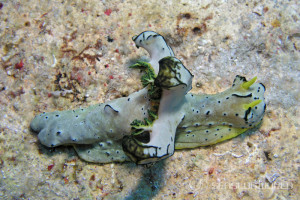
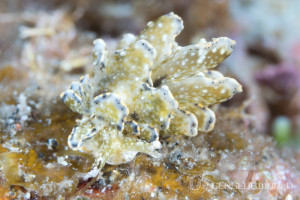
The body is firm and limaciform. Living animals reach 100 mm in length; preserved specimens are up to 58 mm. Body color is dull white to grey, with randomly distributed and variably sized low black tubercles and markings. The foot is yellow throughout, and its margin is visible dorsally and laterally when the animal is crawling. The gills are yellow or green with black tips. Three large, firm, arching extrabranchial appendages surround the gills, the medial of which is shorter than the two laterals — a feature unique to this species among Notodoris. A pattern of reticulating ridges adorns each appendage, marked with black and densest at their tips. The head is angular, accentuated by a series of ridges of irregular black-tipped tubercles. The rhinophores are simple, smooth, and bright yellow. The head bears a raised medial ridge, which is black, beginning anterior to the rhinophores and continuing posteriorly. A series of irregular tubercles, each black-tipped, are situated laterally to each rhinophore. The oral tentacles form two lappets on either side of the head.Distribution
Known from Papua New Guinea, Indonesia, Malaysia, Philippines, Belau (Palau), Pohnpei, and Okinawa.Etymology
Named for Serena Jebb, who found some of the first specimens of this species and is an enthusiastic supporter of this research.Remarks
Found at 10–15 m depth on the edges of barrier reef crests, where it feeds upon the calcareous sponge Leucetta chagosensis Dendy, 1913 (not L. primigenia Haeckel, 1872, as erroneously indicated in Gosliner, Behrens & Williams 1996). Differs from the three other described members of Notodoris (N. gardineri, N. minor, N. citrina), all of which have a bright yellow body color and three overhanging branchial lappets, by its predominantly gray color and unique three arching extrabranchial appendages. The species was briefly transferred to Aegires but is currently returned to Notodoris.References
- Notodoris serenae Gosliner & Behrens, sp. nov., Gosliner T. M. & Behrens D. W. (1997). Description of four new species of phanerobranch dorids (Mollusca: Nudibranchia) from the Indo-Pacific, with a redescription of Gymnodoris aurita (Gould, 1852). Proceedings of the California Academy of Sciences 49(9): 287-308.
- ノトドリス・セレナエ, 殿塚孝昌. (2003). ウミウシガイドブック〈3〉. TBSブリタニカ.
A Kindle field guide by the site author
Kimoto N. (2026). Sea Slugs of Japan & the Indo-Pacific, 2nd Edition.
Kindle Edition
View on Amazon PR (Amazon Associates)Seasonality
Shooting Locations
Loading shooting locations...
Photos of Notodoris serenae
Tag:

















Same Genus Nudibranchs
Similar Colors Nudibranchs

Academic Database
Sea slug observation data is available in international marine biodiversity databases.