Trapania scurra Gosliner & Fahey, 2008
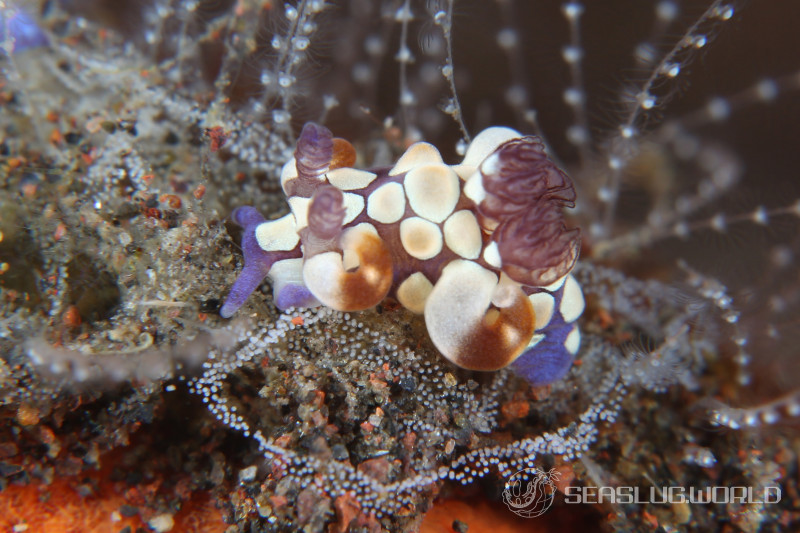
- Location
- Seraya, Tulamben, Pulau Bali, Indonesia
- Date
- 2015/11/14
- Length
- 5mm
- Depth
- 21.0m
- Water temperature
- 29.0℃
Description
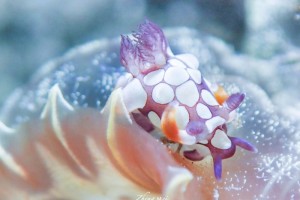
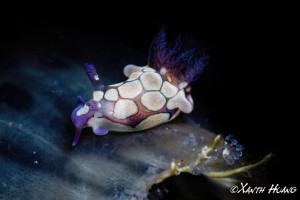
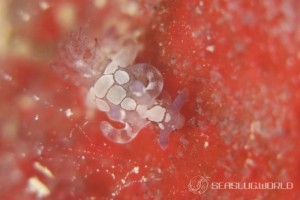
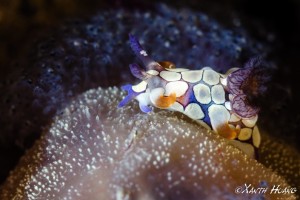
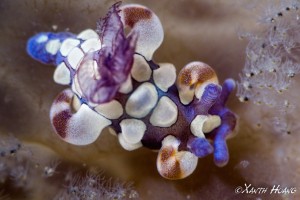
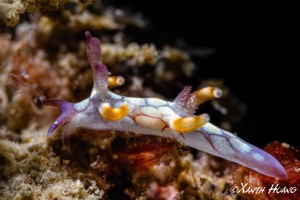
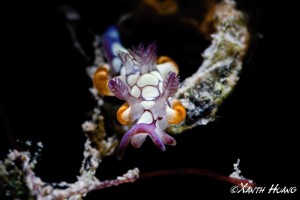
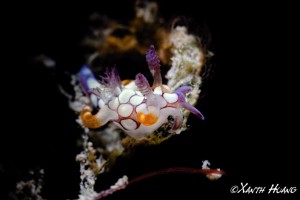
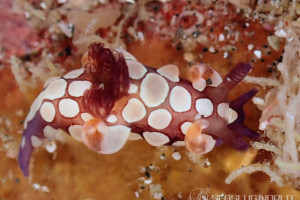
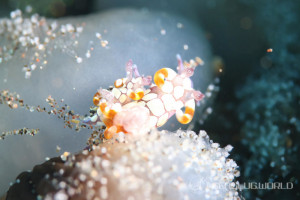
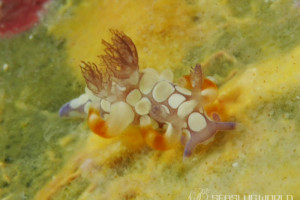
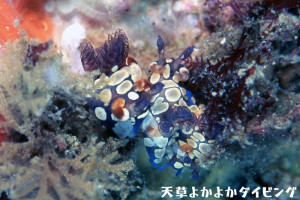
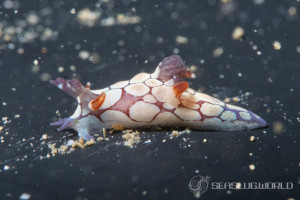
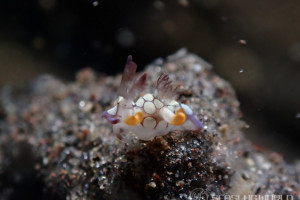
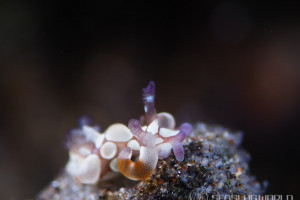
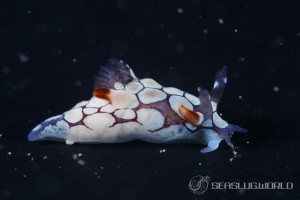
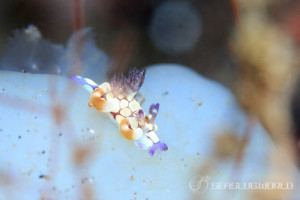
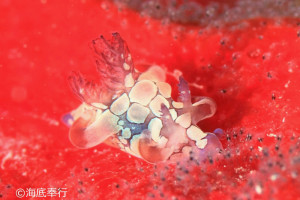
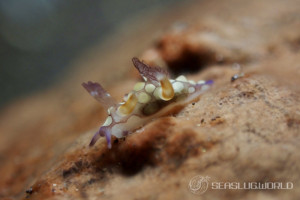
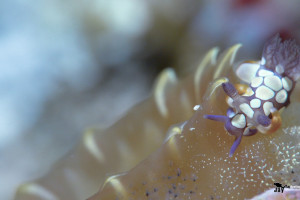
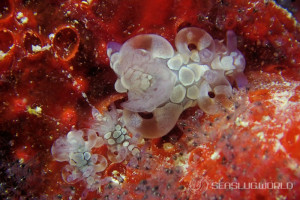
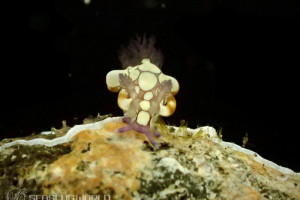
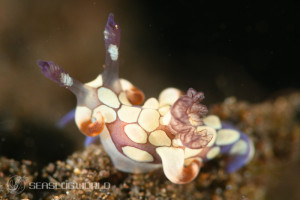
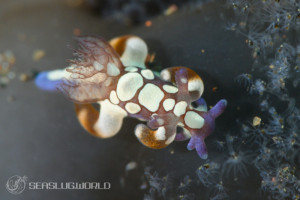
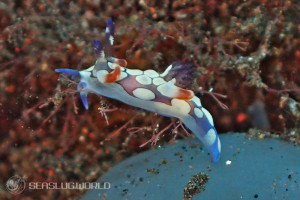
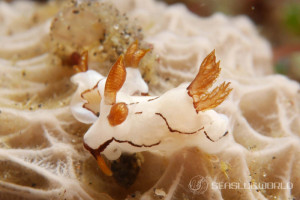
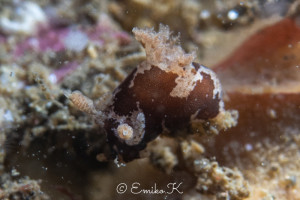
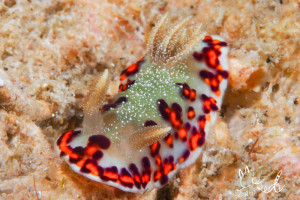
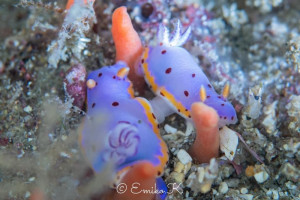
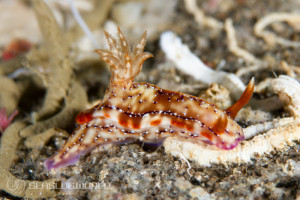
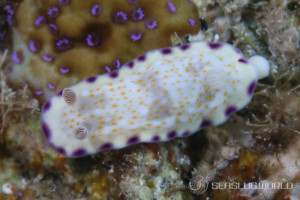
Body 14–15 mm long, stout and convex, lacking a notal margin. Widest at the branchial region. Oral tentacles are long, cylindrical with rounded apices. Rhinophores are short with seven lamellae and roughly uniform in width along their length. Extra-rhinophoral appendages are long compared with the rhinophores and have a curved apex. Extra-branchial appendages are wide, curved and longer than the extra-rhinophoral appendages. Gill consists of three bipinnate branches.The body is translucent lavender with creamy white or yellow patches. The anterior surface of the foot is bright blue, with some blue showing between the cream-yellow patches on the upper surface of the foot. The anterior foot tentacles have creamy white bases and blue tips. The oral tentacles are the same bright blue as the anterior edge of the head. Extra-rhinophoral and extra-branchial appendages are translucent white at the base with red-brown pigment midpoint and near the apices. The rhinophores are translucent lavender with deeper lavender lamellae. Gill leaves are also translucent, each with a lavender rachis.
Distribution
Philippines (type locality: Maricaban Island, Batangas), Indonesia and Malaysia.Etymology
Verbatim from the original description (Gosliner & Fahey, 2008, p.68):The specific name scurra is taken from the Latin word for 'jester'. The bright unusual colours found on this species are reminiscent of a clown or court jester.
Remarks
Described as one of 16 new Indo-Pacific Trapania species in Gosliner, T.M. & Fahey, S.J. 2008 Zoological Journal of the Linnean Society 152: 53-111. The authors stated: "Externally, this species does not closely resemble any other Trapania in its colour pattern ... No other Trapania has the bright blue colouration found on the foot and oral tentacles. No other species has large opaque white spots on pale lavender background colour with lavender gill leaves" (p.69). The radula is also unique among Trapania in having "the same number of denticles on the outside of the main cusp as are found inside the cusp" (p.69).References
- Trapania sp. 6 (Rudman, Sea Slug Forum), Rudman W.B. (1998-2010). Sea Slug Forum. Australian Museum, Sydney. http://www.seaslugforum.net/
- Trapania scurra sp. nov., Gosliner T.M. & Fahey S.J. (2008). Systematics of Trapania (Mollusca: Nudibranchia: Goniodorididae) with descriptions of 16 new species. Systematics and Biodiversity. 6(1): 53-98. https://doi.org/10.1017/s1477200007002587
- Trapania scurra, Terrence Gosliner, Ángel Valdés and David Behrens. (2015). Nudibranch and Sea Slug Identification Indo-Pacific. New World Pubns Inc.
- シラタマツガルウミウシ(新称), 中野理枝. (2018). 日本のウミウシ. 文一総合出版.
- Paz-Sedano S., Moles J., Smirnoff D., Gosliner T.M. & Pola M. (2024). A combined phylogenetic strategy illuminates the evolution of Goniodorididae nudibranchs (Mollusca, Gastropoda, Heterobranchia). Molecular Phylogenetics and Evolution. 192: 107990. https://doi.org/10.1016/j.ympev.2023.107990
Featured in this book

Terrence Gosliner, Ángel Valdés and David Behrens. (2018). Nudibranch and Sea Slug Identification Indo-Pacific 2nd Edition. New World Pubns Inc.
New World Publications
This species, Trapania scurra, is included in the book.
View on Amazon PR (Amazon Associates)Seasonality
Shooting Locations
Loading shooting locations...
Photos of Trapania scurra
Tag:



















Same Genus Nudibranchs
Similar Colors Nudibranchs
Academic Database
Sea slug observation data is available in international marine biodiversity databases.