Doriprismatica balut S. B. Matsuda & Gosliner, 2018
- Location
- Romblon Island, Philippines
- Date
- 2018/03/07
- Length
- 15mm
- Depth
- 15.0m
- Water temperature
- 27.0℃
Description
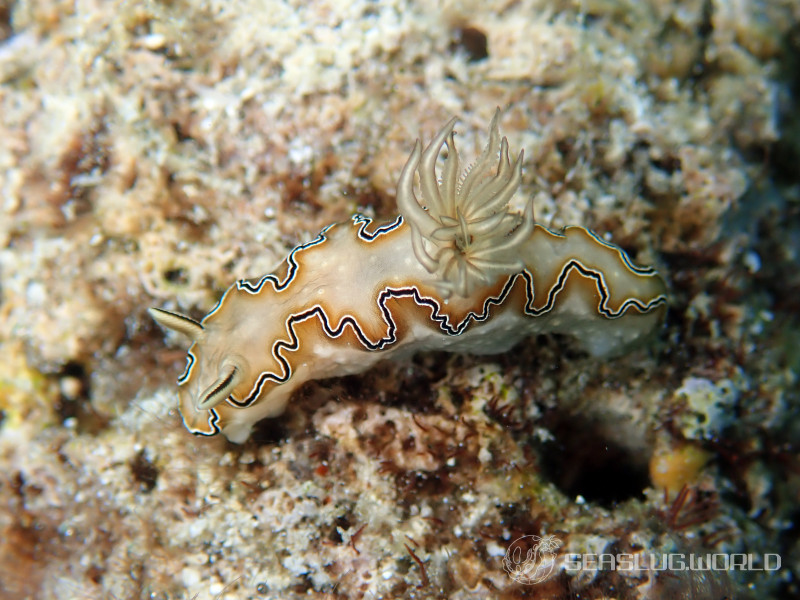
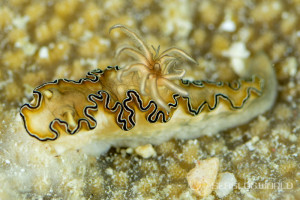
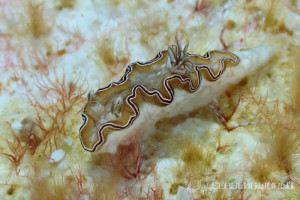
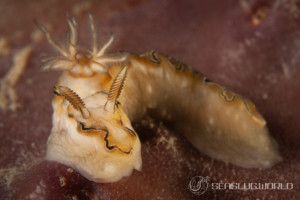
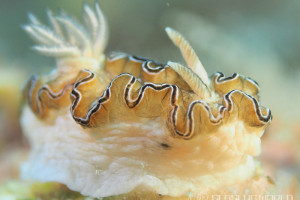
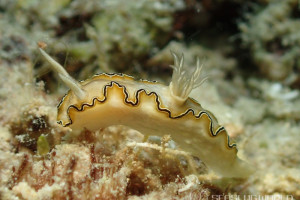
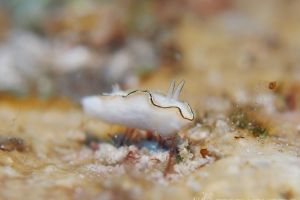
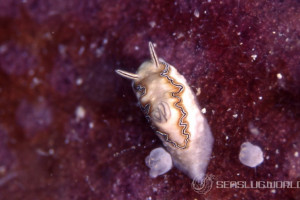
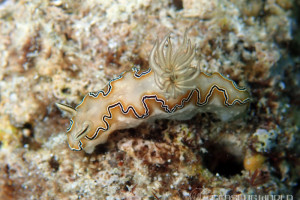
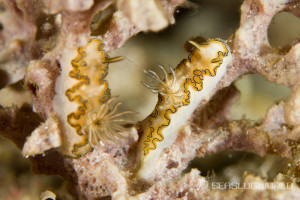
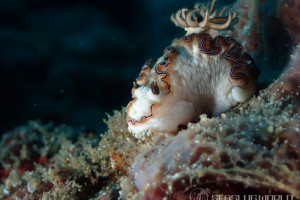
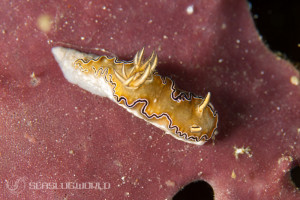
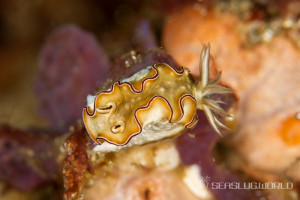
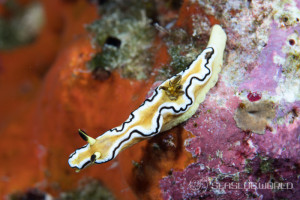
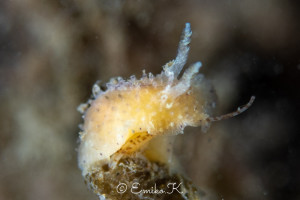
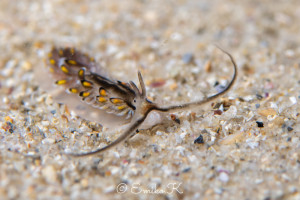
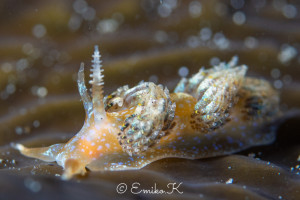
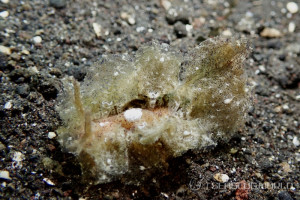
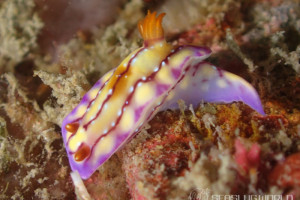
A small chromodorid of the genus Doriprismatica, reaching about 13 mm in length. The body is elongate with a light caramel-colored mantle that darkens slightly toward the edge. The mantle bears permanent and semi-permanent undulations along the margin and a series of marginal bands: a thin inner white band followed by a thicker continuous black band. A second inner white band is found on the ventral surface of the mantle. The continuous black band, without interruptions, distinguishes D. balut from the similar-looking Doriprismatica atromarginata (Cuvier, 1804), in which the black band has multiple breaks. The semi-translucent white gill is composed of 12–14 unipinnate lamellae, some bifid near the apices, with black-outlined tips. The rhinophores are cream and caramel with a black vertical line running along the anterior and posterior surfaces, bearing 10–12 crowded lamellae.Doriprismatica balut is unique within the genus in possessing a distinct rachidian tooth, which is lacking in D. rossi, D. atromarginata, Doriprismatica sibogae (Bergh, 1905), and Doriprismatica paladentata (Rudman, 1986). The egg mass is translucent with relatively large, bright yellow eggs, suggesting direct development.
Distribution
Philippines and Indonesia. Type locality: Maricaban Strait, Mabini (Calumpan Peninsula), Batangas Province, Luzon, Philippines.Etymology
The specific epithet refers to balut, a Filipino delicacy of a fertilized duck egg with a developed embryo, boiled and eaten in the shell. The name alludes to the presumed direct development of D. balut, inferred from its large egg size.Remarks
The a 2017 molecular phylogeny recovered D. balut as the sister lineage to a clade containing all other Doriprismatica species. Genetic uniformity in COI sequences across sampled Philippine specimens further supports its strong divergence from congeners (interspecific p-distances of 11–16%).References
- グロッソドリス属の一種, 殿塚孝昌. (2003). ウミウシガイドブック〈3〉. TBSブリタニカ.
- Doriprismatica sp. 1, Terrence Gosliner, Ángel Valdés and David Behrens. (2015). Nudibranch and Sea Slug Identification Indo-Pacific. New World Pubns Inc.
- Doriprismatica balut sp. nov., MATSUDA S.B. & GOSLINER T.M. (2018). Glossing over cryptic species: Descriptions of four new species of Glossodoris and three new species of Doriprismatica (Nudibranchia: Chromodorididae). Zootaxa. 4444(5). https://doi.org/10.11646/zootaxa.4444.5.1
Featured in this book
Terrence Gosliner, Ángel Valdés and David Behrens. (2018). Nudibranch and Sea Slug Identification Indo-Pacific 2nd Edition. New World Pubns Inc.
New World Publications
This species, Doriprismatica balut, is included in the book.
View on Amazon PR (Amazon Associates)Seasonality
Shooting Locations
Loading shooting locations...
Photos of Doriprismatica balut
Tag:









Same Genus Nudibranchs
Similar Colors Nudibranchs


Academic Database
Sea slug observation data is available in international marine biodiversity databases.