Doriprismatica paladentata (Rudman, 1986)
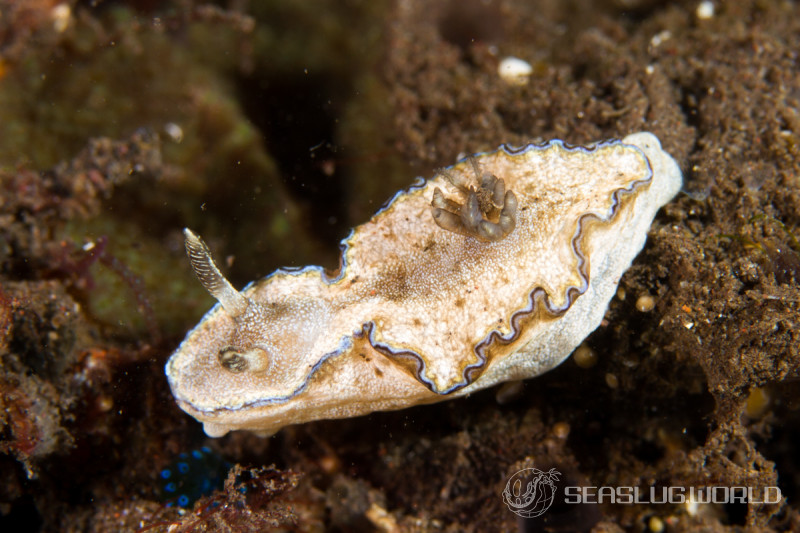
- Location
- MINA point, Tulamben, Pulau Bali, Indonesia
- Date
- 2018/01/11
- Length
- 25mm
- Depth
- 15.0m
- Water temperature
- 29.0℃
Description
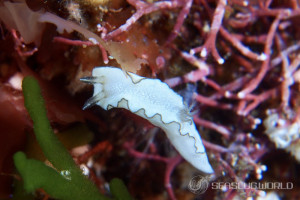
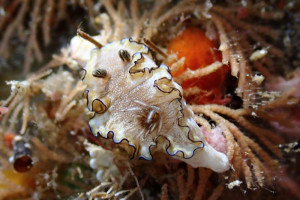
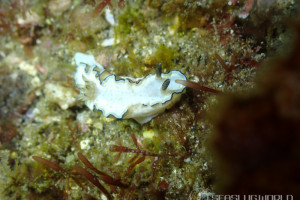
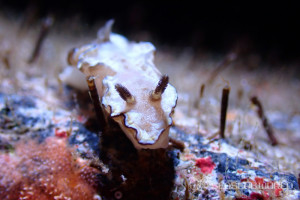
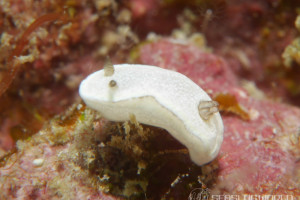
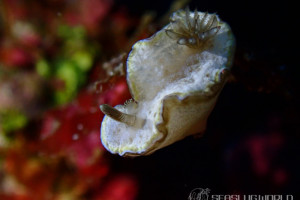
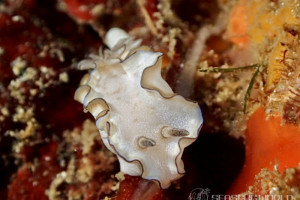
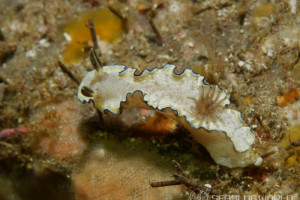
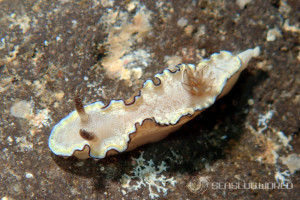
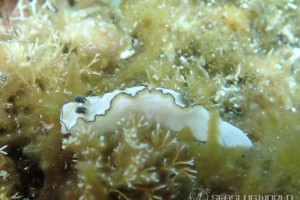
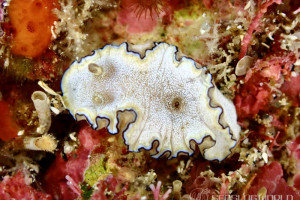
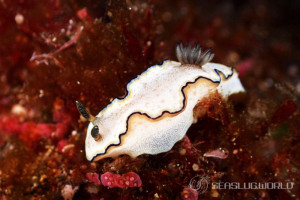
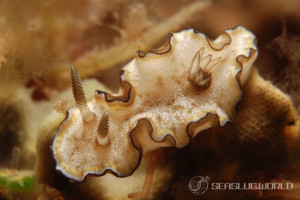
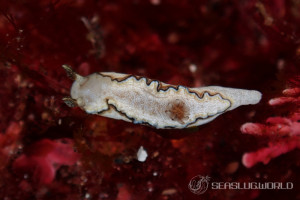
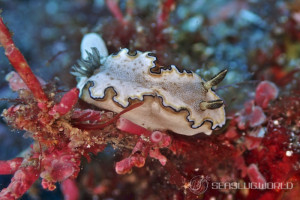
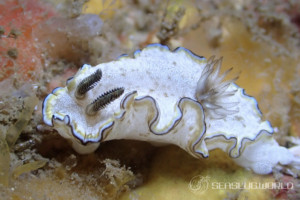
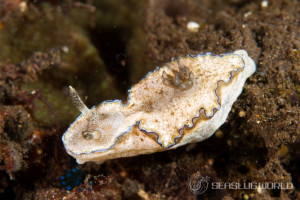
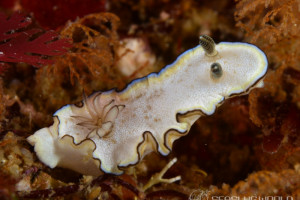
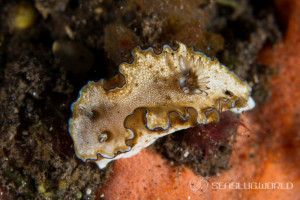
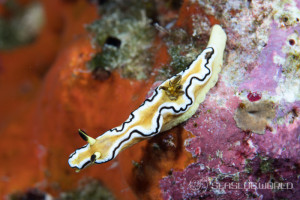
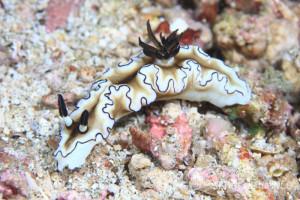
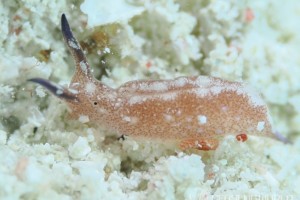
From the original description (Rudman, 1986):The species is very similar in colour to Glossodoris atromarginata with a pale creamy white background colour with a thin blackish line at the edge of the mantle. It differs in having scattered irregularly shaped brown spots on the mantle.Unlike G. atromarginata, in which the white is a uniform pigmentation, in G. paladentatus "the creamy white is produced by closely packed ovoid white spots or bodies on a translucent background. The brown spots are aggregations of similar shaped brown spots." A thin brownish-black line at the mantle border is built of pigment specks and is rather diffuse on both surfaces; the white pigment bodies adjacent to it appear milky blue dorsally because of small black or dark-brown specks on the ventral surface. The rhinophore and gill pockets are edged with a brownish-black line below which is a band of diffuse brown — a key diagnostic character. The rhinophore stalk is translucent white; the rhinophore club has dark-brown lamellae with median anterior and posterior white lines joining at the white tip. Gills translucent whitish, edged with dark brown. Body high and firm with a reduced mantle edge, much as in G. atromarginata. Radular formula of the holotype (13 mm preserved) 20.0.20 × 35 (+2); the innermost lateral on each side has a broad spade-like blade with 9-10 pointed denticles inside the base and 2-4 outside.
Distribution
Type locality is Gallows Reef, Milne Bay, Papua New Guinea, 25 m, 16 April 1982 (collected and photographed by Neville Coleman; HOLOTYPE AM C.136371, PARATYPE AM C.140610) — only two specimens (6 and 13 mm preserved) in the original description. Also recorded subsequently from Vanuatu and elsewhere.Etymology
From the original description (Rudman, 1986):The name paladentatus is from the Latin for spade and tooth, a reference to the spade-like innermost lateral teeth.
Remarks
From the original description (Rudman, 1986):This species is very similar in shape and colour to G. atromarginata.External differences: (1) the whitish body colour is formed from ovoid pigment marks on a translucent background rather than uniform pigmentation; (2) scattered brown spots are absent in G. atromarginata; (3) the dark mantle border is a clear line in G. atromarginata but a diffuse band of greyish specks ventrally in G. paladentatus; (4) "in G. paladentatus there is a dark border around the gill pocket which is never present in G. atromarginata." The buccal armature differs sharply, the teeth of G. paladentatus being twice as large as those of G. atromarginata and "the unique shape of the teeth of G. paladentatus clearly suggests an unusual functional adaptation." Originally described as Glossodoris paladentatus; subsequently transferred to Doriprismatica in a molecular revision — currently accepted as Doriprismatica paladentata on WoRMS.
References
- Doriprismatica paladentata, Johnson R.F. & Gosliner T.M. (2012). Traditional taxonomic groupings mask evolutionary history: a molecular phylogeny and new classification of the chromodorid nudibranchs. PLoS ONE 7(4): e33479.
- Doriprismatica paladentata, Terrence Gosliner, Ángel Valdés and David Behrens. (2015). Nudibranch and Sea Slug Identification Indo-Pacific. New World Pubns Inc.
- スキノハイロウミウシ(新称), 小野篤司 & 加藤昌一. (2020). 新版 ウミウシ. 誠文堂新光社.
Featured in this book
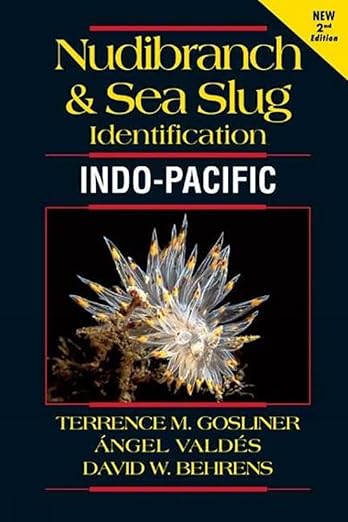
Terrence Gosliner, Ángel Valdés and David Behrens. (2018). Nudibranch and Sea Slug Identification Indo-Pacific 2nd Edition. New World Pubns Inc.
New World Publications
This species, Doriprismatica paladentata, is included in the book.
View on Amazon PR (Amazon Associates)Seasonality
Shooting Locations
Loading shooting locations...
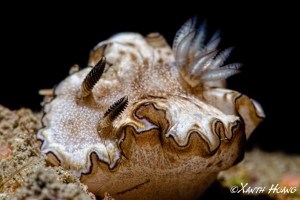
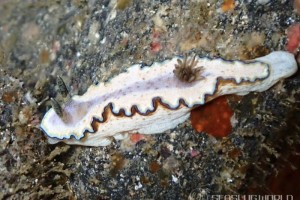
Photos of Doriprismatica paladentata

















Same Genus Nudibranchs
Similar Colors Nudibranchs


Academic Database
Sea slug observation data is available in international marine biodiversity databases.