Doriprismatica stellata (Rudman, 1986)
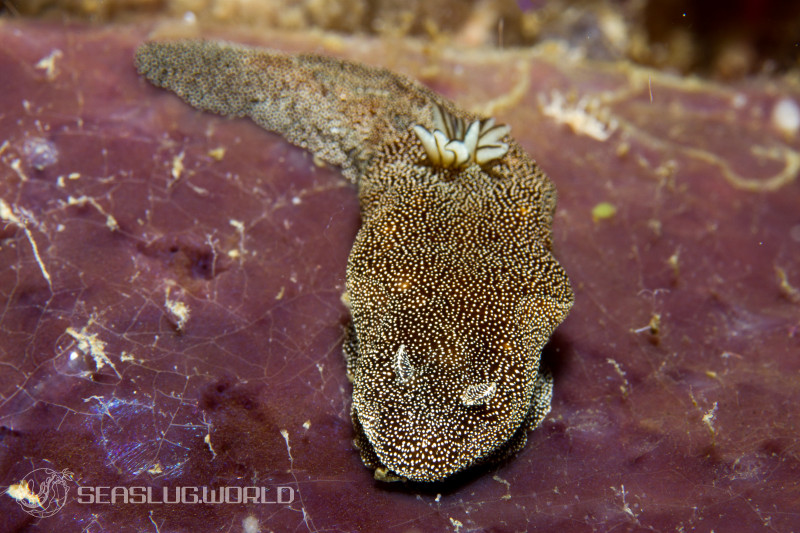
- Location
- Barracuda Point, Sipadan, Borneo, Malaysia
- Date
- 2013/02/20
- Length
- ??mm
- Depth
- ??m
- Water temperature
- ??℃
Description
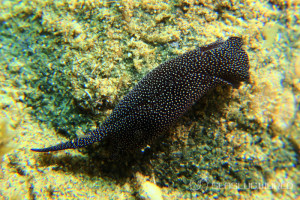
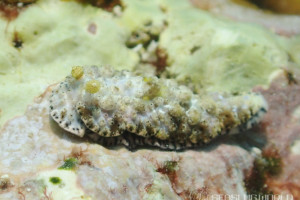
From the original description (Rudman, 1986):The whole body is black with small closely spaced white specks. The rhinophores are black with white specks with a white line up the posterior midline. The gills are translucent white with a black line up each edge.Body relatively high and hard to the touch as in tropical species of Ceratosoma; the mantle edge is very reduced, forming a stiff rounded edge. Behind the head the mantle narrows to form a "neck" before widening on each side once in front of the gills and once adjacent to them, again reminiscent of tropical Ceratosoma. The simple gills form an arc, open posteriorly, around the anus, the two ends curving inwards. Radular formula 34.0.34 × 165 (+4) with a small triangular thickening in the middle of each row. Holotype 26 mm long preserved.
Distribution
Type locality is Buchard Is., Milne Bay, Papua New Guinea, 20 m, 27 December 1981 (collected and photographed by Neville Coleman; AM C.136364, HOLOTYPE — single specimen of the original series). Subsequently observed from Indonesia, the Philippines, and Malaysia.Etymology
From the original description (Rudman, 1986):The name stellatus is from the Latin for 'starry' or 'set with stars', an allusion to the colour of the animal.
Remarks
From the original description (Rudman, 1986):This species is unique in colour, black with white specks, and in shape, with its reduced mantle and high firm body, is reminiscent of tropical species of Ceratosoma. However, the reproductive system and narrow radula clearly show that it is a species of Glossodoris. The morphology of the radular teeth is similar to that of G. atromarginata but the teeth are somewhat smaller.Originally described as Glossodoris stellatus; subsequently transferred to Doriprismatica in a molecular phylogenetic revision — currently accepted as Doriprismatica stellata on WoRMS.
References
A Kindle field guide by the site author
Kimoto N. (2026). Sea Slugs of Japan & the Indo-Pacific, 2nd Edition.
Kindle Edition
View on Amazon PR (Amazon Associates)Seasonality
Shooting Locations
Loading shooting locations...
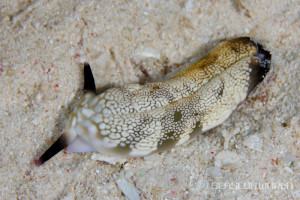
Photos of Doriprismatica stellata



Same Genus Nudibranchs
Similar Colors Nudibranchs
Academic Database
Sea slug observation data is available in international marine biodiversity databases.