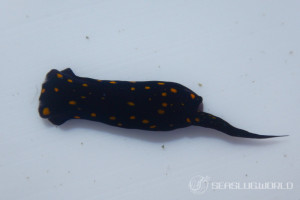
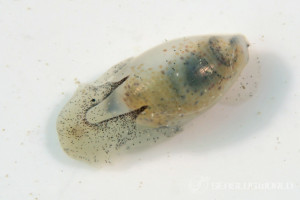
Mariaglaja alexisi (Gosliner, 2015)
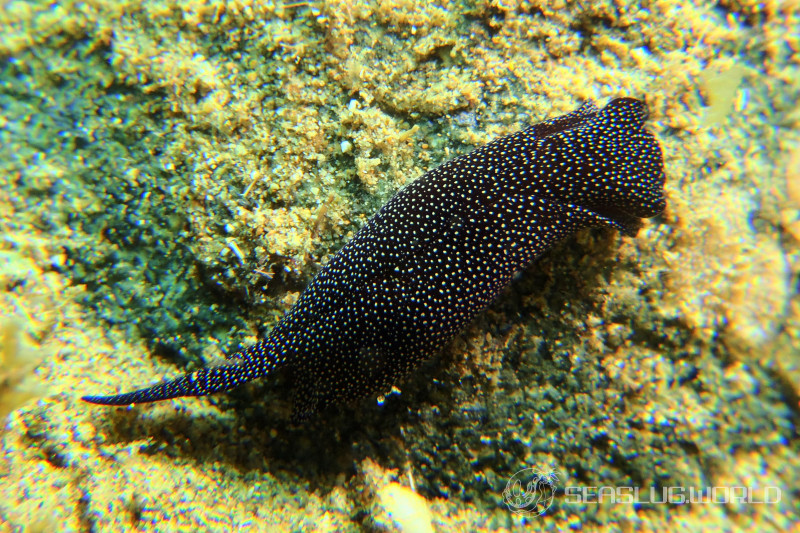
- Location
- Secret Garden, Anilao, Philippines
- Date
- 2013/03/17
- Length
- 15mm
- Depth
- ??m
- Water temperature
- ??℃
Description
A medium-sized aglajid head-shield sea slug. The holotype is 30 mm in body length alive. The body is uniformly black, densely sprinkled with numerous minute opaque white punctations on the cephalic shield, posterior shield and parapodia; the foot is uniformly black without white spots. One specimen from Puerto Galera entirely lacked the white punctations. The body is elongate and narrow, with a quadrilobate anterior margin of the cephalic shield (the most diagnostic external feature). The cephalic shield is elongate, accounting for about two-thirds of the body length, triangular, broadest anteriorly, and terminating posteriorly in a short rounded lobe. The posterior shield ends in a long, bilobed appendage on the left side and a short, broad lobe on the right. The parapodia are relatively wide and cover much of the cephalic shield. The gill bears eight primary plicate folds. The internal shell is thinly calcified, brownish and largely embedded within the posterior shield.Distribution
Type locality: Mainit Bubbles, Mabini, Batangas, Philippines (20 m depth, on silty sand). At the original description (Gosliner 2015) the species was also known from Puerto Galera (Mindoro Oriental, Philippines, 17 m depth, on a sandy slope); subsequent records remain limited to the Philippine Verde Island Passage region.Etymology
Named after the Filipino dive guide and photographer Alexis Principe, who found the only specimen on which the species could be described and who, in the words of the original description, "has made many new discoveries and has a great passion for the unique biodiversity of the Philippines".Remarks
Most similar in colour pattern to the congener Mariaglaja inornata (Baba, 1955), which also has a black body with opaque white spots, but M. inornata lacks white spots on the cephalic and posterior shields (which are present in M. alexisi), bears a broad anterior opaque white band with small orange lines or spots in front of it on the cephalic shield, has a trilobate (not quadrilobate) anterior margin of the head, and is typically associated with hard coral substrates rather than sandy substrates. Some dark-spotted colour variants of Mariaglaja sandrana (Rudman, 1973) also recall the species; however, M. alexisi is roughly twice the size of the largest M. sandrana, and the right lobe of the posterior shield is elongate and acute rather than truncate and rounded.References
- Chelidonura alexisi sp. nov., Gosliner T.M. (2015). The new species of aglajid cephalaspidean mollusks from the tropical Indo-Pacific of the Verde Island Passage. Proceedings of the California Academy of Sciences, ser. 4, 62(6): 191-205.
- Mariaglaja alexisi comb. nov., Andrea Zamora-Silva and Manuel António E. Malaquias Molecular phylogeny of the Aglajidae head-shield sea slugs (Heterobranchia: Cephalaspidea): new evolutionary lineages revealed and proposal of a new classification Zoological Journal of the Linnean Society, 2017
A Kindle field guide by the site author
Kimoto N. (2026). Sea Slugs of Japan & the Indo-Pacific, 2nd Edition.
Kindle Edition
View on Amazon PR (Amazon Associates)Seasonality
Shooting Locations
Loading shooting locations...
Photos of Mariaglaja alexisi


Same Genus Nudibranchs
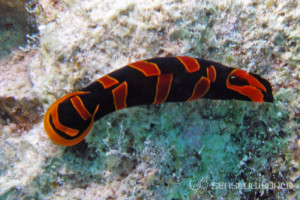
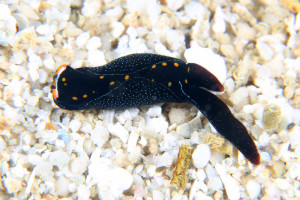
Similar Colors Nudibranchs
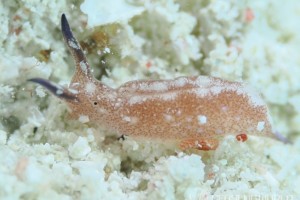
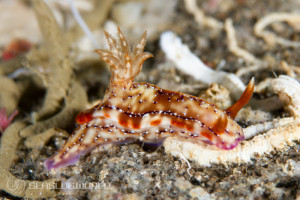
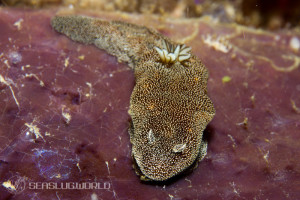
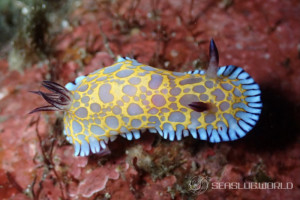
Academic Database
Sea slug observation data is available in international marine biodiversity databases.