Mariaglaja mandroroa (Gosliner, 2011)
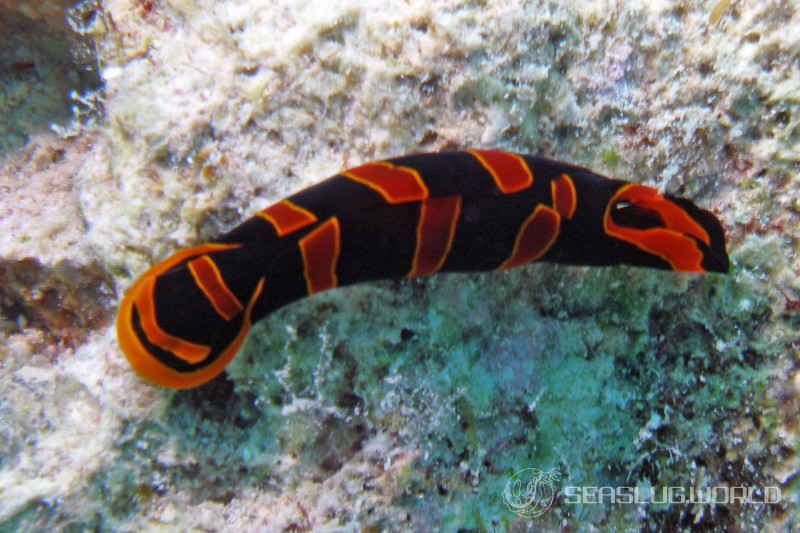
- Location
- Oosakiraionfisshunone, Ishigaki and Yaeyama, Okinawa, Japan
- Date
- 2006/10/11
- Length
- 20mm
- Depth
- 5.0m
- Water temperature
- 25.0℃
Description
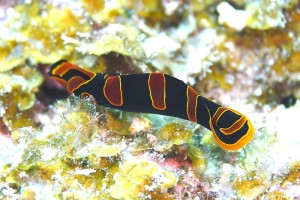
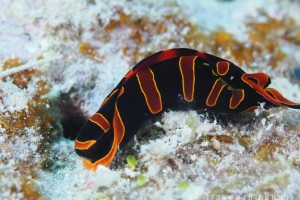
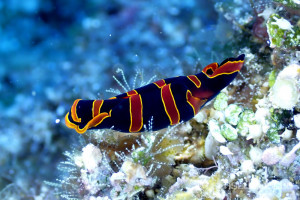
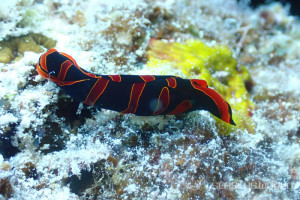
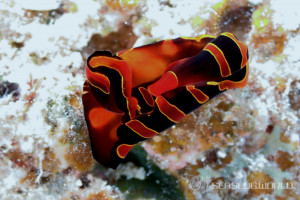
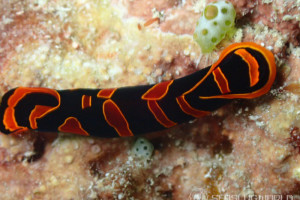
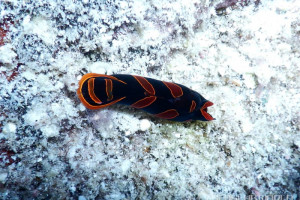
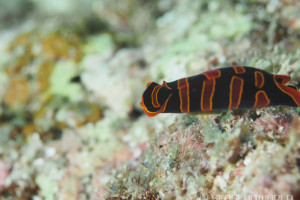
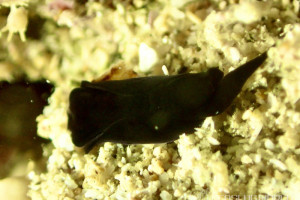
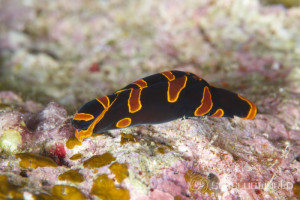
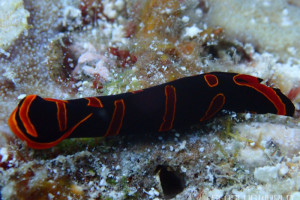
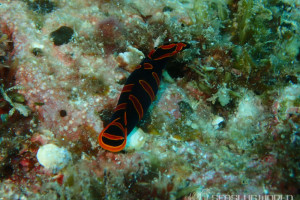
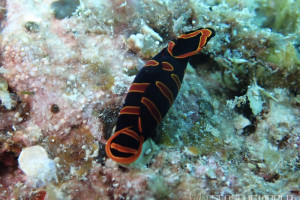
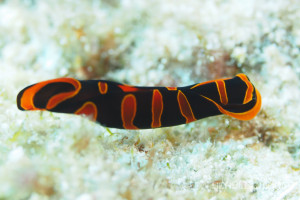
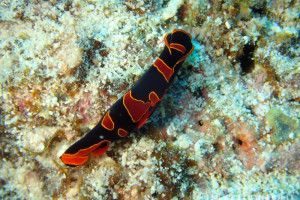
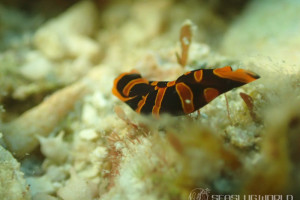
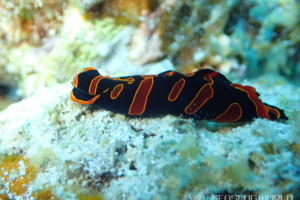
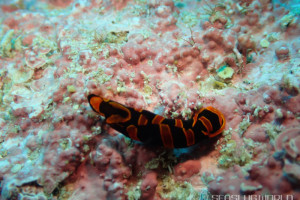
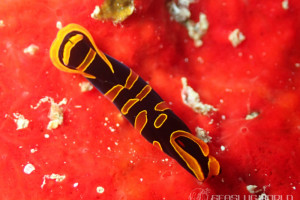
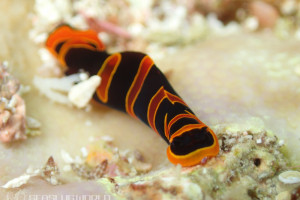
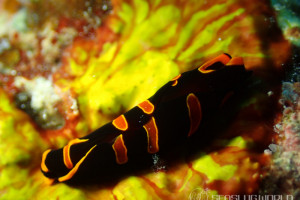
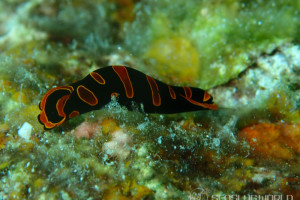
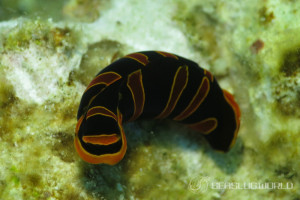
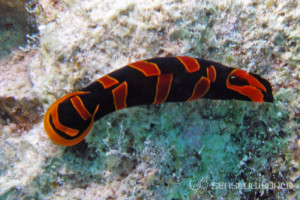
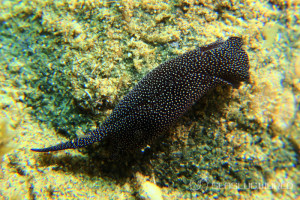
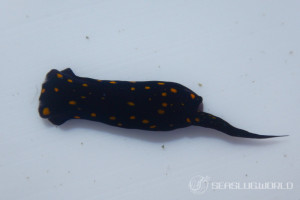
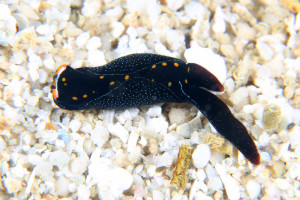
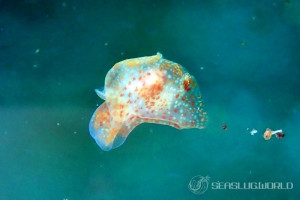
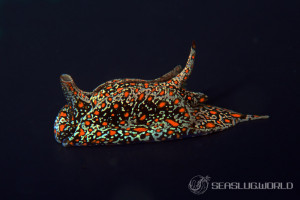
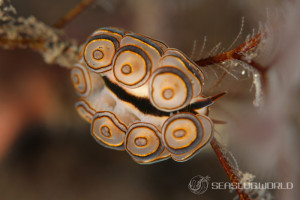
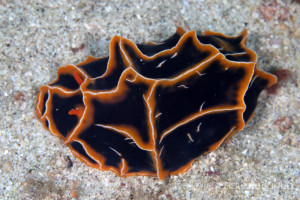
An elongate, narrow aglajid head-shield slug. The general body colour is dark brown to black with burnt orange patches and circles each bordered by bright yellow. This pigment pattern is found on the cephalic and posterior shields, the parapodia and the foot. The anterior end of the cephalic shield is trilobate. The cephalic shield is triangular, broadest anteriorly, and terminates posteriorly with a short rounded lobe. The posterior shield is well rounded anteriorly and ends in two short, broad posterior lobes that are acutely pointed at their ends; the lobes are approximately equal in length. The parapodia are relatively short, leaving most of the cephalic and posterior shields visible. The gill is plicate with 11 primary folds.The shell occupies the left third of the posterior shield, is relatively thickly calcified, and is shiny white with a brownish tinge. It has a broad anteriorly-directed wing and an elongate extension that is deeply imbedded in the posterior shield right to the end of the right posterior lobe. The penial papilla is smooth and conical, with a small curved apical stylet at its apex. Mariaglaja mandroroa is the only species of the Chelidonura group described with an apical cuticular stylet on the penis.
Distribution
Widely distributed in the tropical Indo-Pacific. Recorded from Japan, Taiwan, Indonesia, the Philippines, Tanzania and Madagascar. Type locality: west of Nosy Valiha, Radama Islands, Madagascar (11 m). Found on shallow reef flats, often under coral rubble or crawling in the open at 8–13 m depth.Etymology
The name "mandroroa" is the Malagasy word meaning "to hallucinate", referring to the striking, psychedelic colour pattern of this species.Remarks
Originally described as Chelidonura mandroroa, but transferred to Mariaglaja by Zamora-a 2017 revision of Aglajidae based on molecular phylogenetic analysis. Easily distinguished from all other aglajids by its unique colour pattern of a black body with orange patches surrounded by yellow lines. Initially tentatively placed in Philinopsis by Rudman 2001, but anatomical and molecular features (cephalic shield shape, calcified shell, short nerve commissures and apical cuticular stylet on the penis) clearly support placement in the Chelidonura clade. Originally described in Gosliner T. 2011 Zootaxa 2751: 1-24.References
- フィリノープシス属の1種, 小野篤司. (2004). 沖縄のウミウシ. ラトルズ.
- Chelidonura mandroroa n.sp., GOSLINER T. (2011). Six new species of aglajid opisthobranch mollusks from the tropical Indo-Pacific. Zootaxa. 2751(1). https://doi.org/10.11646/zootaxa.2751.1.1
- アカオビツバメガイ(新称), 中野理枝, 今川郁 & 今本淳. (2013). 南西諸島の後鰓類1. 頭楯亜目. ちりぼたん. 43(1-4): 1-22.
- Chelidonura mandroroa, Terrence Gosliner, Ángel Valdés and David Behrens. (2015). Nudibranch and Sea Slug Identification Indo-Pacific. New World Pubns Inc.
- Andrea Zamora-Silva and Manuel António E. Malaquias Molecular phylogeny of the Aglajidae head-shield sea slugs (Heterobranchia: Cephalaspidea): new evolutionary lineages revealed and proposal of a new classification Zoological Journal of the Linnean Society, 2017
Featured in this book
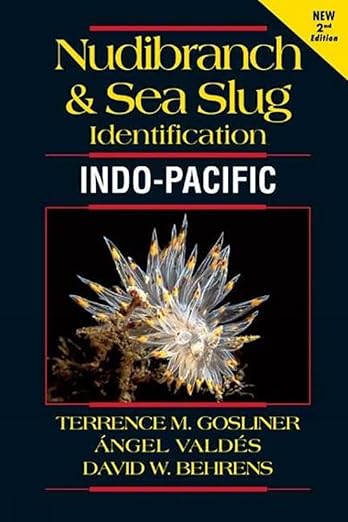
Terrence Gosliner, Ángel Valdés and David Behrens. (2018). Nudibranch and Sea Slug Identification Indo-Pacific 2nd Edition. New World Pubns Inc.
New World Publications
This species, Mariaglaja mandroroa, is included in the book.
View on Amazon PR (Amazon Associates)Seasonality
Shooting Locations
Loading shooting locations...
Photos of Mariaglaja mandroroa















Same Genus Nudibranchs
Similar Colors Nudibranchs


Academic Database
Sea slug observation data is available in international marine biodiversity databases.