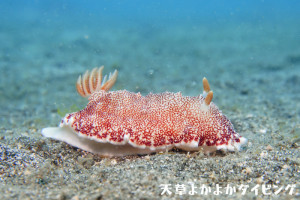
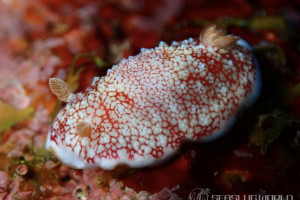
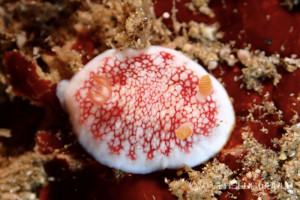
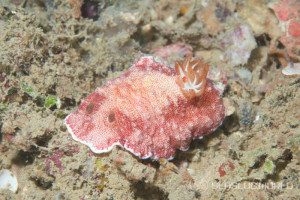
Goniobranchus reticulatus (Quoy & Gaimard, 1832)
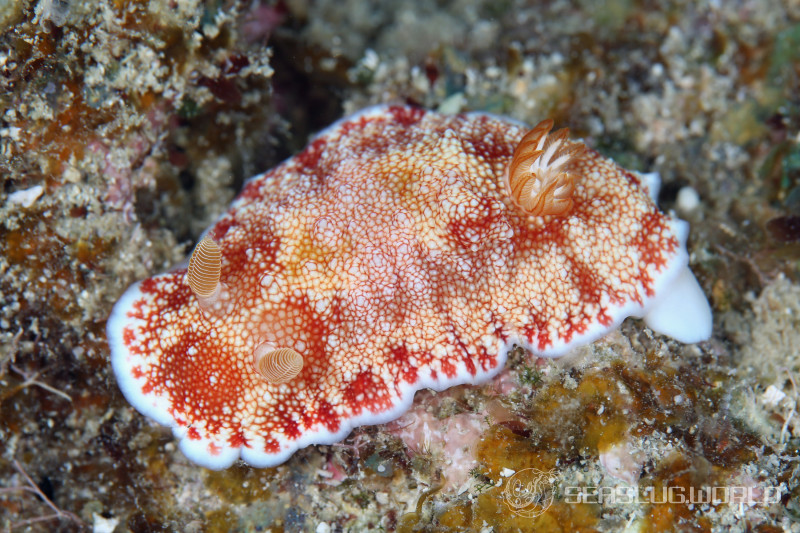
- Location
- Nashiro, Okinawa Island (Chatan and Southern area), Okinawa, Japan
- Date
- 2016/03/18
- Length
- 30mm
- Depth
- 8.0m
- Water temperature
- 21.0℃
Description
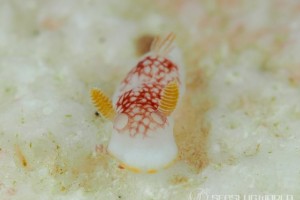
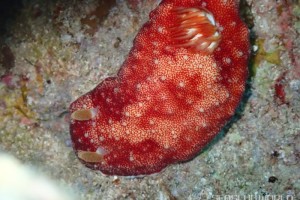
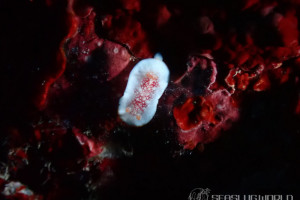
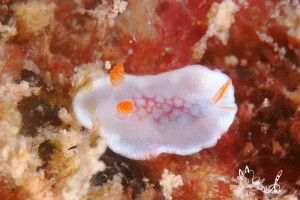
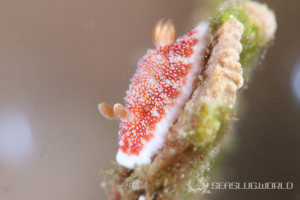
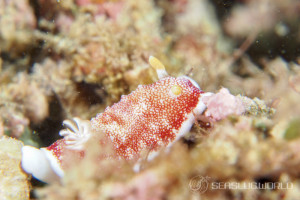
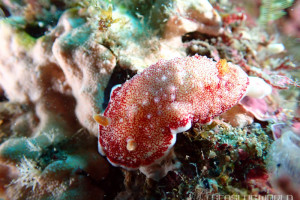
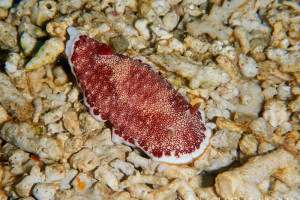
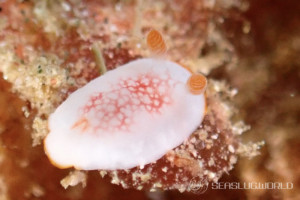
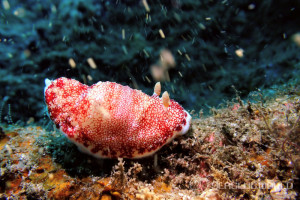
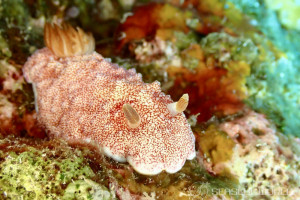
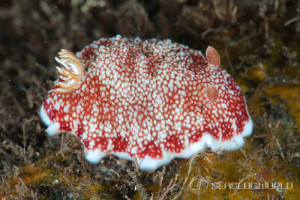
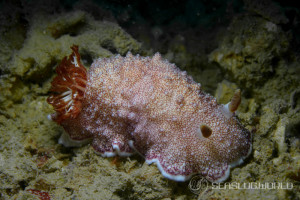
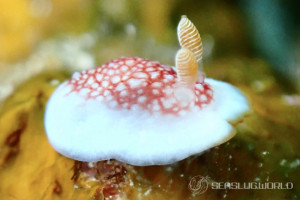
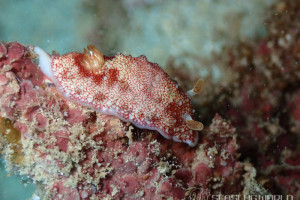
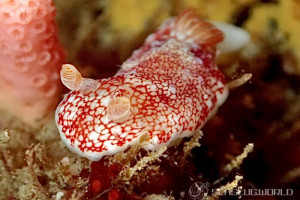
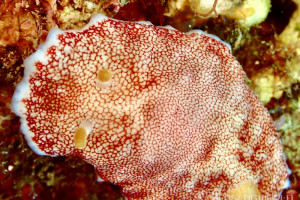
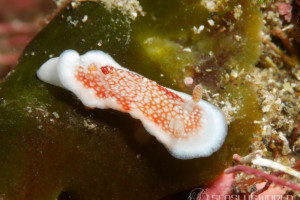
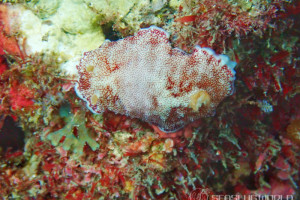
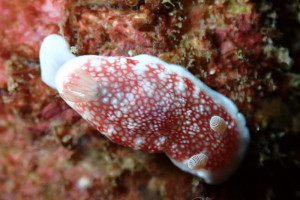
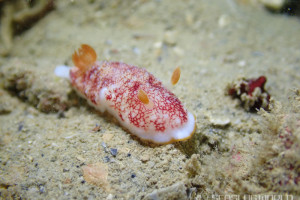
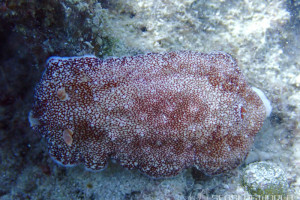
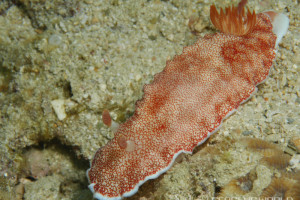
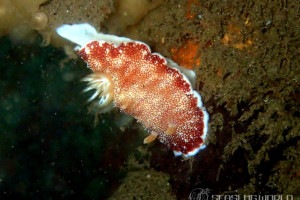
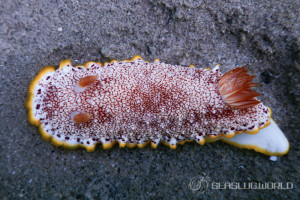
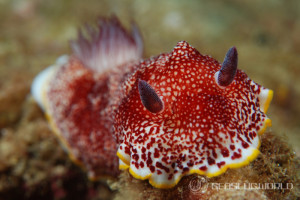
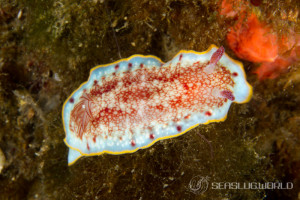
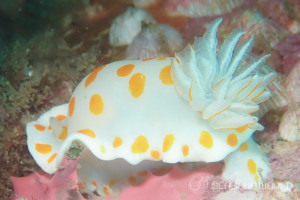
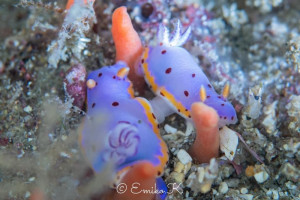
Reaches up to about 60 mm in body length. The mantle is white and densely covered with a finely reticulated network of red lines, with the outer edge fringed by a white line (sometimes with an additional thin yellow line). The mantle surface bears low rounded tubercles, on which the reticulation becomes coarser and appears whitish; this crepe-like texture is the source of the Japanese name chirimen-umiushi ("crepe sea slug"). The rhinophores have a white axis with vermilion lamellae and a white lamellar margin. The secondary gill is white centrally with vermilion-edged branchial leaves, with several posterior leaves curving toward the anus, an externally diagnostic feature.After copulation Goniobranchus reticulatus autotomises its penis and regenerates a functional one within 24 hours (Sekizawa et al. 2013). It is distinguished from the similarly patterned Goniobranchus tinctorius by its finer mantle reticulation, taller and overall larger body, higher number of branchial leaves with posterior leaves curving inward, more numerous and backward-pointing penial spines, and egg capsules each containing one to six embryos rather than a single embryo (Sekizawa et al. 2018).
Distribution
Widely distributed in the tropical and subtropical Indo-West Pacific. The type locality is Tongatapu, Tonga. In Japan it is recorded from rocky coasts from central Honshu southwards, including the Ryukyu Islands.Etymology
The specific epithet reticulatus is Latin for "net-like", referring to the red reticulate pattern on the mantle.Remarks
Originally described by Quoy & Gaimard 1832 as Doris reticulata and later transferred to Chromodoris. Following the molecular phylogeny of the Chromodorididae by Johnson & a 2012 paper, the species was reassigned to Goniobranchus. Soong et al. 2020 subsequently demonstrated that the red-reticulate Goniobranchus assemblage to which this species belongs constitutes a species complex containing multiple cryptic lineages, suggesting that further taxonomic refinement is likely.Goniobranchus reticulatus was for some time treated as a colour form of the variably patterned Goniobranchus tinctorius. Sekizawa et al. 2018 compared external and internal morphology, the arrangement of embryos within egg capsules, mating behaviour, and reproductive isolation in crossing experiments, and demonstrated that the two are clearly distinct species and that mantle colour pattern is a reliable identification character.
References
- Goniobranchus reticulatus, Pease W.H. (1866). Remarks on Nudibranchiata inhabiting the Pacific Islands, with descriptions of two new genera. American Journal of Conchology. 2(3): 204-208.
- Glossodoris reticulata (Pease), Allan J.K. (1947). Nudibranchia from the Clarence River Heads, north coast, New South Wales. Records of the Australian Museum, 21(8): 433-463, pls. xli-xliii and map. https://doi.org/10.3853/j.0067-1975.21.1947.561
- レティクラータ, 小野篤司. (1999). ウミウシガイドブック. TBSブリタニカ.
- クロモドリス属の一種, 殿塚孝昌. (2003). ウミウシガイドブック〈3〉. TBSブリタニカ.
- サラサウミウシ, 小野篤司. (2004). 沖縄のウミウシ. ラトルズ.
- サラサウミウシ, 中野理枝. (2004). 本州のウミウシ. ラトルズ.
- Goniobranchus reticulatus, Johnson R.F. & Gosliner T.M. (2012). Traditional taxonomic groupings mask evolutionary history: a molecular phylogeny and new classification of the chromodorid nudibranchs. PLoS ONE 7(4): e33479.
- Goniobranchus reticulatus, Terrence Gosliner, Ángel Valdés and David Behrens. (2015). Nudibranch and Sea Slug Identification Indo-Pacific. New World Pubns Inc.
- Chromodoris reticulata, Sekizawa A., Yama R. & Nakashima Y. (2018). Biological Differences between Chromodoris reticulata and Chromodoris tinctoria (Opisthobranchia: Nudibranchia). Venus, Japanese Journal of Malacology. 76(1-4): 45-52. https://doi.org/10.18941/venus.76.1-4_45
- チリメンウミウシ, 中野理枝. (2018). 日本のウミウシ. 文一総合出版.
- Goniobranchus reticulatus, Terrence Gosliner, Ángel Valdés and David Behrens. (2018). Nudibranch and Sea Slug Identification Indo-Pacific 2nd Edition. New World Pubns Inc.
- sp. 5; G. reticulatus, red-reticulate complex, Soong G.Y., Wilson N.G. & Reimer J.D. (2020). A species complex within the red-reticulate Goniobranchus Pease, 1866 (Nudibranchia: Doridina: Chromodorididae). Marine Biodiversity. 50: 25. https://doi.org/10.1007/s12526-020-01048-w
Featured in this book
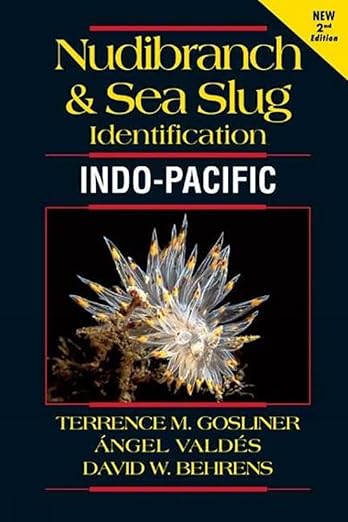
Terrence Gosliner, Ángel Valdés and David Behrens. (2018). Nudibranch and Sea Slug Identification Indo-Pacific 2nd Edition. New World Pubns Inc.
New World Publications
This species, Goniobranchus reticulatus, is included in the book.
View on Amazon PR (Amazon Associates)Seasonality
Shooting Locations
Loading shooting locations...
Photos of Goniobranchus reticulatus
Tag:























Same Genus Nudibranchs

Similar Colors Nudibranchs
Academic Database
Sea slug observation data is available in international marine biodiversity databases.