Hypselodoris tryoni (Garrett, 1873)
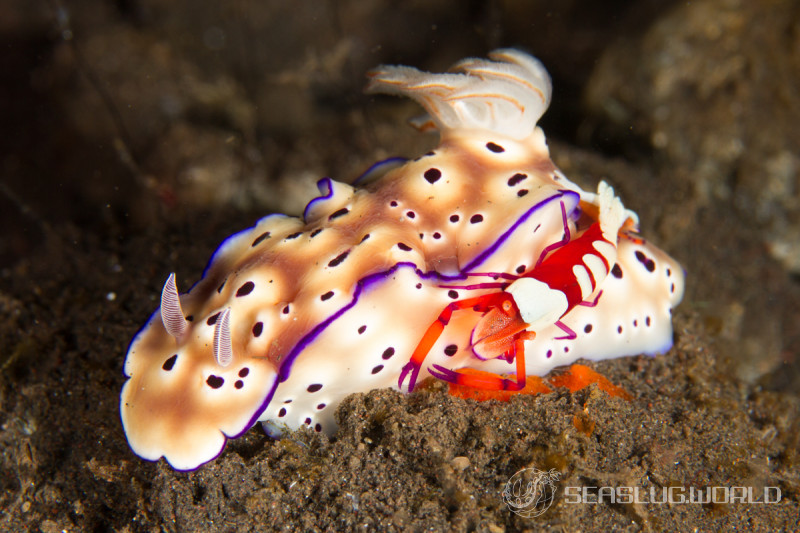
- Location
- USAT Liberty Shipwreck, Tulamben, Pulau Bali, Indonesia
- Date
- 2018/01/11
- Length
- 30mm
- Depth
- 15.0m
- Water temperature
- 29.0℃
Description
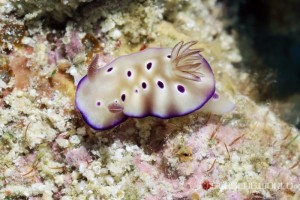
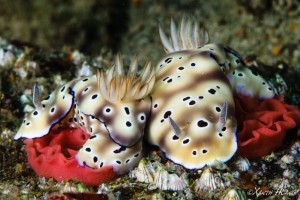
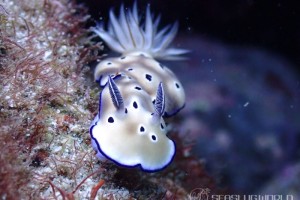
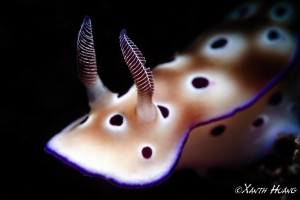
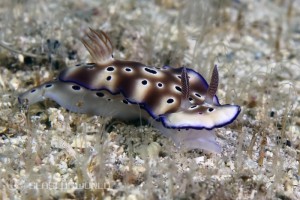
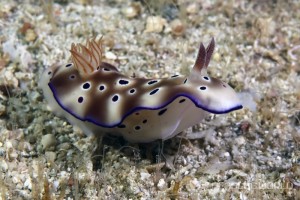
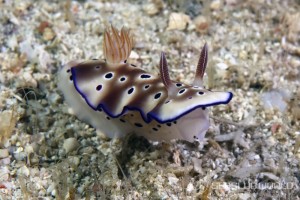
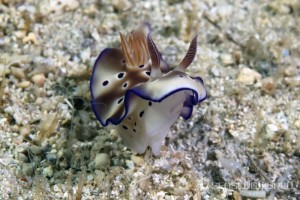
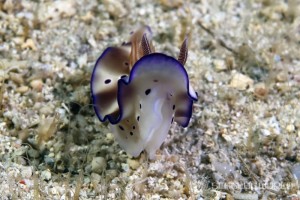
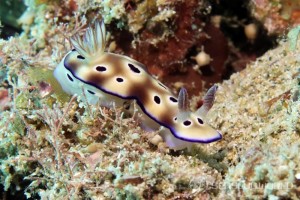
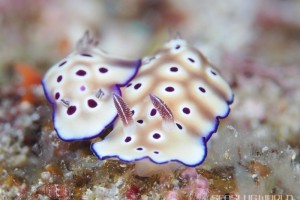
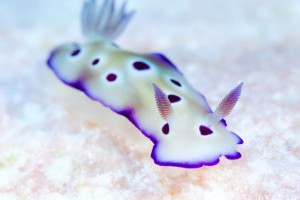
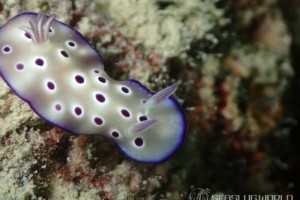
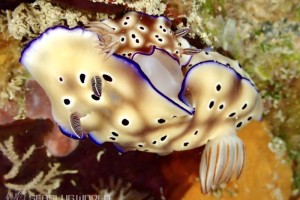
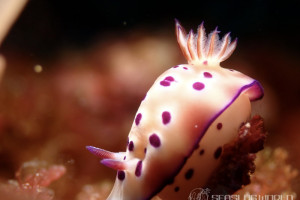
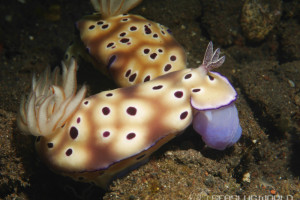
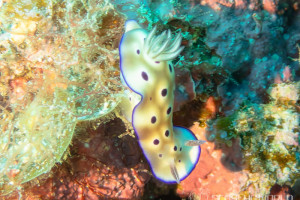
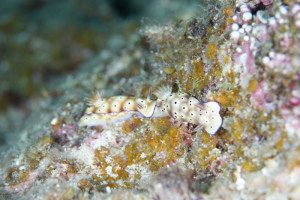
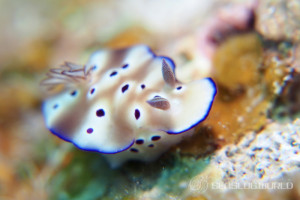
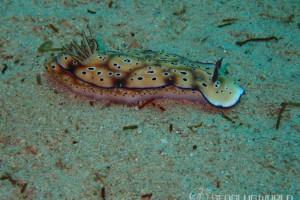
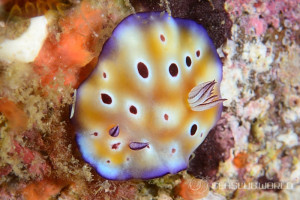
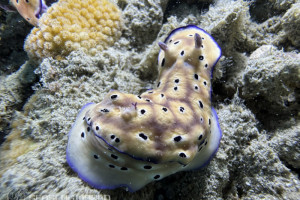
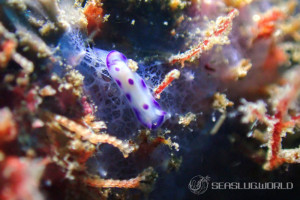
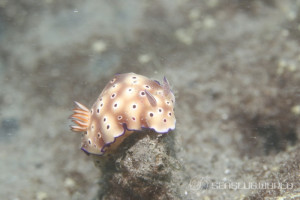
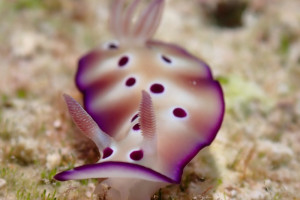
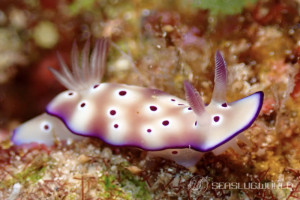
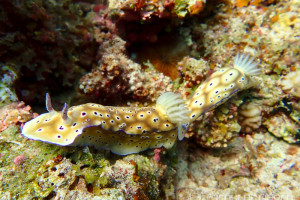
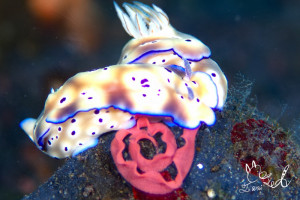
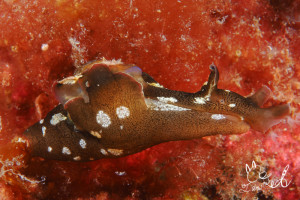
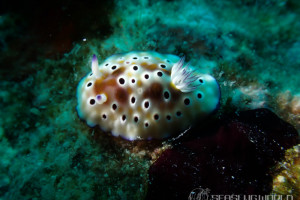
A relatively large chromodorid; mantle width can exceed 100 mm in adults. The mantle is whitish cream to pale yellow, overlaid by a diffuse purple-brown reticulate pattern and scattered with small dark purple to nearly black spots, each ringed in opaque white. A thin bluish violet line runs along the mantle margin. The rhinophore club is purplish with white midlines and white lamellar edges, and the simple gills are white with orange-brown to red-brown borders.Distribution
The type locality is Tahiti, French Polynesia. Widely distributed across the Indo-West Pacific, with confirmed records from East Africa, the Red Sea, the western Pacific, and the central Pacific, including Japan, the Philippines, Indonesia, Australia, Papua New Guinea, the Solomon Islands, Vanuatu, Palau, the Marshall Islands, and the Society Islands.Etymology
The specific epithet tryoni honours the American malacologist George Washington Tryon Jr. (1838–1888), best known for initiating the monumental Manual of Conchology at the Academy of Natural Sciences of Philadelphia.Remarks
This species is renowned for its conspicuous trailing behaviour, in which two — occasionally three — individuals move in single file, the rear animal following the one ahead by rhinophore contact. It is among the most frequently cited behavioural examples for the family. The Japanese vernacular name "Madara-irouminushi" was proposed by Okutani 1994 for the now-synonymized Chromodoris odhneri Risbec, 1953 and is currently applied to this species.References
- Goniodoris tryoni n.sp., Garrett A. (1873). Descriptions of new species of marine shells inhabiting the South Sea Islands. Proceedings of the Academy of Natural Sciences of Philadelphia, 25: 209-231.
- マダライロウミウシ(新称)Chromodoris odhneri, 奥谷喬司. (1994). サンゴ礁の生きもの. 東海大学出版会.
- Risbecia tryoni (Garrett, 1873), Gosliner T.M. & Johnson R.F. (1999). Phylogeny of Hypselodoris (Nudibranchia: Chromodorididae) with a review of the monophyletic clade of Indo-Pacific species, including descriptions of twelve new species. Zoological Journal of the Linnean Society. 125: 1-114. https://doi.org/10.1111/j.1096-3642.1999.tb00585.x
- チータウミウシ, 益田一. (1999). 海洋生物ガイドブック. 第2刷. 東海大学出版会.
- トリュオニ, 小野篤司. (1999). ウミウシガイドブック. TBSブリタニカ.
- リスベキア・トリュオニ, 殿塚孝昌. (2003). ウミウシガイドブック〈3〉. TBSブリタニカ.
- マダライロウミウシ, 小野篤司. (2004). 沖縄のウミウシ. ラトルズ.
- マダライロウミウシ, 中野理枝. (2004). 本州のウミウシ. ラトルズ.
- マダライロウミウシ, 小野篤司 & 加藤昌一. (2009). ウミウシ. 誠文堂新光社.
- Hypselodoris tryoni, Johnson R.F. & Gosliner T.M. (2012). Traditional taxonomic groupings mask evolutionary history: a molecular phylogeny and new classification of the chromodorid nudibranchs. PLoS ONE 7(4): e33479.
A Kindle field guide by the site author
Kimoto N. (2026). Sea Slugs of Japan & the Indo-Pacific, 2nd Edition.
Kindle Edition
View on Amazon PR (Amazon Associates)Seasonality
Shooting Locations
Loading shooting locations...
Photos of Hypselodoris tryoni
Tag:


















Same Genus Nudibranchs

Similar Colors Nudibranchs

Academic Database
Sea slug observation data is available in international marine biodiversity databases.