Platydoris cinereobranchiata Dorgan, Á. Valdés & Gosliner, 2002
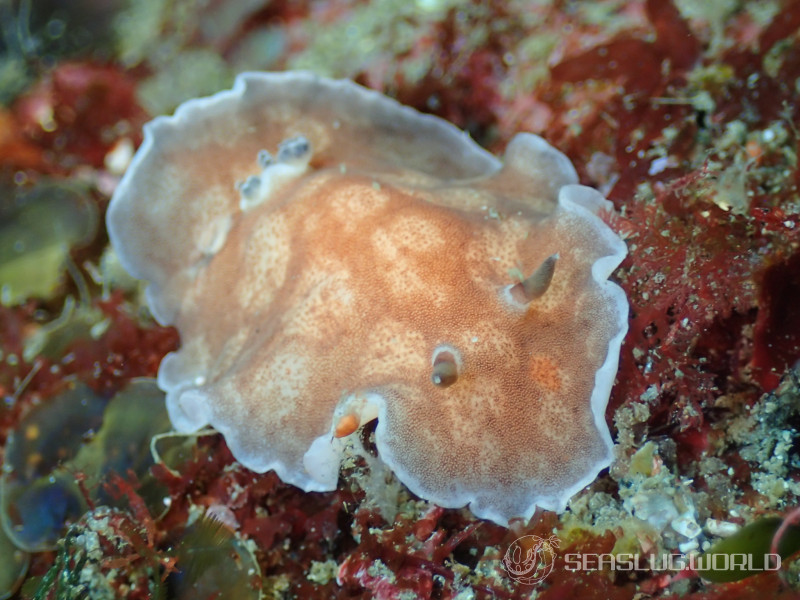
- Location
- Kamagane, Tago, Futou, Dougashima, Shizuoka, Japan
- Date
- 2019/04/14
- Length
- 30mm
- Depth
- 22.0m
- Water temperature
- 17.0℃
Description
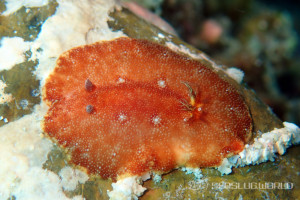
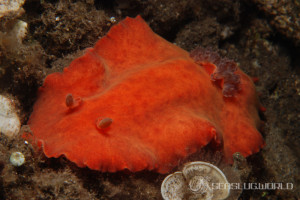
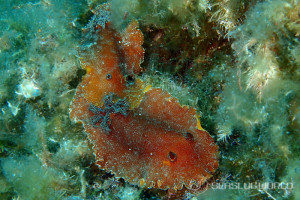
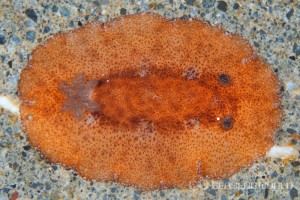
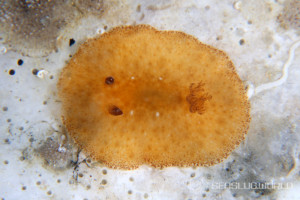
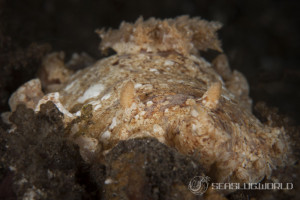
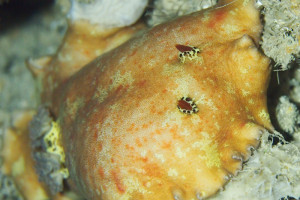
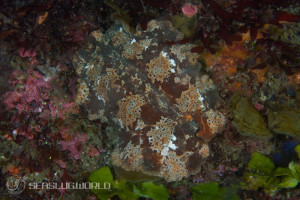
Body flat and wide. The rhinophoral and branchial sheaths are elevated. The branchial sheath has six branchial lobes, with the anterior and posterior ones being larger than the others. The gill is composed of six tripinnate branchial leaves. The perfoliate rhinophores always have 31 lamellae. The background colour is tan, covered with very small black spots and large orange-red blotches. The gill and rhinophores are dark purple-brown, with white-tipped rhinophores. The ventral side bears scattered very small dark spots. Radular formula 34 x (69.0.69) in a 47 mm specimen (CASIZ 103740). Rachidian teeth absent. The innermost teeth have short cusps and lack denticles. The mid-lateral teeth have a cusp about as long as the base and lack denticles. The outermost tooth is straight with denticles; the next tooth has a much-reduced hook and also bears denticles.Distribution
Known from the Philippines (type material). Also referable here are specimens recorded in 1950 from the Seychelles as P. tabulata.Etymology
Verbatim from the original description (Dorgan, Valdes & Gosliner, 2002, p.306):From the Latin cinereus (grey, ash coloured) and brachiata (with gills), in reference to the grey colour of the gill of this species.
Remarks
Described as a new species in Dorgan, K.M., Valdes, A. & Gosliner, T.M. 2002 Zoologica Scripta 31(3): 271-319. Externally similar to Platydoris formosa, but distinguished by the ash-coloured branchial leaves, the absence of large orange ventral spots and pigment on the foot, the absence of black spots between the rhinophores and anterior to the branchial sheath, the white ring around the branchial and rhinophoral sheaths, and ash-coloured rhinophores with white apices (uniformly red in P. formosa). The radula differs from that of P. formosa in possessing denticulate outermost teeth. The spelling "P. cinerobranchiata" sometimes appears in subsequent literature but is a typographical error; the original spelling is cinereobranchiata.References
- フォルモーサ, 小野篤司. (1999). ウミウシガイドブック. TBSブリタニカ.
- ホンカワウミウシ(新称), 小野篤司. (2000). ウミウシガイドブック. 第2版. TBSブリタニカ.
- Dorgan K.M., Valdés Á. & Gosliner T.M. (2002). Phylogenetic systematics of the genus Platydoris (Mollusca, Nudibranchia, Doridoidea) with descriptions of six new species. Zoologica Scripta. 31(3): 271-319. https://doi.org/10.1046/j.1463-6409.2002.00105.x
- ホンカワウミウシ, 小野篤司. (2004). 沖縄のウミウシ. ラトルズ.
- ハイエラクモガタウミウシ(新称), 中野理枝. (2018). 日本のウミウシ. 文一総合出版.
- Platydoris cinereobranchiata, Terrence Gosliner, Ángel Valdés and David Behrens. (2018). Nudibranch and Sea Slug Identification Indo-Pacific 2nd Edition. New World Pubns Inc.
Featured in this book
Terrence Gosliner, Ángel Valdés and David Behrens. (2018). Nudibranch and Sea Slug Identification Indo-Pacific 2nd Edition. New World Pubns Inc.
New World Publications
This species, Platydoris cinereobranchiata, is included in the book.
View on Amazon PR (Amazon Associates)Seasonality
Shooting Locations
Loading shooting locations...
Photos of Platydoris cinereobranchiata


Same Genus Nudibranchs
Similar Colors Nudibranchs
Academic Database
Sea slug observation data is available in international marine biodiversity databases.