Phyllodesmium lizardense Burghardt, Schrödl & Wägele, 2008
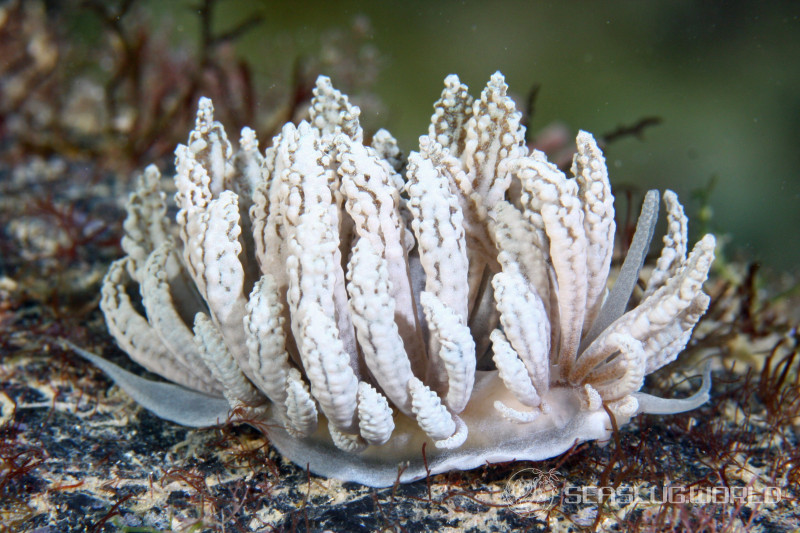
- Location
- Yamakawa Beach, Okinawa Island (Motobu and Northern area), Okinawa, Japan
- Date
- 2011/02/19
- Length
- 20mm
- Depth
- 7.0m
- Water temperature
- 22.0℃
Description
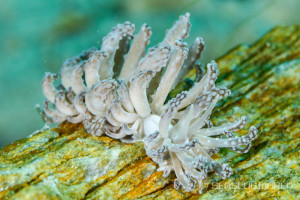
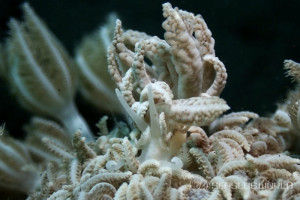
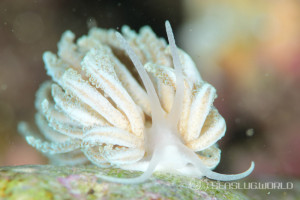
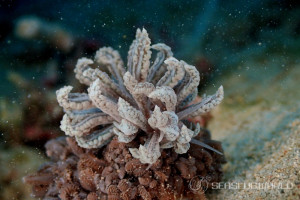
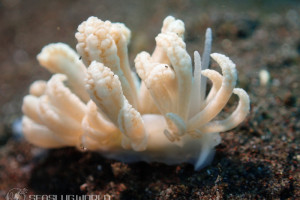
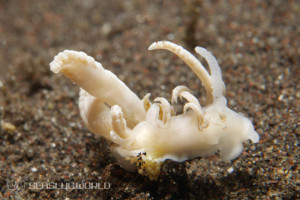
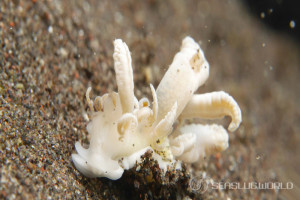
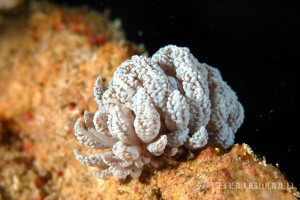
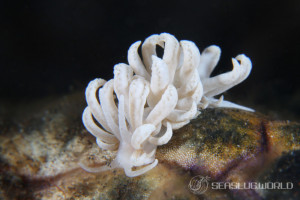
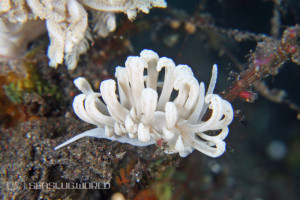
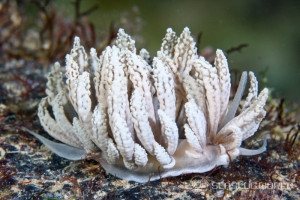
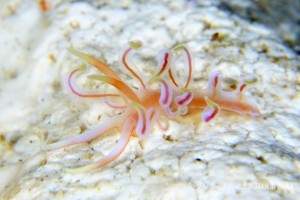
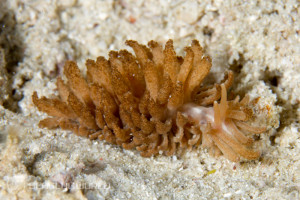
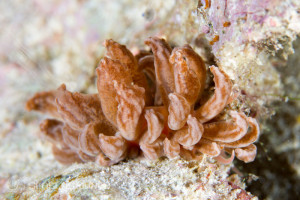
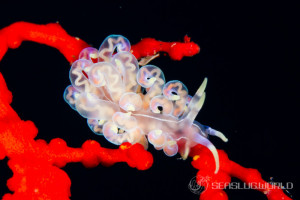
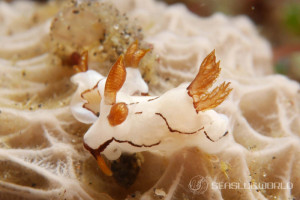
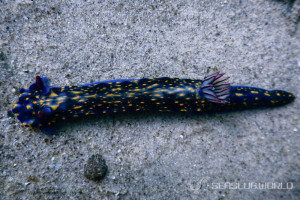
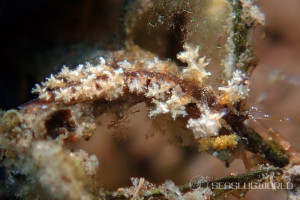
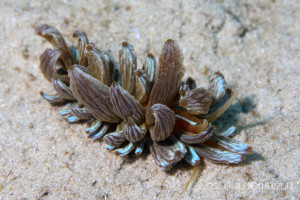
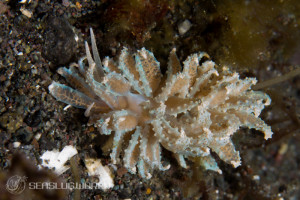
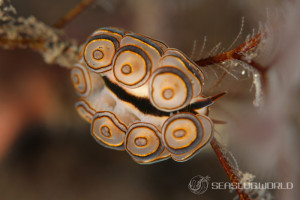
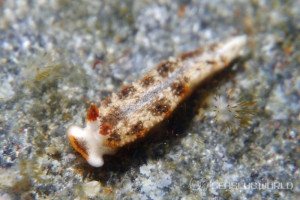
A medium-sized Phyllodesmium reaching about 45 mm in body length (excluding cerata). The body — including oral tentacles, rhinophores and foot — is translucent white, and the right digestive glandular branch shows through as a distinct brown band, due to the symbiotic zooxanthellae it contains. Up to about 50 cerata are arranged in five mainly incomplete arched pads on each body side. The cerata are dorso-ventrally flattened and broadened in the upper half, with the surface covered in creamish pustules and a brownish reticulate pattern in the depressions between pustules. The cerata closely mimic the polyps of the host xeniid soft coral in colour and shape, providing very effective camouflage within the host colony.Live zooxanthellae (Symbiodinium) are retained inside the digestive gland branches within the cerata, sustaining a solar-powered (photosymbiotic) lifestyle.
Distribution
Type locality: Casuarina Beach, Lizard Island, Northern Great Barrier Reef, Australia (~0.5 m depth, July 2005). At the time of description it was known only from two sites around Lizard Island (Casuarina Beach and Loomis Beach).Etymology
The specific epithet is a toponym referring to the type locality, Lizard Island on the Great Barrier Reef. The original spelling lizardensis was later adjusted to the neuter form lizardense to agree with the genus.Remarks
A specialist on octocorals of the family Xeniidae, whose polyps the cerata mimic in colour and shape. Shares the xeniid-feeding ecology with related solar-powered congeners such as Phyllodesmium jakobsenae, Phyllodesmium rudmani and Phyllodesmium lembehense.References
- Phyllodesmium lizardense sp. nov., Burghardt I., Schrödl M. & Wägele H. (2008). Three new solar-powered species of the genus Phyllodesmium Ehrenberg, 1831 (Mollusca: Nudibranchia: Aeolidoidea) from the tropical Indo-Pacific, with analysis of their photosynthetic activity and notes on biology. Journal of Molluscan Studies. 74(3): 277-292.
- Phyllodesmium lizardense, Terrence Gosliner, Ángel Valdés and David Behrens. (2015). Nudibranch and Sea Slug Identification Indo-Pacific. New World Pubns Inc.
- リザードミノウミウシ, 中野理枝. (2018). 日本のウミウシ. 文一総合出版.
Featured in this book
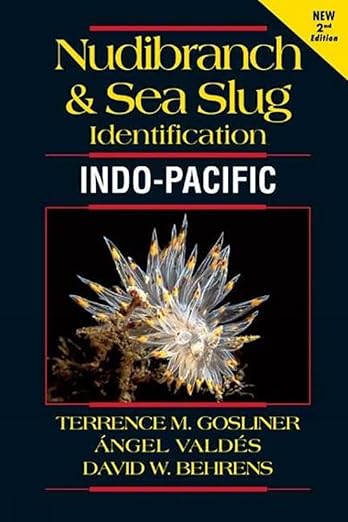
Terrence Gosliner, Ángel Valdés and David Behrens. (2018). Nudibranch and Sea Slug Identification Indo-Pacific 2nd Edition. New World Pubns Inc.
New World Publications
This species, Phyllodesmium lizardense, is included in the book.
View on Amazon PR (Amazon Associates)Seasonality
Shooting Locations
Loading shooting locations...
Photos of Phyllodesmium lizardense
Tag:






Same Genus Nudibranchs

Similar Colors Nudibranchs
Academic Database
Sea slug observation data is available in international marine biodiversity databases.