Sagaminopteron pohnpei (Hoff & Carlson, 1983)
Description
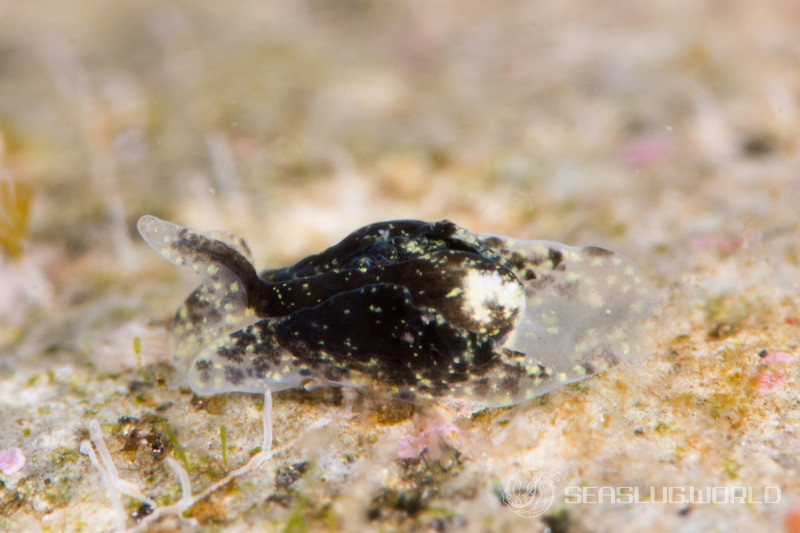
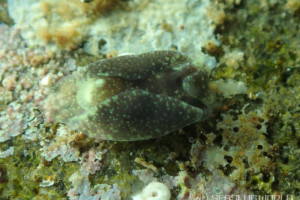
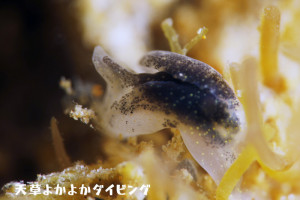
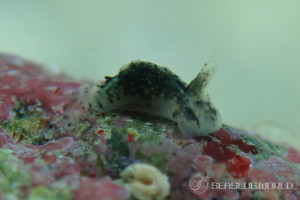
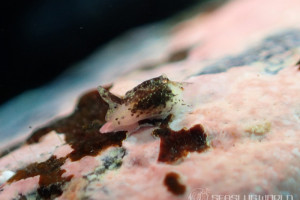
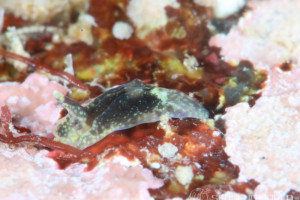
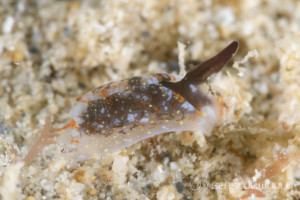
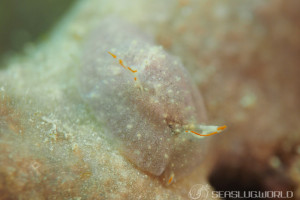
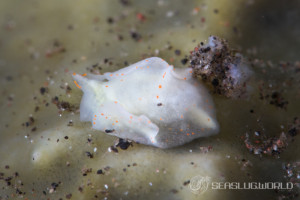
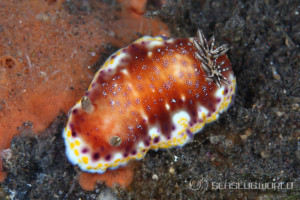
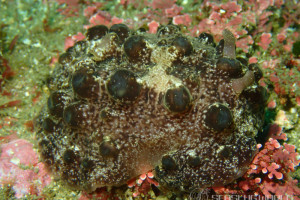
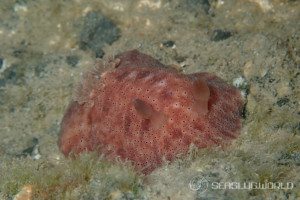
A small gastropterid 3–5 mm in length. Body colour ranges widely from brown to orange, reddish or even black, with brown specimens often bearing scattered opaque white and yellow spots. The animal swims by flapping its well-developed parapodia. The head shield is a short triangle, terminating posteriorly in a tubular siphon-like crest. The visceral mass is oval and entirely lacks a flagellum. On the right side, beneath a crescent-shaped ridge, sits a finely bipinnate gill of six leaves. The penial bulb lacks any rows of spines and is highly muscularized. The prostate is elongate with two distinct swollen bulbs. The radula consists of broad inner lateral teeth bearing a row of denticles on the inner edge and outer lateral teeth with a winged extension on the inner margin. Egg masses are small spherical clusters of approximately 100 white eggs, with one egg per capsule.Distribution
Type locality: Pohnpei (formerly Ponape), Federated States of Micronesia. Also recorded from Palau and Oahu, Hawaiian Islands, with a distribution spanning the western and central Pacific. In Hawai'i it has been observed sympatrically with Siphopteron quadrispinosum on shallow sandy bottoms in Kāne'ohe Bay.Etymology
The specific epithet pohnpei is a toponym referring to the type locality, Pohnpei Island (formerly Ponape) in the Federated States of Micronesia.Remarks
Originally described as Gastropteron pohnpei in a 1983 paper in their treatment of Micronesian species (Publications of the Seto Marine Biological Laboratory 27(4-6): 261–264). A 1989 revision revised the family and transferred it to Siphopteron. In the molecular phylogeny of Ong, Hallas & Gosliner 2017, the species clustered firmly within Sagaminopteron rather than Siphopteron, and was formally transferred to Sagaminopteron. WoRMS currently treats Sagaminopteron pohnpei as the valid name, with Siphopteron pohnpei as its synonym, and seaslug.world follows this treatment.The most similar species is Sagaminopteron multimaculatum Ong & Gosliner, 2017, the only other Sagaminopteron species that entirely lacks a flagellum. The two are 7.4–7.6 % different in their COI sequences and are clearly distinguished by ABGD analysis. Externally, S. pohnpei shows the wider colour range described above, while S. multimaculatum is greenish-brown with orange, white and yellow spots. Internally, the prostate of S. pohnpei is elongate with two distinct swollen bulbs, whereas in S. multimaculatum it is simple, curved and relatively short with only one expanded area. The penial bulb is also much more highly muscularized in S. pohnpei.
The Japanese vernacular name "マダラウミコチョウ" used by Nakano 2004/2018 is here applied instead to Sagaminopteron multimaculatum, which more typically displays the spotted pattern that the name describes; for the present species seaslug.world uses the katakana transcription of the scientific name, "サガミノプテロン・ポンペイ".
References
- Gastropteron pohnpei n.sp., Hoff P.J. & Carlson C.H. (1983). Gastropteron pohnpei, a new Gastropteridae from Micronesia (Opisthobranchia: Cephalaspidea). Publications of the Seto Marine Biological Laboratory. 27(4-6): 261-264. https://doi.org/10.5134/176055
- Siphopteron pohnpei (Hoff & Carlson, 1983) comb. nov., Gosliner T.M. (1989). Revision of the Gastropteridae (Opisthobranchia: Cephalaspidea) with descriptions of a new genus and six new species. The Veliger 32(4): 333-381.
- マダラウミコチョウ, 中野理枝. (2004). 本州のウミウシ. ラトルズ.
- Ong E., Hallas J.M. & Gosliner T.M. (2017). Like a bat out of heaven: the phylogeny and diversity of the bat-winged slugs (Heterobranchia: Gastropteridae). Zoological Journal of the Linnean Society. 180(4): 755-789. https://doi.org/10.1093/zoolinnean/zlw018
- マダラウミコチョウ, 中野理枝. (2018). 日本のウミウシ. 文一総合出版.
- サガミノプテロン・ポンペイ, 小野篤司 & 加藤昌一. (2020). 新版 ウミウシ. 誠文堂新光社.
Featured in this book
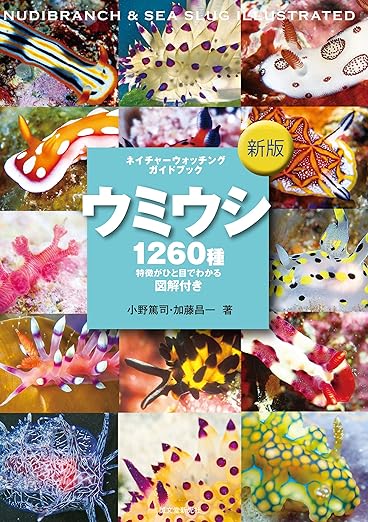
小野篤司 & 加藤昌一. (2020). 新版 ウミウシ. 誠文堂新光社.
誠文堂新光社
This species, Sagaminopteron pohnpei, is included in the book.
View on Amazon PR (Amazon Associates)Seasonality
Shooting Locations
Loading shooting locations...
Photos of Sagaminopteron pohnpei


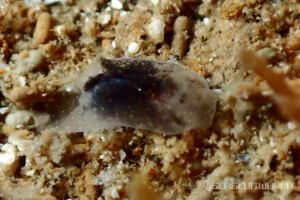

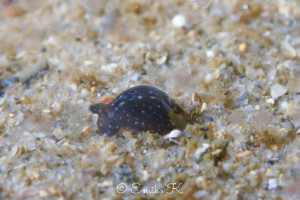

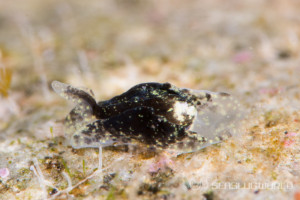

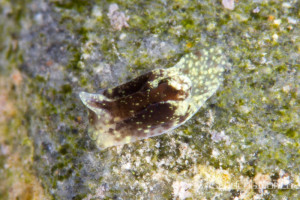


Same Genus Nudibranchs
Similar Colors Nudibranchs


Academic Database
Sea slug observation data is available in international marine biodiversity databases.